A class of biological molecules grouped by not dissolving in water. They store energy, form the boundaries of every cell, and act as signalling molecules, and the category is defined by a physical property rather than by a shared structure.
Lipids are the only major class of biological molecules defined by solubility rather than by chemistry. Carbohydrates, proteins and nucleic acids each have a characteristic structure; lipids share only that they are largely insoluble in water and dissolve in organic solvents.
The consequence is that the class is chemically heterogeneous. Fats, phospholipids, steroids and some vitamins are all lipids and are not variations on one molecular theme.
What they share physically is a substantial hydrocarbon portion, which repels water because it cannot form hydrogen bonds with it.

Triglycerides are the storage form: three fatty acids attached to a glycerol backbone. They are the fats and oils of diet and of adipose tissue.
Fatty acids differ in chain length and in saturation. A saturated chain has no double bonds and packs closely, so saturated fats are solid at room temperature. An unsaturated chain has one or more double bonds, each producing a kink that prevents close packing, so unsaturated fats are liquid.
Trans fats have double bonds in a configuration that does not kink, so they behave like saturated fats. Most in the food supply were produced industrially by partial hydrogenation, and their association with cardiovascular disease led to restriction or prohibition in many countries.

Phospholipids and sphingolipids have a water-attracting head group and water-repelling tails. This dual character is what makes cell membranes possible, as the cell membranes capsule describes.
Steroids share a four-ring structure. Cholesterol is the parent compound in animals, and it is both a membrane component and the precursor of steroid hormones including testosterone, oestrogen and cortisol, and of bile acids and vitamin D.

Eicosanoids, including prostaglandins, are signalling molecules derived from fatty acids. They mediate inflammation, pain and fever, and non-steroidal anti-inflammatory drugs work by blocking the enzymes that produce them, as the inflammation capsule sets out.
Terpenes and related compounds include many plant pigments and scents, and the fat-soluble vitamins.
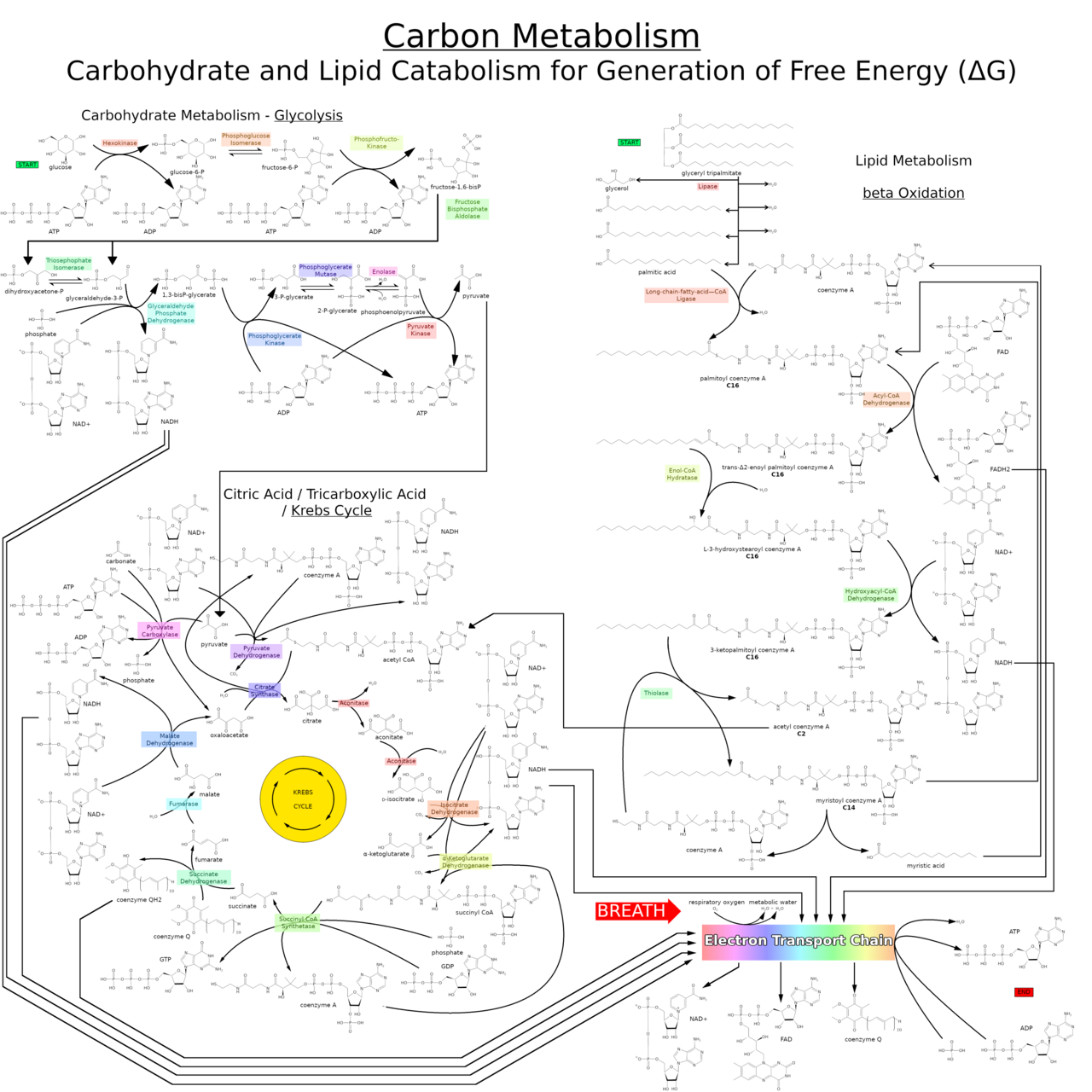
Energy storage is the function most associated with them, and fat stores more than twice the energy per gram of carbohydrate or protein, because its carbon is more reduced and because it is stored without water while glycogen is not.
That density is why fat is the storage form for organisms that must move. Storing the same energy as glycogen would weigh several times more.
Membranes are the structural function. Every cell and every internal compartment is bounded by a lipid bilayer.
Signalling covers steroid hormones, eicosanoids and a range of lipid messengers within cells.
Insulation and protection: subcutaneous fat reduces heat loss, and fat surrounding organs cushions them.
Absorption of the fat-soluble vitamins A, D, E and K requires dietary fat, which is why deficiency can occur where fat absorption is impaired even when intake is adequate.
The relationship between dietary fat and disease has been argued about for decades and the position has shifted substantially.
Total fat intake is now regarded as a poor predictor of cardiovascular outcomes, and dietary guidelines that emphasised reducing total fat have generally been revised toward composition.
Replacing saturated fat with polyunsaturated fat is associated with reduced cardiovascular risk in trials and cohorts, while replacing it with refined carbohydrate is not, which is the finding that reframed the question from how much to what instead.
Trans fats are the clearest case, with consistent evidence of harm and effective regulatory action.
Dietary cholesterol has a smaller effect on blood cholesterol than was assumed, since the body regulates its own synthesis, and limits on dietary cholesterol have been relaxed in several countries' guidelines.
The dietary fat and heart disease capsule treats the history of this argument, which is among the clearest cases of a confident nutritional consensus being substantially revised.
Lipids are the reason cells have boundaries, which is a precondition for life having discrete units at all, and the reason organisms can store energy compactly enough to move.
The category is also a useful reminder that biological classification sometimes tracks a physical property rather than a shared origin, which is why the group contains molecules with almost nothing structurally in common.