Enzymes speed up chemical reactions by factors that reach ten to the power of seventeen, at body temperature and neutral pH, without being consumed. Almost every reaction in a living cell would be far too slow to sustain life without one.
Catalysis is normally described in multiples, and the multiples here are hard to hold in mind.
Orotidine monophosphate decarboxylase accelerates its reaction by about ten to the seventeenth power. Uncatalysed, the reaction has a half-life of roughly seventy eight million years. With the enzyme it takes about twenty milliseconds.
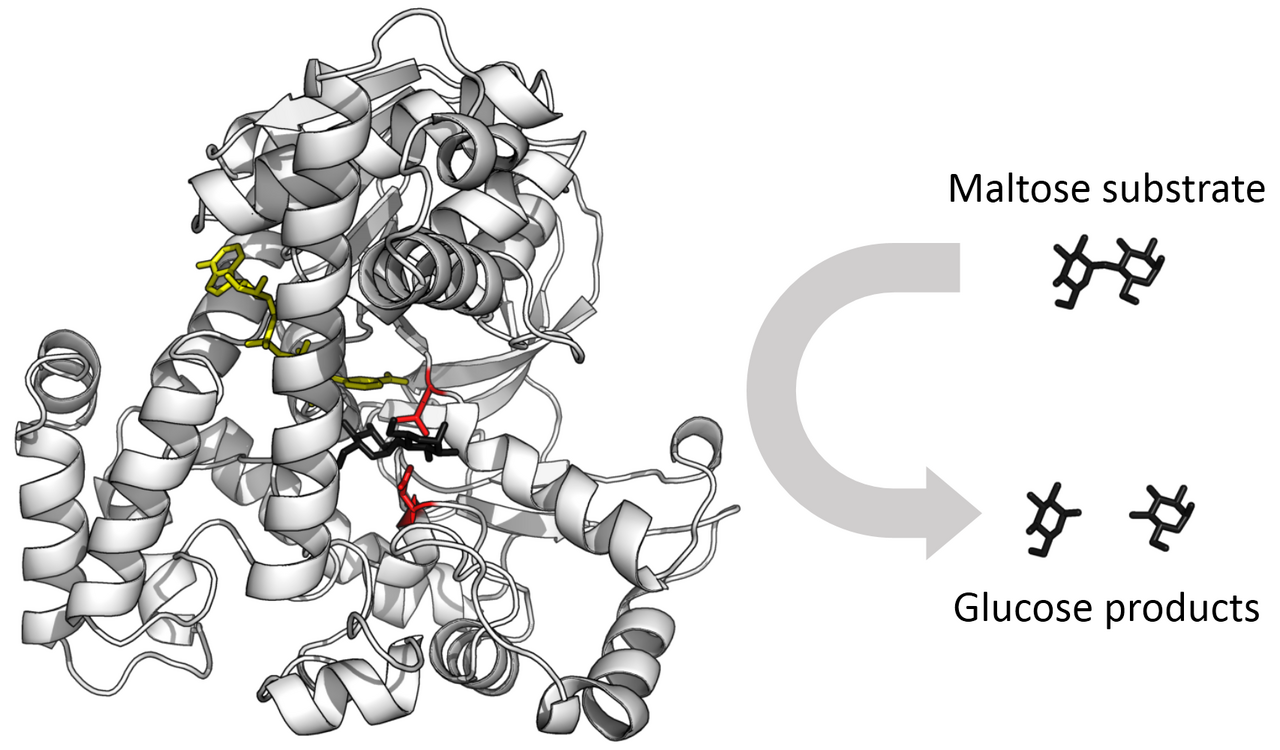
Carbonic anhydrase converts up to a million molecules of carbon dioxide per second per enzyme, which is fast enough that the reaction is limited by how quickly substrate can diffuse to the active site rather than by the chemistry.
Industrial catalysts do not approach this, and they generally require high temperature, high pressure, or extreme pH. Enzymes work in water at around body temperature.
A catalyst does not change how much energy a reaction releases or whether it is favourable. It lowers the activation energy: the barrier that must be climbed before reactants can become products.
The central insight, from Linus Pauling in 1946, is that an enzyme does not bind its substrate most tightly. It binds the transition state most tightly, the strained, half-transformed arrangement between substrate and product. Stabilising that arrangement lowers the barrier directly.
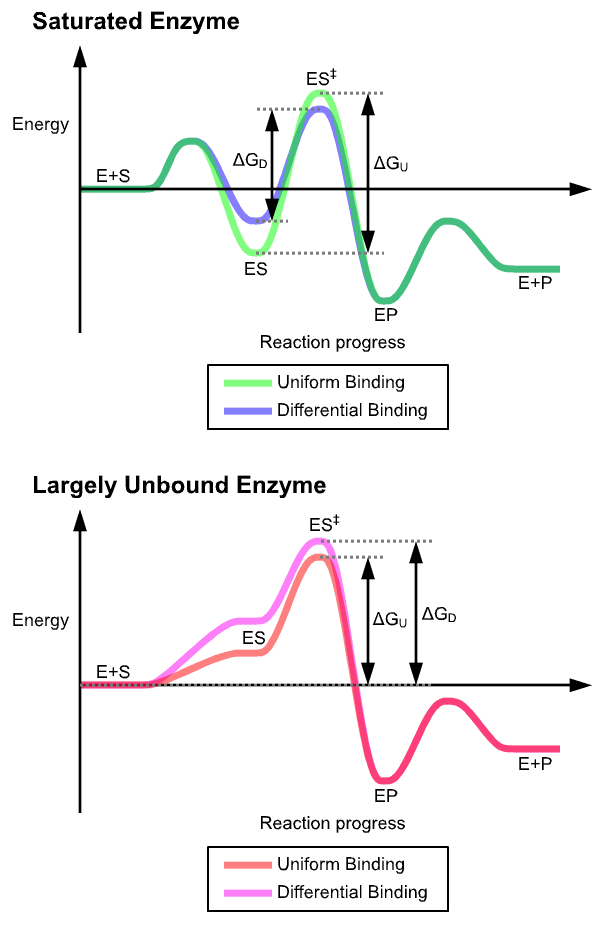
The strongest evidence for this is that molecules resembling transition states bind enzymes far more tightly than substrates do, often by many orders of magnitude, and these transition state analogues are a standard route to drug design.
Several mechanisms contribute. Proximity and orientation hold reactants together in the right alignment, converting a chance encounter into a certainty. Acid-base catalysis uses amino acid side chains to donate or accept protons at the right moment. Covalent catalysis forms a temporary bond with the substrate. And exclusion of water from the active site can change the chemistry substantially, since water stabilises charges that need to be unstable for the reaction to proceed.
Emil Fischer proposed the lock and key model in 1894: the substrate fits a rigid complementary site.
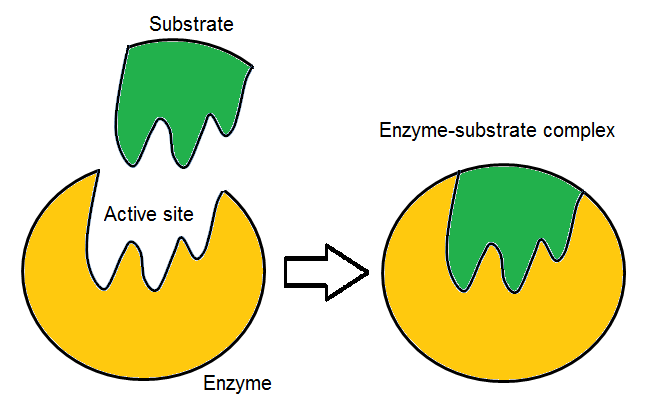
It explains specificity well and is mechanically wrong. Daniel Koshland's induced fit model, from 1958, has the enzyme change shape on binding, closing around the substrate. This is observed directly in structures solved with and without substrate bound, and it matters: a rigid site perfectly complementary to the substrate would stabilise the substrate rather than the transition state, which is the opposite of catalysis.
An enzyme that ran continuously at maximum rate would be useless. Control is what makes metabolism a system rather than a set of reactions.
Competitive inhibitors occupy the active site. Allosteric regulators bind elsewhere and change the enzyme's shape, which allows a molecule bearing no resemblance to the substrate to switch the enzyme on or off. Feedback inhibition has the end product of a pathway inhibit its first enzyme, which is a thermostat implemented in protein.
Covalent modification, particularly adding or removing a phosphate group, switches enzymes between active and inactive states and is the basis of most cellular signalling.
A large fraction of pharmaceuticals are enzyme inhibitors. Statins inhibit an enzyme in cholesterol synthesis. Aspirin covalently modifies cyclooxygenase. Penicillin blocks an enzyme building bacterial cell walls. Most antiretrovirals inhibit viral enzymes, and protease inhibitors were designed explicitly as transition state analogues.
Industrially, enzymes are used in detergents, in food processing, in producing biofuels, and in the polymerase chain reaction, which depends on a DNA polymerase from a hot spring bacterium that survives the temperatures the method requires.
Directed evolution, developed by Frances Arnold and recognised with the 2018 Nobel Prize in Chemistry, produces enzymes for reactions that no natural enzyme performs, by mutating and selecting rather than designing. It works better than rational design, which is a useful comment on how well the mechanism is really understood.