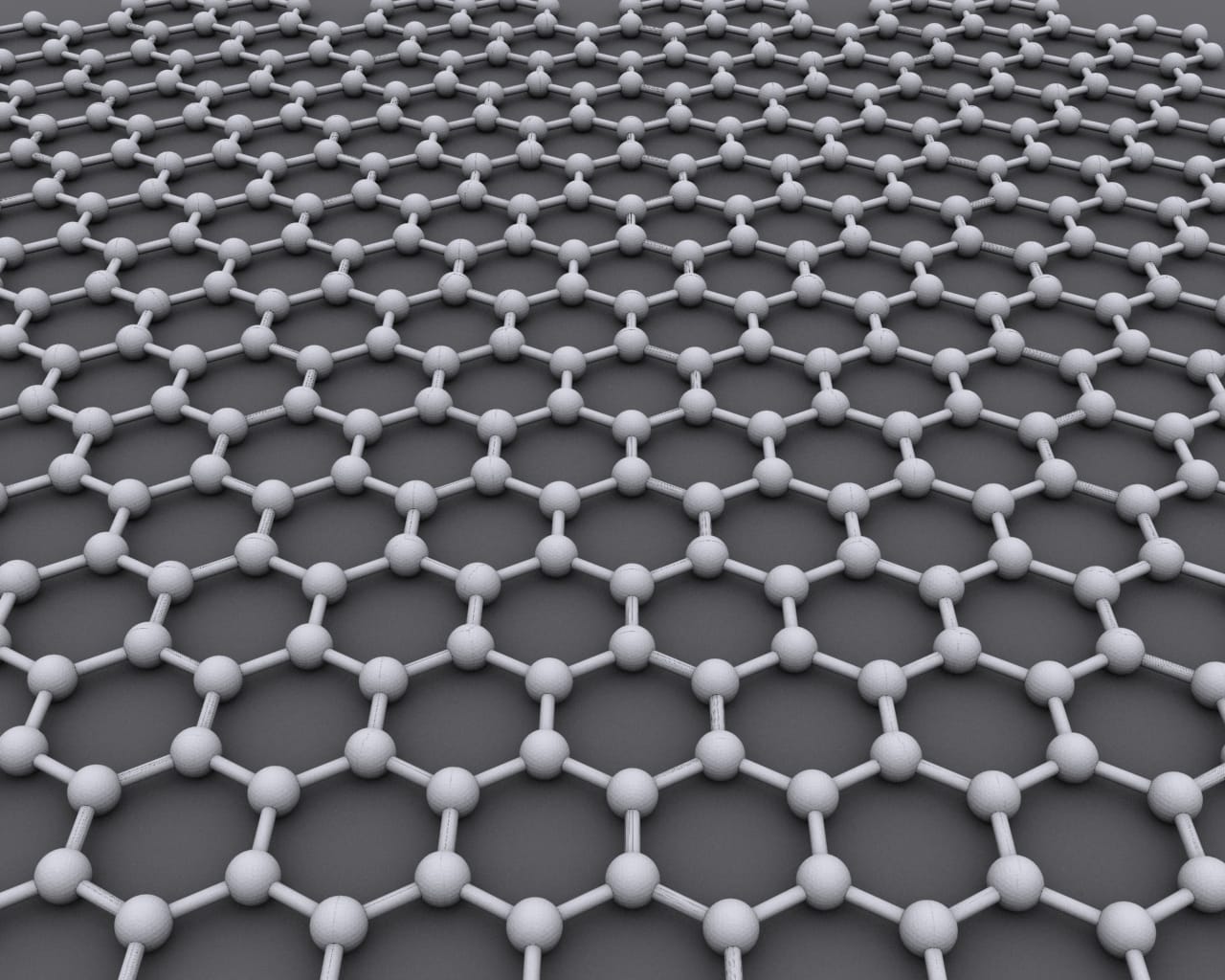
Graphene is a single layer of carbon atoms arranged in a hexagonal lattice, one atom thick. Its measured properties are extraordinary and not in dispute. Whether it has delivered on what was promised for it is a different question, and a useful case study in how new materials are talked about.
Graphene is the strongest material ever measured, with a tensile strength around two hundred times that of steel by weight. It conducts electricity better than copper and heat better than any other known material. It is nearly transparent, absorbing about 2.3 per cent of visible light, and impermeable to gases including helium. Electrons move through it as though they had no mass, which makes it a laboratory for relativistic quantum effects that would otherwise require a particle accelerator.
Graphene was described theoretically for decades and assumed to be impossible to isolate, since two-dimensional crystals were expected to be thermodynamically unstable. In 2004 Andre Geim and Konstantin Novoselov at Manchester obtained it by repeatedly peeling graphite with adhesive tape until a single layer remained, a method that became famous for how unglamorous it was. They received the Nobel Prize in Physics in 2010, an unusually short interval.


Graphene was described on its discovery as a material that would transform electronics, batteries, water filtration, aerospace, and medicine. Very large public research programmes were funded on that basis, including a European flagship of a billion euros. Two decades later, the consumer products containing graphene are mostly modest: composite additives in sports equipment, some coatings, thermal management in a few devices.
The reasons are instructive rather than scandalous.
Manufacture at scale is the central obstacle. Tape-peeled flakes are perfect and useless commercially. Chemical vapour deposition produces large sheets of good quality but slowly and expensively, and transferring a sheet to a working surface without tearing or contaminating it remains hard. Much material sold as graphene is in fact graphite nanoplatelets of many layers, and a 2018 survey of commercial suppliers found the majority were selling material with a low proportion of actual graphene, with no accepted standard for the label.
There is also a physics problem specific to electronics. Graphene has no band gap, so a graphene transistor cannot be switched fully off, which is precisely what a digital logic device must do. Engineering a gap is possible and degrades the properties that made it attractive.
The honest summary is that graphene is a real material with real properties that is following the ordinary timeline of materials development rather than the accelerated one it was sold with. Carbon fibre took roughly forty years from laboratory to widespread use, and aluminium was a precious metal before an economical process existed. Graphene has genuinely transformed condensed matter physics, where it opened the study of two-dimensional materials and led to discoveries including superconductivity in twisted bilayers. What it has not yet done is transform manufacturing, and treating that as a failure rather than a schedule confuses two different claims.
Two decades after isolation, commercial use is real, narrow, and unglamorous, which is what the ordinary timeline predicts.
The established applications are additives rather than devices: polymer composites for automotive parts, heat spreaders in phones, industrial elastomers, anti-corrosion coatings, and loudspeaker diaphragms, where stiffness at low mass is worth paying for. In each the graphene is a component improving a conventional material, not a graphene product.
Device manufacture has attracted serious investment more recently. Paragraf, making wafer-scale graphene electronics and sensors, raised 55 million dollars in 2025, and a Cambridge spinout working on graphene photonic circuits raised a comparable sum. A Korean manufacturer completed a mass-production facility in late 2025 aimed at fast-charging battery materials, with commercial output expected around 2027.
None of this is the material replacing silicon, which the band gap problem still forbids. It is a specialty materials industry of a few hundred producers finding the applications where graphene's properties justify its cost, which is how a new material normally arrives.