Molecules built from many repeating units linked in chains. They include most plastics, all proteins and nucleic acids, rubber and cellulose, and their properties follow from the chain structure rather than from the chemistry of the units alone.
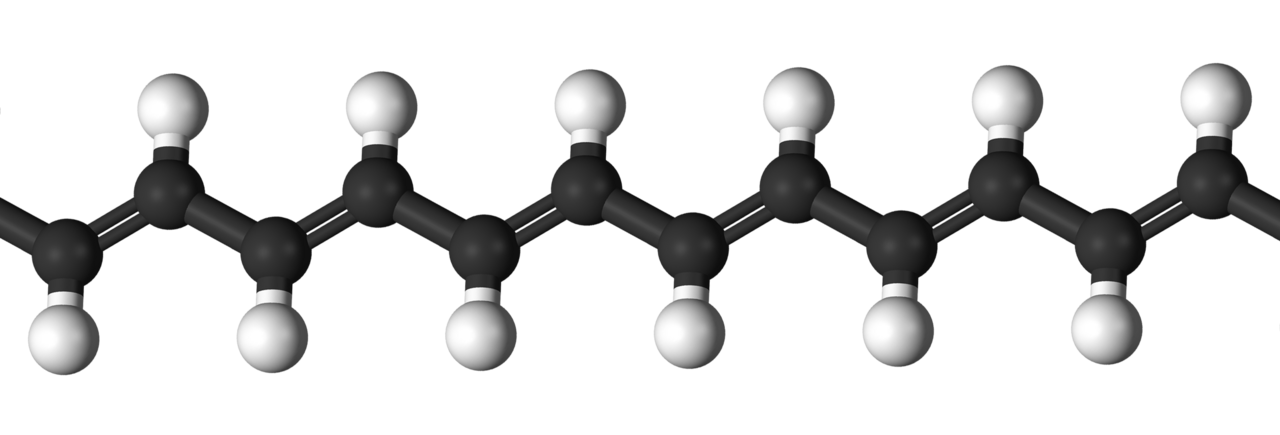
A polymer is a large molecule composed of repeated subunits called monomers, joined covalently into chains.
Chain length matters enormously. The same monomer polymerised to different lengths produces materials with different melting points, strengths and viscosities, and properties change sharply with molecular weight up to a point and then level off.
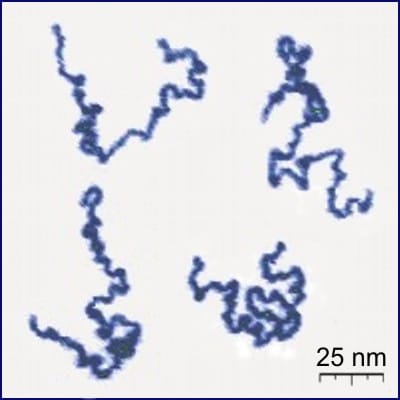
Chains can be linear, branched or cross-linked. Cross-linking, in which chains are chemically joined to one another, converts a material that flows into one that does not, which is the difference between raw and vulcanised rubber.
Arrangement matters as much as composition. Regions where chains align in an ordered way are crystalline and give strength and stiffness; disordered regions are amorphous and give flexibility. Most polymers are partly both, and the proportion determines the material's character.
The glass transition temperature is where an amorphous polymer changes from brittle to rubbery. It explains why the same plastic is flexible in summer and cracks in cold, and it is a property of chain mobility rather than of melting.
Biology is built from polymers.
Proteins are polymers of amino acids, described in their own capsule. Nucleic acids are polymers of nucleotides. Cellulose and starch are polymers of glucose, as the carbohydrates capsule sets out. Natural rubber is a polymer of isoprene.
Humans used these long before understanding them. Wood, cotton, wool, silk and leather are polymeric materials, and rubber was used in Mesoamerica for millennia before Europeans encountered it.
Charles Goodyear's discovery of vulcanisation in 1839, cross-linking rubber with sulphur, made it usable across a wide temperature range and is the first deliberate chemical modification of a polymer's properties.
Bakelite, produced by Leo Baekeland in 1907, was the first fully synthetic plastic, made from phenol and formaldehyde. It is thermosetting, meaning it cross-links irreversibly on curing and cannot be remelted, and it was adopted rapidly for electrical insulation.
Hermann Staudinger established in the 1920s that polymers are genuinely large covalently bonded molecules rather than aggregates of small ones held together by weak forces, which was resisted at the time and earned the 1953 Nobel Prize. Modern polymer science begins with that recognition.
The 1930s produced polyethylene, polystyrene, polyvinyl chloride and nylon, the last developed by Wallace Carothers at DuPont and the first fully synthetic fibre.
Ziegler-Natta catalysts in the 1950s allowed control over chain structure and stereochemistry, which permitted polymers to be designed for specific properties rather than accepted as produced.
Thermoplastics soften on heating and can be reshaped repeatedly, which makes them recyclable in principle. Polyethylene, polypropylene, PVC and PET are the highest volume plastics.
Thermosets cross-link on curing and cannot be remelted, which gives heat resistance and dimensional stability and makes recycling far harder. Epoxies and vulcanised rubber are examples.
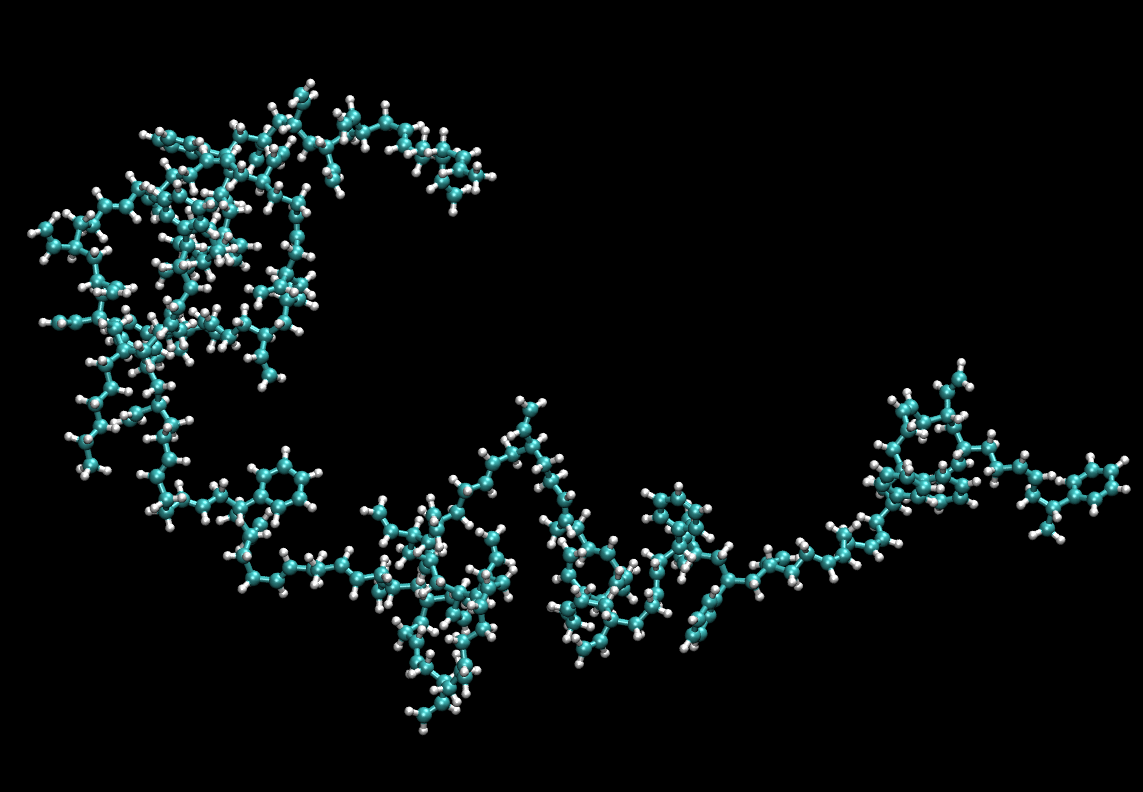
Elastomers deform substantially and recover, because their chains are coiled and lightly cross-linked.
Fibres are drawn so that chains align along the length, which is why drawing increases tensile strength dramatically and why synthetic fibres are strong in one direction.
Copolymers combine two or more monomers in one chain, producing properties neither homopolymer has, and most synthetic rubbers are made this way.
Plastics are durable, which is what makes them useful and what makes their disposal difficult.
Global production has risen continuously and a large majority of all plastic ever made has been discarded rather than recycled or incinerated.
Recycling rates are low, and mechanical recycling degrades the material, since chains shorten and contamination accumulates, so recycled plastic generally becomes a lower-grade product rather than the same one.
Chemical recycling, breaking polymers back into monomers, avoids that degradation and is currently expensive and limited in scale.
Biodegradable polymers exist and frequently require industrial composting conditions that most waste streams do not provide, so the label is a weaker claim than it appears.
Microplastics are the fragmentation product, and their presence throughout the environment and in human tissue is treated in its own capsule.
The honest summary is that the properties making plastics valuable, being cheap, durable and light, are the same ones making disposal difficult, and no substitute currently matches them across all three.
Polymers are the material basis of both biology and a large part of modern manufacturing, which is unusual: the same structural principle underlies DNA and a supermarket bag.
They also illustrate how a material's properties come from architecture rather than composition alone. Cellulose and starch are both glucose chains, and one is structural timber and the other is food, differing only in how the units are joined.