The cell type that carries and processes signals in the nervous system. Neurons are electrically excitable, connect to one another at junctions called synapses, and their pattern of connection is what a nervous system consists of.
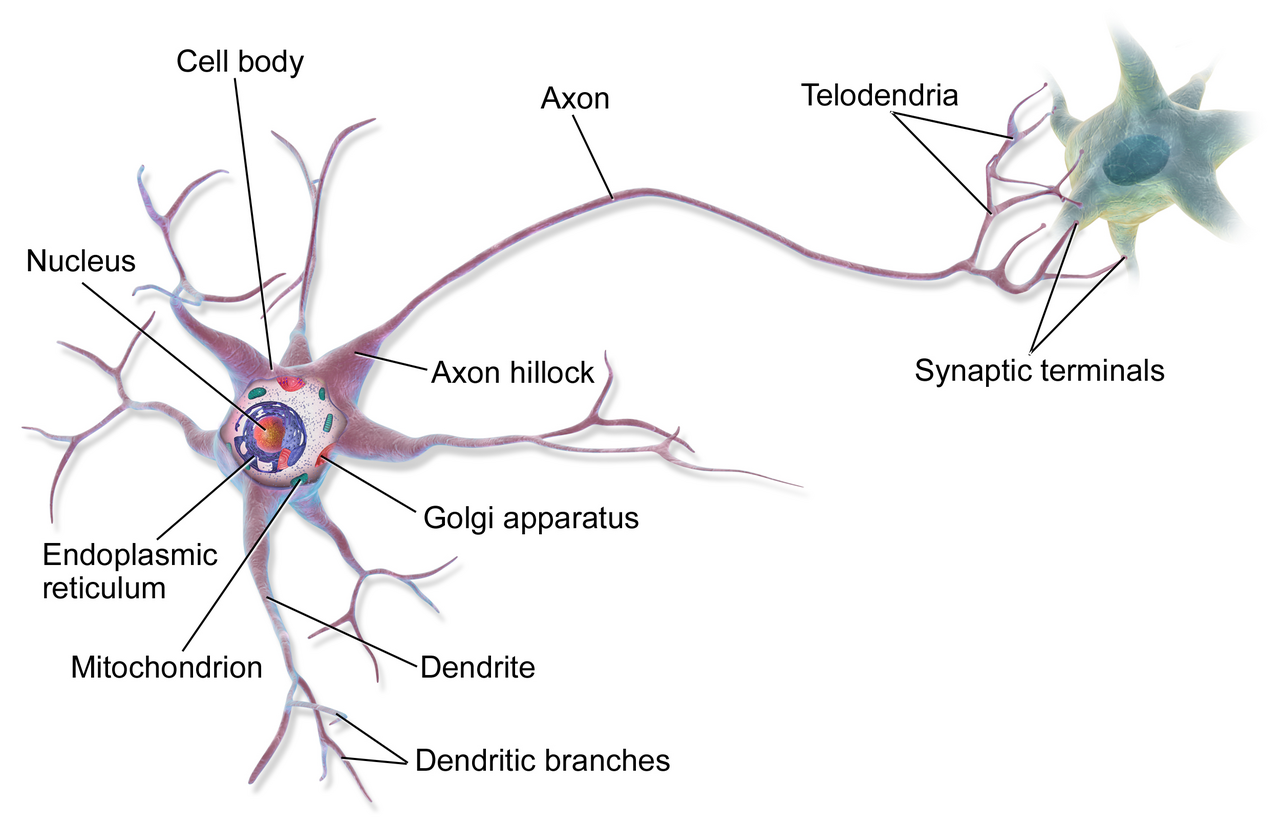
A neuron has three functional parts.
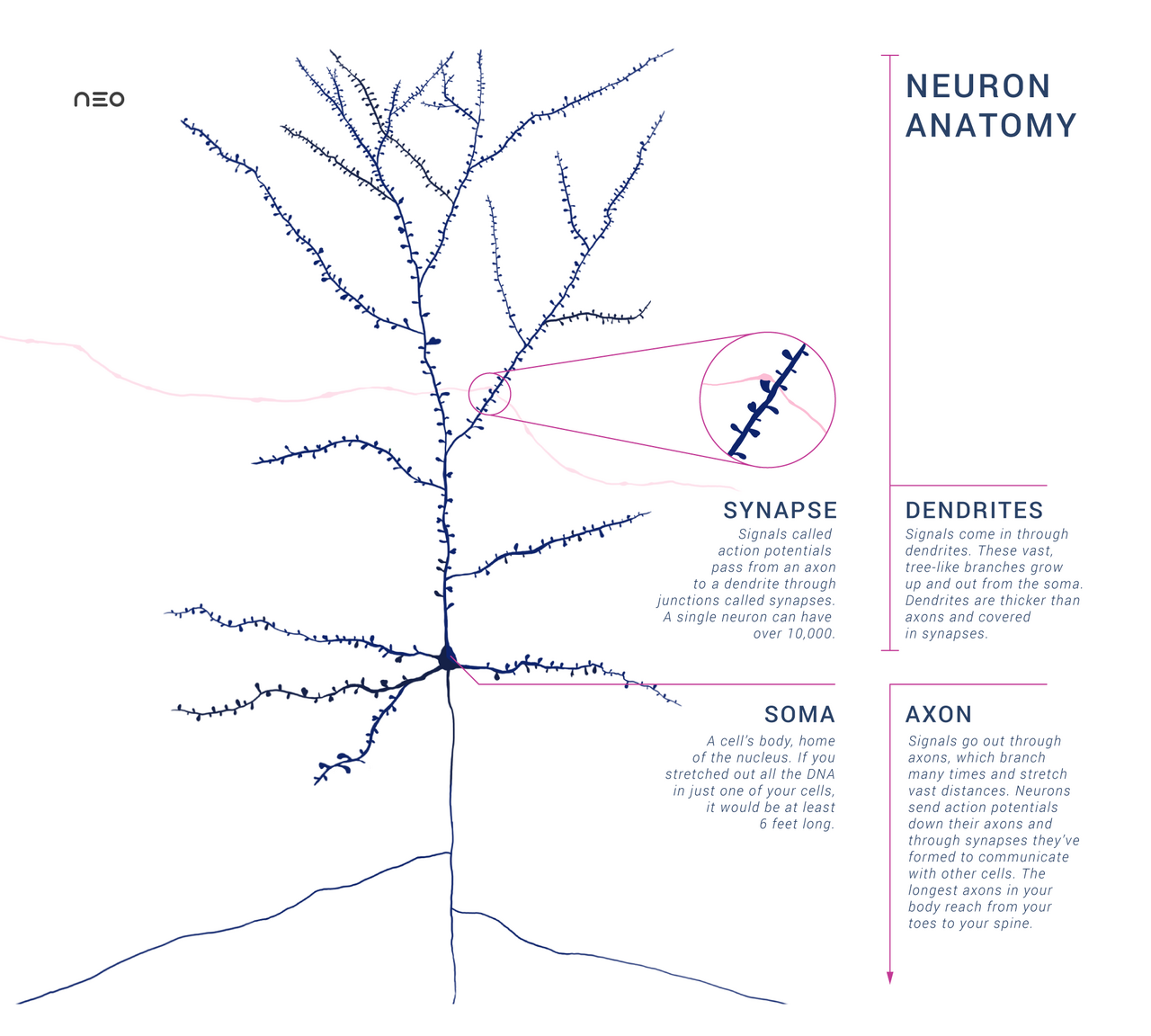
Dendrites are branching extensions that receive input from other neurons. A single neuron may carry thousands of input sites on its dendrites.
The cell body contains the nucleus and performs the cell's metabolic work. It is also where incoming signals are summed.
The axon is a single long extension that carries the output signal away. Axons vary enormously in length, from microns within a local circuit to over a metre for those running from the spinal cord to the foot. Near its end the axon branches, and each branch ends in a terminal that contacts another cell.
Many axons are wrapped in myelin, a fatty insulating sheath formed by supporting cells, interrupted at regular intervals. Myelin increases conduction speed by a large factor, because the signal jumps between the gaps rather than propagating continuously.
A resting neuron maintains an electrical difference across its membrane, with the inside about seventy millivolts negative relative to the outside. This is maintained by pumps that move sodium out and potassium in, and by the membrane's differing permeability to those ions.
Incoming signals shift this voltage up or down. If the total shift at the start of the axon reaches a threshold, voltage-sensitive channels open, sodium rushes in, and the voltage briefly reverses. This is the action potential, treated in its own capsule.
Two features of it matter. It is all or nothing: reaching threshold produces a full-sized spike and falling short produces nothing, so signal strength is encoded in firing rate and timing rather than amplitude. And it regenerates as it travels, so it arrives at the end of a long axon undiminished, unlike a passive electrical signal in a wire.
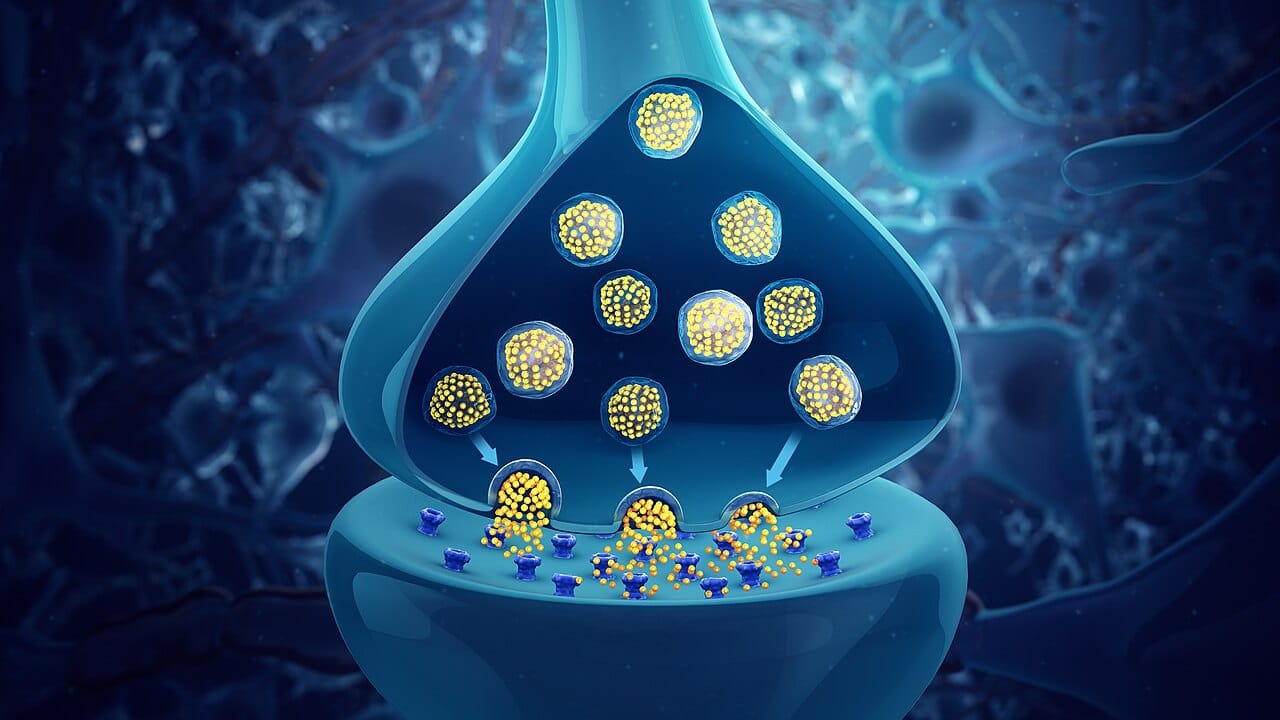
At a chemical synapse the two neurons are separated by a gap of about twenty nanometres. The arriving action potential causes vesicles to release neurotransmitter molecules into the gap, which bind receptors on the receiving cell and change its voltage.
Synapses are excitatory or inhibitory depending on the transmitter and receptor. Glutamate is the main excitatory transmitter in the vertebrate brain and GABA the main inhibitory one, and the balance between them is what keeps activity stable. Losing inhibition produces seizures.
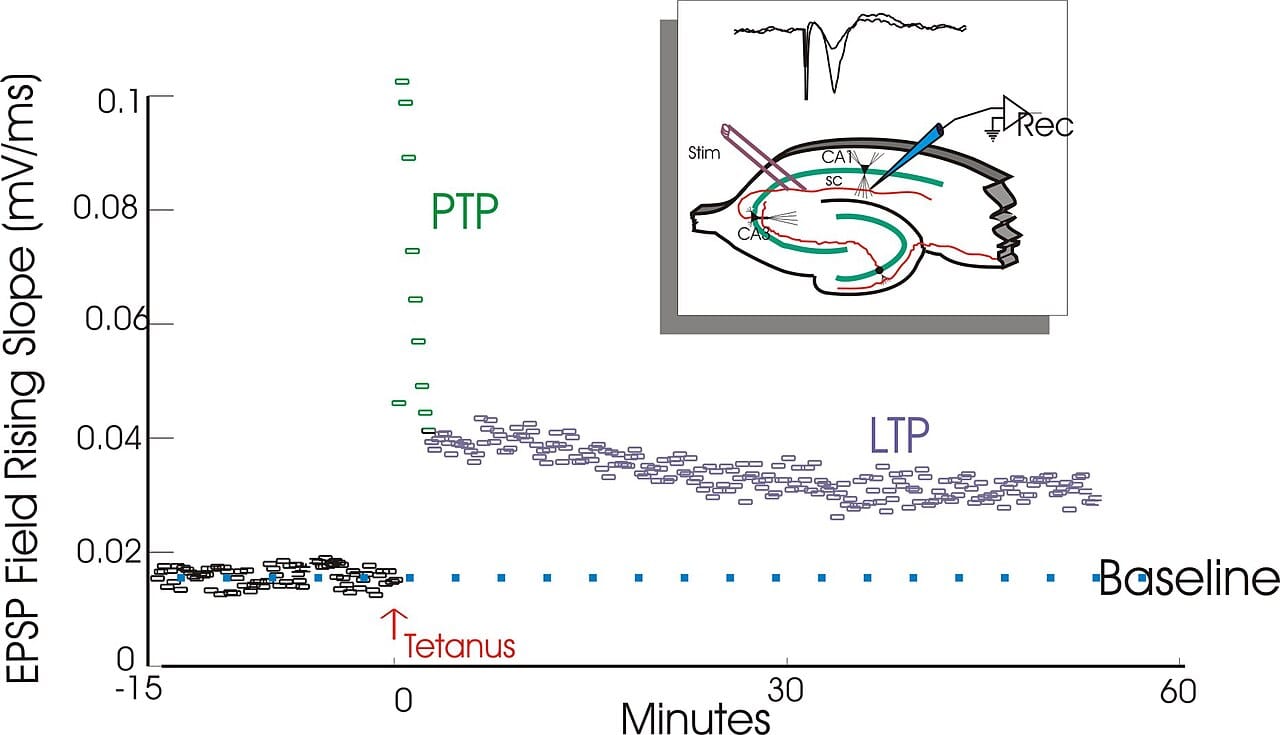
The chemical step looks inefficient and is the source of the system's power. Because transmission depends on the amount released and the receptors present, a synapse's strength can change with use, which is the physical basis of learning. Electrical synapses also exist, are faster, and are far less modifiable.
Chemical transmission is also where most psychoactive and neurological drugs act, since the synapse offers many distinct points of intervention.
The adult human brain contains on the order of eighty six billion neurons, a figure established by Suzana Herculano-Houzel's counting method and lower than the hundred billion previously quoted.
Glial cells are roughly comparable in number. Once regarded as merely structural, they are now known to regulate the chemical environment, form myelin, prune synapses and participate in signalling.
Neurons vary widely. Sensory neurons carry input from receptors, motor neurons drive muscles, and interneurons connect neurons to each other and make up the great majority in the brain. Shapes differ dramatically: a cerebellar Purkinje cell carries an enormous flat dendritic tree receiving something like a hundred thousand inputs.
That the nervous system is made of discrete cells was not obvious. The prevailing view in the nineteenth century was that it formed a continuous network.
Camillo Golgi developed a stain in 1873 that marks a small random fraction of neurons completely, which allowed individual cells to be traced through tissue. Golgi himself held the continuous-network view.
Santiago Ramón y Cajal used Golgi's method to argue the opposite, that neurons are separate cells communicating at points of contact, which became the neuron doctrine. He also inferred the direction of signal flow from cell shape.
The two shared the Nobel Prize in 1906 and used their lectures to argue against each other. Electron microscopy in the 1950s settled it by showing the synaptic gap directly, confirming Cajal.
The neuron is the unit from which nervous systems are built, and nearly everything about behaviour, perception and thought is implemented in the activity and connectivity of these cells.
Its properties also explain the general shape of neurological disease. Neurons in the adult central nervous system largely do not divide to replace losses, which is why damage from stroke, injury and neurodegeneration tends to be permanent, and why regeneration is such a persistent research goal.