A brief burst of activity at a synapse can strengthen it for hours, days or longer. It is the best-supported cellular mechanism for learning, it was predicted decades before it was found, and connecting it to actual memories took another thirty years.
Donald Hebb proposed in 1949 that when one cell repeatedly takes part in firing another, some change occurs that makes the first more efficient at doing so. The formulation is usually compressed to cells that fire together wire together.
The proposal was theoretical. Hebb had no mechanism and no way to observe one; he argued that learning must involve changes at connections between neurons, because nothing else could store the required information.
Terje Lomo observed the effect in 1966 in the rabbit hippocampus, and published it with Timothy Bliss in 1973.
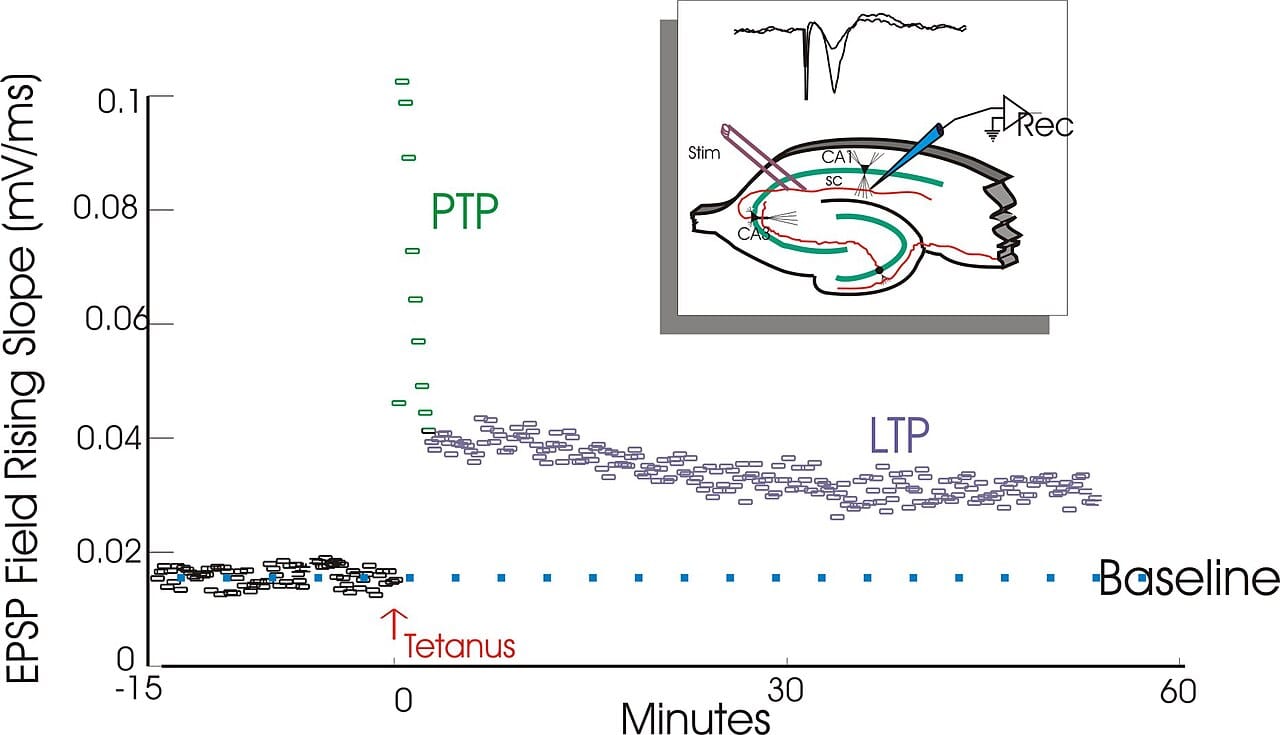
Delivering a brief high-frequency train of stimuli to a pathway produced a larger response to subsequent single stimuli, and the enhancement persisted for hours in the anaesthetised animal and for weeks in freely moving ones.
The location mattered. The hippocampus was already known to be essential for forming new memories, from the patient Henry Molaison, whose surgery in 1953 removed both hippocampi and left him unable to form new episodic memories while leaving older ones and his skills intact.
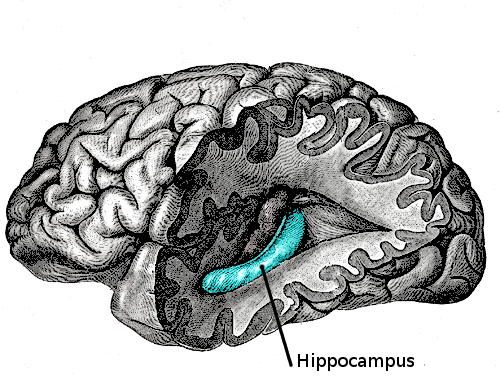
Finding a lasting synaptic change in exactly the structure required for memory formation was strong circumstantial evidence.
The core of it is one receptor with an unusual property.
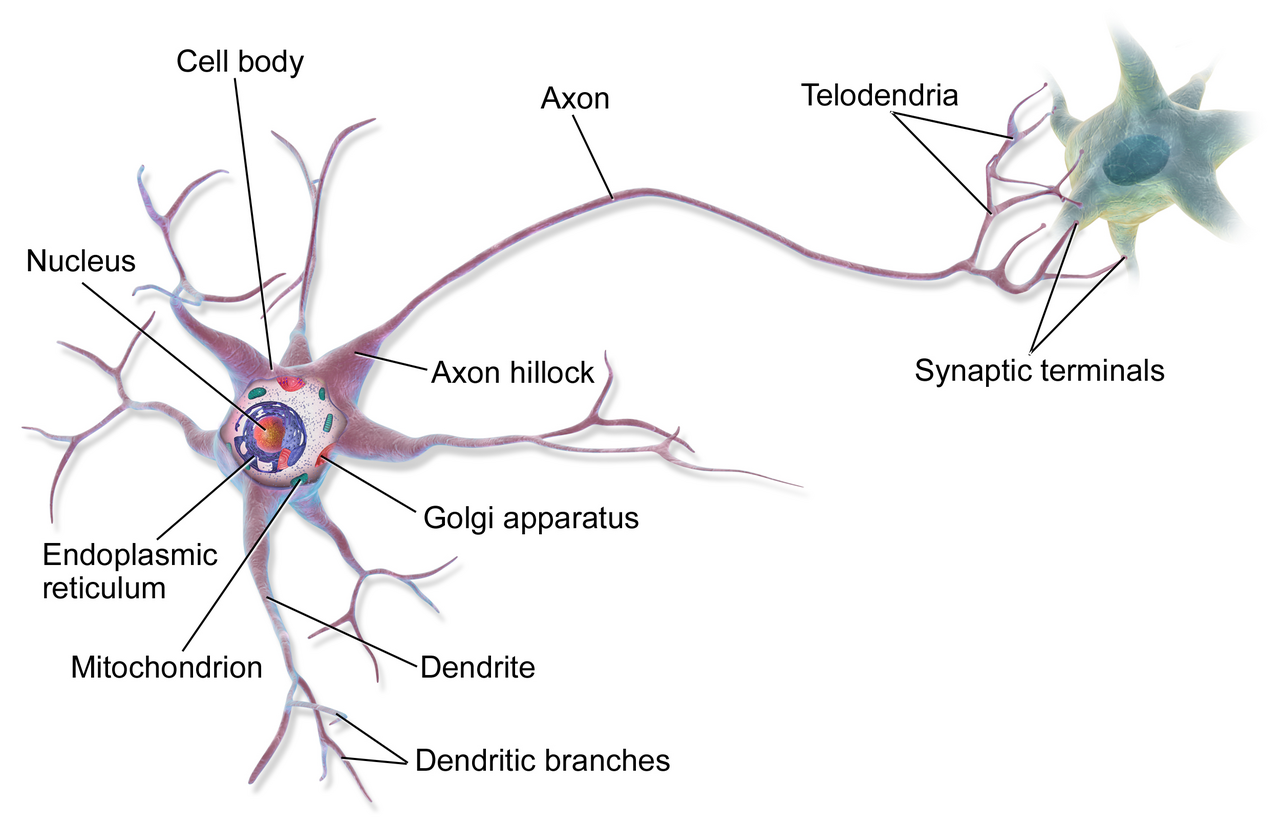
The NMDA receptor is a coincidence detector. It is blocked by a magnesium ion that only leaves when the receiving cell is already depolarised, so the receptor opens only when the presynaptic cell releases glutamate and the postsynaptic cell is simultaneously active. That is Hebb's condition implemented in a protein.
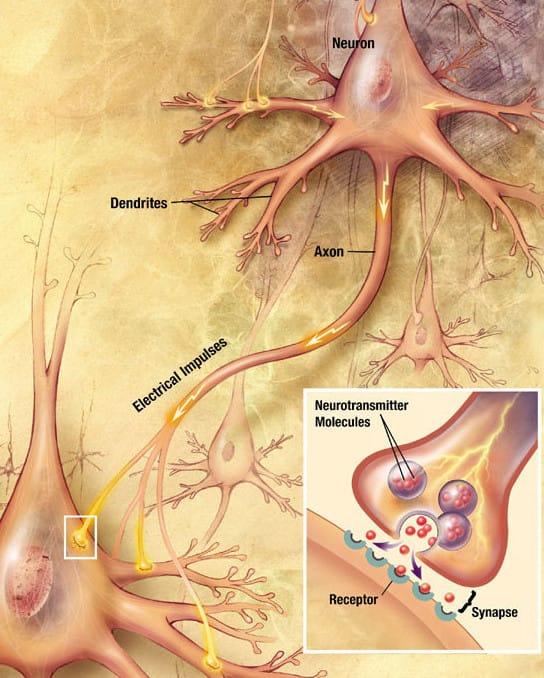
When it opens, calcium enters. Calcium triggers signalling cascades that insert more AMPA receptors into the postsynaptic membrane, making the synapse respond more strongly to the same amount of transmitter.
Early-phase potentiation lasts one to three hours and requires no new protein synthesis. Late-phase potentiation lasts much longer, requires new proteins and gene transcription, and involves structural change: dendritic spines enlarge and new ones form, which has been imaged directly in living tissue.
The opposite process exists. Long-term depression weakens synapses under low-frequency stimulation, and a system that could only strengthen would saturate.
Showing a mechanism exists is not showing it is used. Establishing the link took several converging lines.
Blocking NMDA receptors pharmacologically impairs both potentiation and spatial learning in the same animals, at the same doses.
Genetic manipulation of the receptor produces corresponding changes in learning, in both directions: mice engineered with a receptor subunit that stays open longer show enhanced potentiation and better performance on several learning tasks.
Optogenetic work provided the strongest evidence. Neurons active during a fear memory can be tagged and then reactivated later with light, and doing so produces the behaviour associated with the memory in the absence of any cue. The memory can be inactivated by weakening those synapses and restored by strengthening them again, which is close to a direct demonstration that the synaptic change is the memory.
Whether potentiation as studied in slices is the same process operating during natural learning is not fully established. The stimulation protocols used in the laboratory are far more intense than anything a behaving animal produces.
How memories persist for decades is unresolved. Synaptic proteins turn over in days to weeks, so a lasting memory cannot be stored in a stable molecule. Proposals involve self-sustaining molecular states, structural changes maintained by ongoing activity, or distributed storage in which no individual synapse needs to persist.
And a minority position holds that the essential storage is not synaptic at all, pointing to intracellular mechanisms or to evidence that some memories survive procedures that should erase synaptic changes. This is not the mainstream view and it has not been eliminated.
Memantine, used in Alzheimer's disease, acts on NMDA receptors. Ketamine blocks them, and its rapid antidepressant effect appears to involve a rebound in synaptic strengthening.
Reconsolidation, in which a retrieved memory becomes briefly labile before being restored, has prompted trials of disrupting traumatic memories during that window. Results are mixed and the approach remains experimental.