The mechanisms by which an organism develops as male, female or another form. The systems are far more varied than the mammalian arrangement suggests, and several do not involve chromosomes at all.
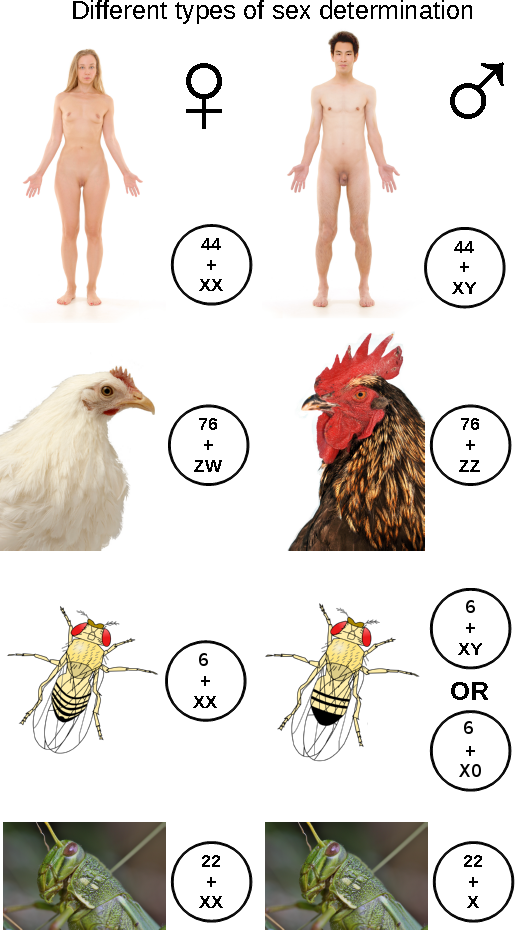
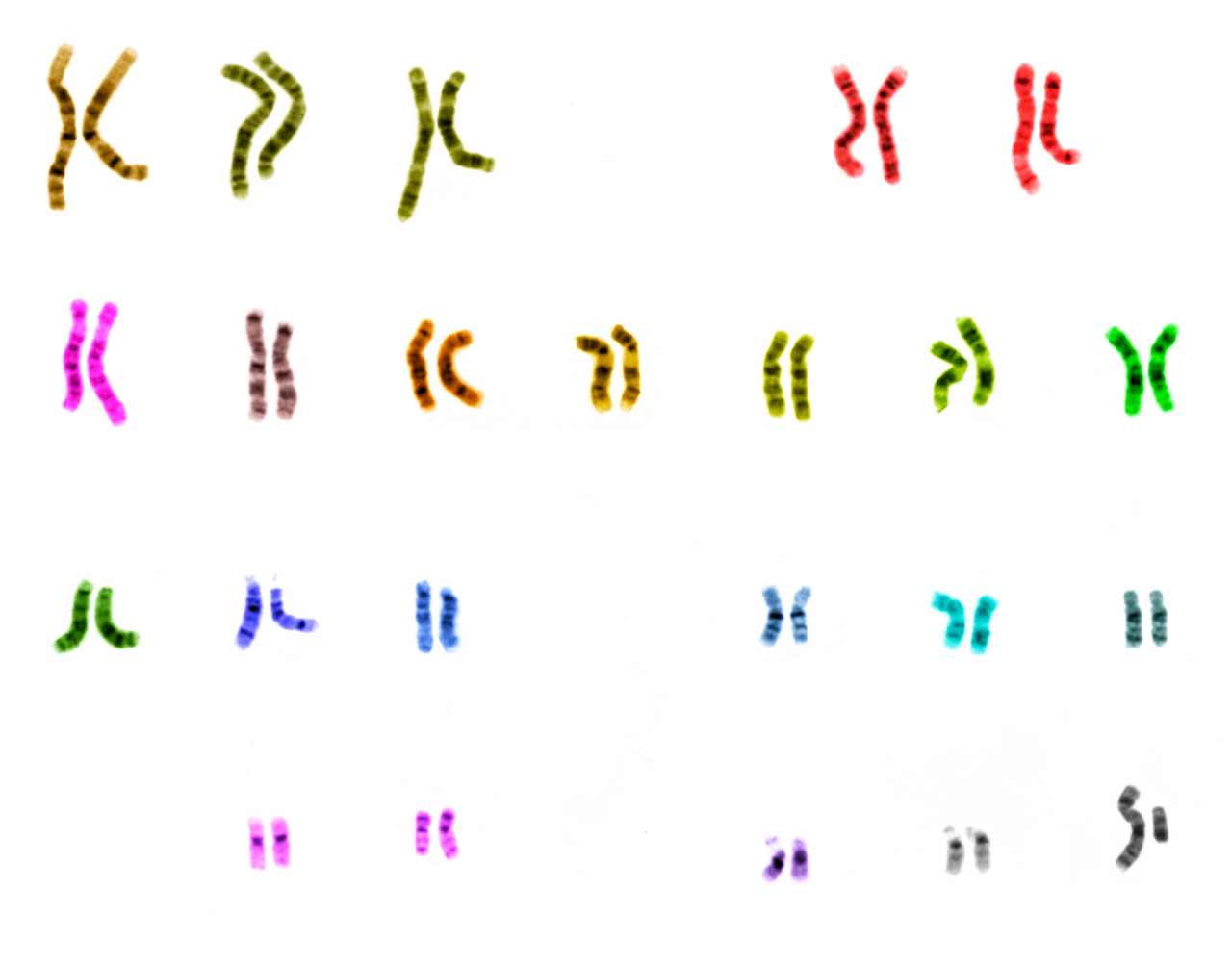
Mammals use XX and XY chromosomes. Females typically have two X chromosomes and males one X and one Y.
The determining factor is a single gene on the Y chromosome, SRY, which initiates development of the testes. Without it the gonad develops as an ovary.
Everything downstream follows from hormones the gonad produces, which is why the pathway can be interrupted at several points. Individuals with XY chromosomes and a non-functional androgen receptor develop female external anatomy, and individuals with XX chromosomes exposed to high androgen levels develop differently. These conditions are grouped as differences of sex development and are the reason chromosomes, gonads, hormones and anatomy are distinguished rather than treated as one thing.

The Y chromosome is small and carries few genes. Because it does not recombine along most of its length, it cannot repair damage by exchange with a partner, and it has lost the great majority of the genes it once shared with the X. Whether it will disappear entirely is argued about; some rodent species have already lost it and determine sex by other means.
Birds, butterflies and some reptiles use ZW, in which the female carries the two different chromosomes and the male two identical ones. This is the reverse of the mammalian arrangement and evolved independently.
Many insects use an XO system, in which sex depends on the number of X chromosomes with no Y at all.
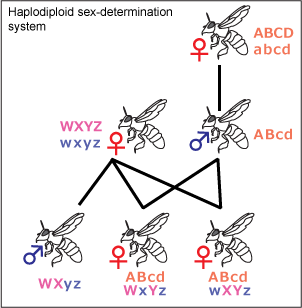
Bees, ants and wasps use haplodiploidy. Fertilised eggs develop into females with two sets of chromosomes and unfertilised eggs into males with one. A consequence is that full sisters share three quarters of their genes rather than half, which has been invoked in explanations of eusociality in these groups.
Temperature-dependent sex determination occurs in most turtles, all crocodilians and some lizards. The temperature of the nest during a critical window of incubation determines the outcome, with the relationship differing by group: in many turtles warmer nests produce females, in crocodilians intermediate temperatures produce males.
This is directly consequential for conservation, since rising temperatures skew sex ratios. Populations of green turtles in some regions have been reported as producing overwhelmingly female hatchlings, which threatens long-term viability regardless of how many eggs hatch.
Some fish determine sex by social conditions and change sex during life. Many wrasses change from female to male when a dominant male is removed, and clownfish change from male to female. Sequential hermaphroditism of this kind is common in fish and occurs in some invertebrates.
Environmental determination by density, nutrition or host occurs in various invertebrates.
Sex determination mechanisms are evolutionarily labile, changing far more readily than the existence of two sexes.
The distinction between males and females, defined by the production of small mobile gametes or large immobile ones, is ancient and conserved across the great majority of sexually reproducing eukaryotes.
How an individual is directed down one path or the other has changed repeatedly and independently across lineages. Sex chromosomes have arisen many times from ordinary chromosomes, and temperature-based systems have been gained and lost.
The general lesson is that a stable outcome does not require a stable mechanism, and that generalising from the mammalian case to biology at large produces immediate errors.
Sex determination is a clear case of a developmental switch: a single gene or a temperature threshold initiates a cascade producing large differences in anatomy and physiology, which makes it a standard model for how development is controlled.
Its variety also has practical consequences. Conservation of reptiles requires managing nest temperatures, aquaculture depends on manipulating sex ratios in fish, and pest control has used systems that bias offspring sex. Each of these works only because the mechanism differs between groups.