In a large population with random mating and nothing else happening, gene frequencies do not change from one generation to the next. It sounds like a statement about nothing, and it is the foundation of population genetics, because it defines what has to be explained.
An objection to Mendelian inheritance circulated in the early twentieth century: if a trait is dominant, should it not spread through a population until everyone has it?
The reasoning felt intuitive and was wrong, and the question was put to G. H. Hardy at Cambridge by the geneticist Reginald Punnett.
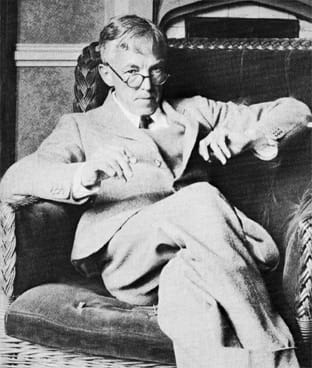
Hardy's reply, published in Science in 1908, showed by elementary algebra that dominance has nothing to do with frequency. A dominant allele masks a recessive one in appearance; it confers no tendency to become more common. Absent some force acting on it, its frequency stays where it is.
Hardy considered the result trivial and said so in the paper, remarking that he supposed it would be of some interest to biologists. Wilhelm Weinberg, a German physician, published the same result independently the same year and in more general form, and his contribution went unrecognised in the English-speaking world for decades.
For a gene with two versions at frequencies p and q, where p and q sum to one, the genotype frequencies in the next generation are p squared, 2pq and q squared.
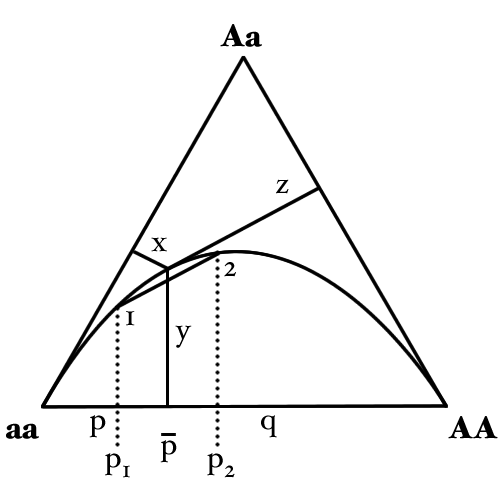
Those frequencies then remain constant indefinitely, provided five conditions hold: the population is large enough that chance sampling is negligible, mating is random with respect to the gene, there is no mutation, no migration, and no selection.
The equilibrium is reached in a single generation of random mating, whatever the starting genotype frequencies, which is the surprising part.
The conditions are never all met. That is the point.
The principle is a null model. It states what would be observed if no evolutionary force were operating, so any departure from it is a measurement of a force that is operating. This is the same logical role that inertia plays in mechanics: a body continues at constant velocity unless something acts on it, so acceleration is evidence of a force.
Population genetics is built on this move. Deviation from expected genotype frequencies indicates non-random mating, selection, or population structure. The size of the deviation quantifies the strength of the effect. Without a baseline expectation there would be nothing to measure against.
Carrier frequency estimation is the most direct application. Cystic fibrosis affects about one in 2,500 births in populations of northern European descent. That is q squared, so q is about one in fifty, and the carrier frequency 2pq is roughly one in twenty five. This calculation is standard in genetic counselling.
Detecting genotyping error is the routine laboratory use. In genome-wide association studies, a marker whose genotype frequencies depart sharply from equilibrium in healthy controls is usually a technical failure rather than a biological finding, and such markers are filtered out before analysis. The principle is doing quality control on millions of measurements.
Detecting population structure is the other major use. If a sample unknowingly combines two populations with different allele frequencies, the pooled sample shows a deficit of heterozygotes, called the Wahlund effect. This is a signal that the sample is not what it appears to be, and it matters because unrecognised structure produces spurious associations in genetic studies.
Estimating inbreeding uses the same deficit, since inbreeding also reduces heterozygosity below expectation, and the inbreeding coefficient is defined by how far below.
It is not a claim that populations do not evolve, and it is occasionally misread that way.
It says that inheritance itself is not a force. Mendelian segregation shuffles alleles without changing their frequencies, so any change in frequency has an external cause. That is a considerably stronger and more useful statement than it first appears, and establishing it removed a genuine obstacle to accepting that Mendelian genetics and Darwinian evolution were compatible.
That reconciliation, worked out by Ronald Fisher, J. B. S. Haldane and Sewall Wright over the following decades, became the modern synthesis, and this two-page result is where it starts.