An extinct class of marine arthropods that existed for roughly 270 million years, left an exceptionally rich fossil record, and are among the most useful organisms in the dating of rock.
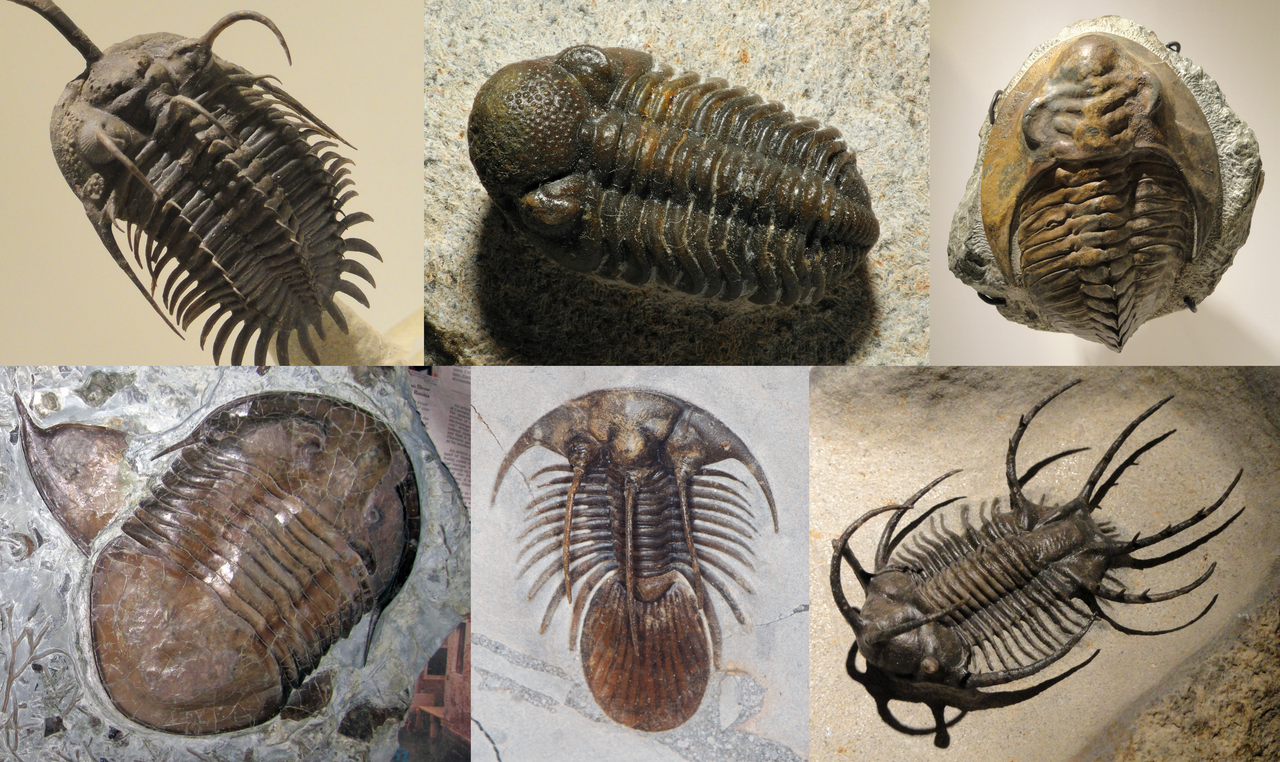
Trilobites were arthropods, related to modern crustaceans, insects and arachnids, and they were exclusively marine.
The name refers to a division into three lengthwise lobes, a central axial lobe and one on each side, rather than to the head, thorax and tail division that is more obvious.
They ranged from a couple of millimetres to over seventy centimetres. More than twenty thousand species have been described, which makes them one of the best-documented extinct groups.
Their exoskeleton was strengthened with calcite, which is unusual among arthropods and is the principal reason for their fossil abundance: a mineralised shell preserves far better than a purely organic one.
Like other arthropods they moulted, so a single individual left several shed exoskeletons over its life, which further inflates their representation in the record.
Trilobites possess the oldest well-preserved visual systems known, and their eyes are unlike any modern animal's.
The lenses were made of calcite, a mineral, rather than of protein. Calcite is birefringent, splitting light into two rays, which would produce a double image, and the lenses are oriented along the single crystal axis where that effect vanishes.
Some species had eyes composed of many small lenses in contact, and others had larger separated lenses each with its own corneal covering, an arrangement found in no living animal.
The optical properties have been analysed in detail, and several designs correspond to solutions that were independently derived in optics much later, including compound lens forms that correct spherical aberration.
Eyeless trilobites occur repeatedly in lineages that moved into deep or muddy environments, which is a clear illustration of the loss of a costly structure when it stops being useful.
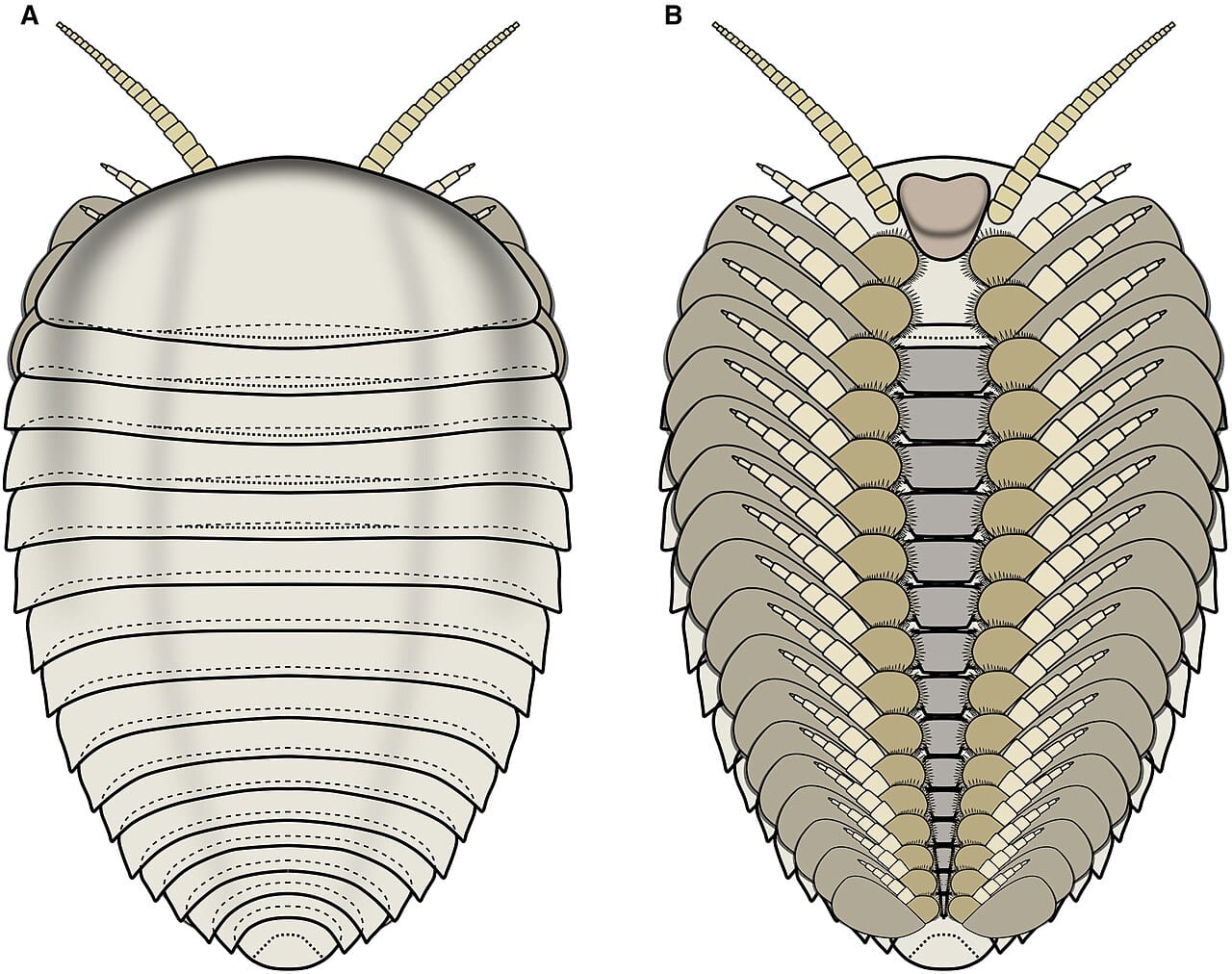
Most information about limbs, gills and internal organs comes from a small number of exceptional deposits where soft tissue was preserved, since the ordinary record consists of the mineralised upper surface alone.
They had a pair of jointed limbs per body segment, each with a walking branch and a feathery branch used for respiration.
Modes of life were varied. Many crawled on or burrowed into the sea floor. Some were active swimmers with large eyes. Some filtered particles from sediment, and some appear to have been predators.
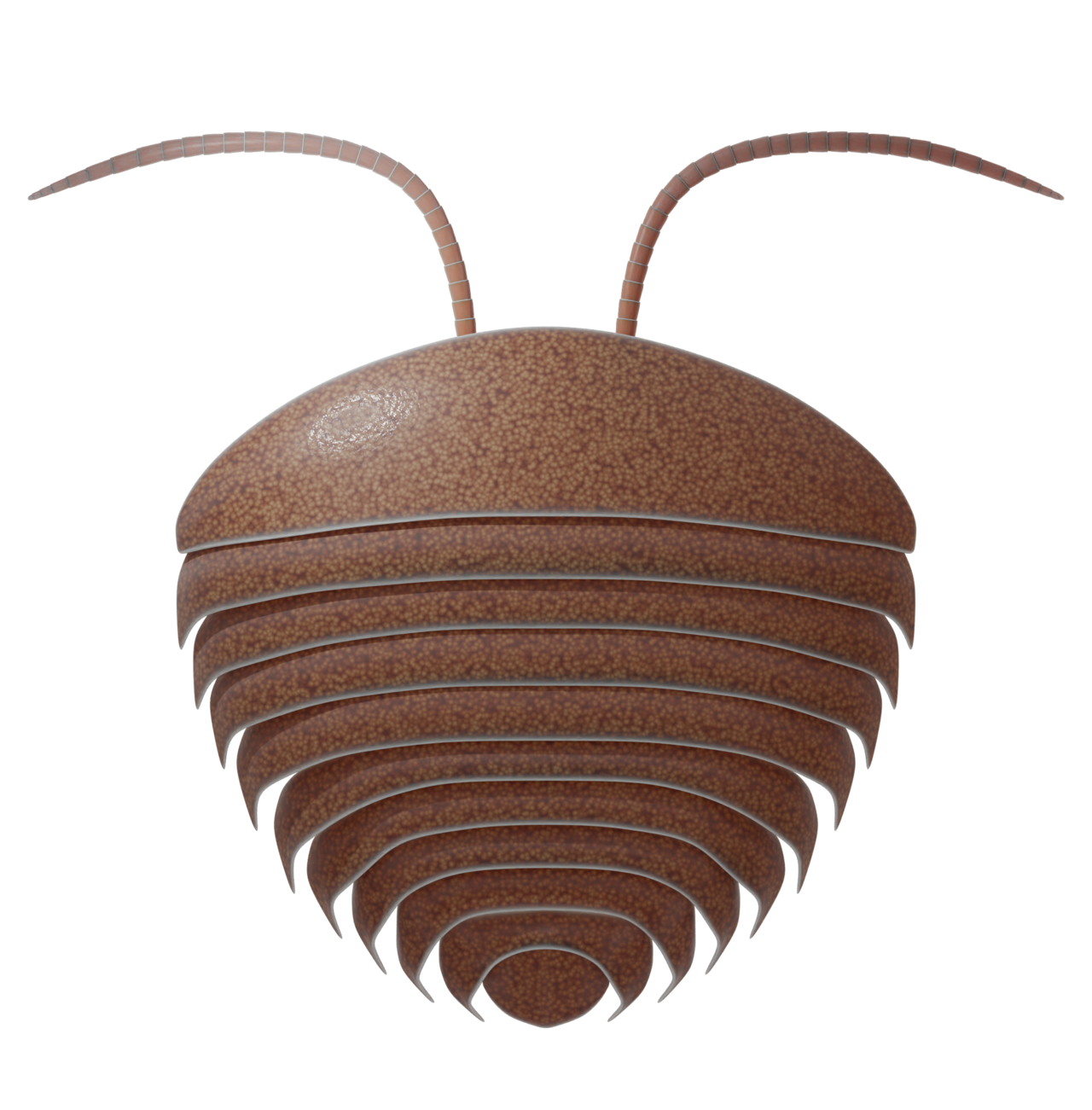
Many could enrol, curling into a ball with the tail tucked under the head so that only the hard shell was exposed. Enrolled specimens are common, and the mechanism involves interlocking structures that are anatomically elaborate.
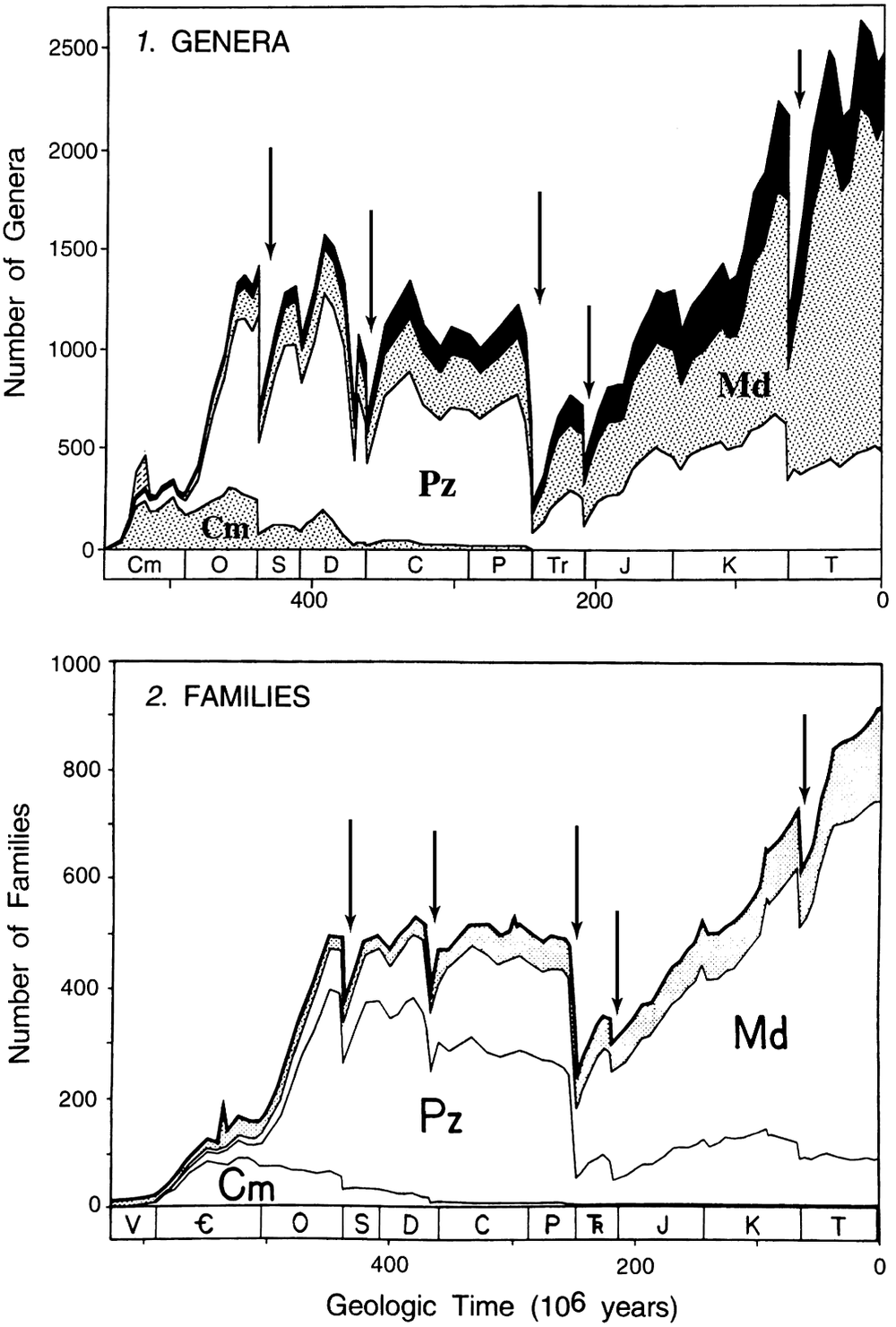
Trilobites appear in the Cambrian, around 521 million years ago, and they appear already diversified, with no known simpler ancestors. This is part of the pattern discussed in the Cambrian explosion capsule.
They were extremely abundant through the Cambrian and Ordovician, and the end-Ordovician extinction removed a large proportion of them.
They declined thereafter without recovering their former diversity, and the last of them died in the end-Permian extinction around 252 million years ago, the most severe extinction in the fossil record.
Their total span of roughly 270 million years considerably exceeds the time since they vanished.
Trilobites are among the best index fossils available, for reasons that follow from their biology.
They were geographically widespread, being marine and often planktonic as larvae. They were abundant, so they are likely to be found. They preserve well. And species were relatively short-lived, changing recognisably over intervals short enough to be useful for dating.
The subdivision of the Cambrian was built substantially on trilobite zones, and their assemblages remain a standard tool for correlating rocks between continents.
They also contributed to the recognition of continental drift. Distinct trilobite faunas found on opposite sides of the present Atlantic, in patterns that make no sense with the continents in their current positions, were among the biogeographical evidence for plate tectonics.
Trilobites provide the clearest long-run record of how a single group changes over hundreds of millions of years, across two mass extinctions, which is a timescale no living group can supply.
Their eyes are also a rare case in which the fossil record preserves the optics of an extinct sensory system directly, rather than requiring it to be inferred from anatomy, because the lenses are mineral and remain in place.