Birds are dinosaurs. The claim was regarded as fringe for most of the twentieth century, and it is now among the best supported conclusions in vertebrate paleontology, established by fossils with feathers preserved on them.
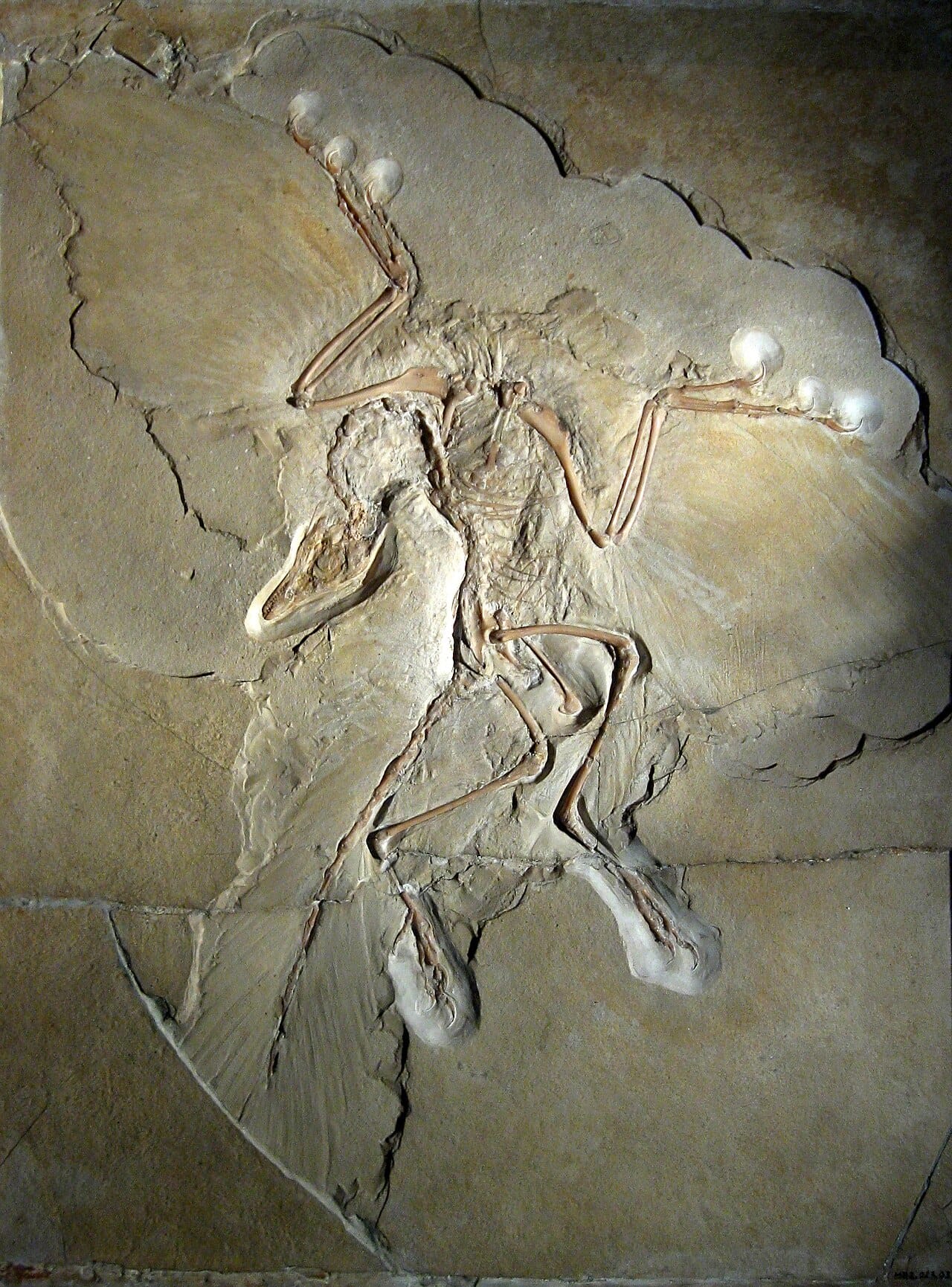
Thomas Henry Huxley noticed the skeletal resemblance between birds and dinosaurs in the 1860s, working from Archaeopteryx, found in Bavaria in 1861. It has feathers and a wishbone like a bird, and teeth, a long bony tail and clawed fingers like a small theropod dinosaur.
The idea was then set aside for most of a century. The influential objection, from Gerhard Heilmann in 1926, was that dinosaurs lacked clavicles and could not therefore have given rise to a group with a wishbone. Dinosaur clavicles were subsequently found, repeatedly, and the objection dissolved, but the conclusion drawn from it outlived it.
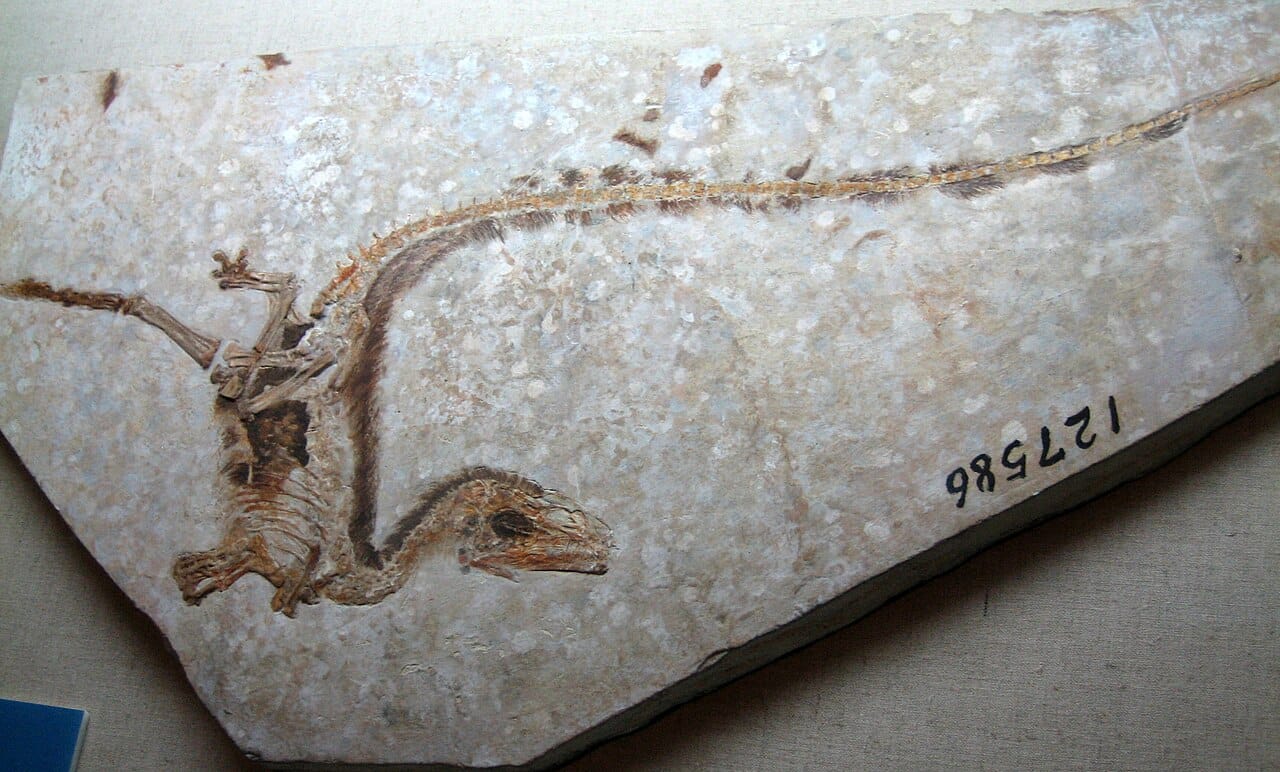
In 1996 a specimen from the Yixian Formation in Liaoning, north-eastern China, was described with a dark halo of filaments along its back and tail. Sinosauropteryx was a small theropod, not a bird, and it had a body covering.
The Liaoning deposits preserve soft tissue in exceptional detail, and over the following decades produced dozens of feathered species across the theropod family tree, and later beyond it. Feathers turned up on tyrannosauroids, on oviraptorosaurs, on dromaeosaurs, and in simpler filamentous form on ornithischians, which sit on the other main branch of the dinosaur tree. That last finding suggests some kind of body covering may be ancestral for dinosaurs as a whole.
Fossil feathers preserve melanosomes, the pigment-bearing structures within the cells that produce them. Melanosome shape correlates with colour in living birds: sausage-shaped for black and grey, spherical for reddish brown.
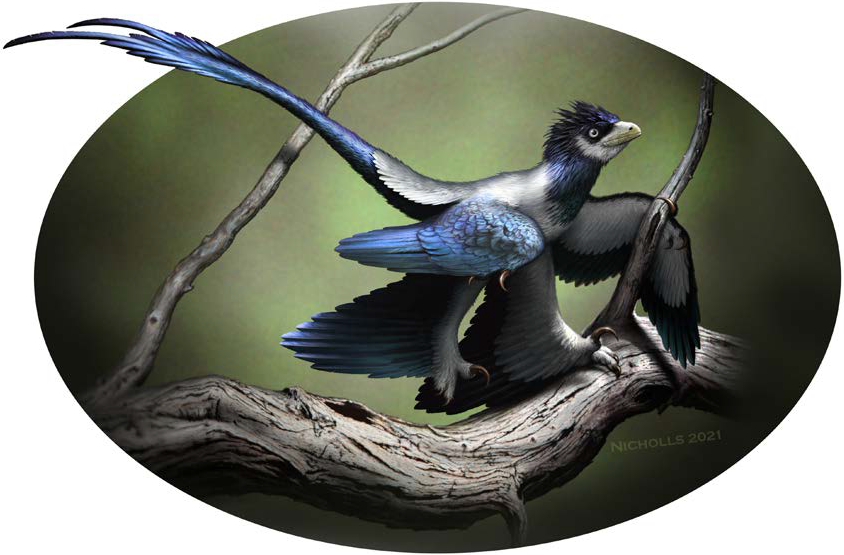
Applying that relationship to fossils has produced pigmentation patterns for several species since 2010. Anchiornis was mapped as grey and black with a reddish crest and white-banded limb feathers. Sinosauropteryx had a reddish brown striped tail and a bandit-like facial mask, together with countershading consistent with living in open habitat.
The distribution of feathers across the family tree makes the sequence clear. Simple filaments appear on animals far too large and too ground-bound to fly, so the earliest feathers cannot have been for flight. Insulation and display are the leading explanations, both well supported by the anatomy.
Complex vaned feathers with asymmetric shape, which is a flight adaptation, appear later and in a narrower group. Flight was assembled from structures already present for other reasons, which is the ordinary pattern of evolutionary novelty rather than an exception to it.
How flight itself began is unresolved. The ground-up account has running animals using feathered forelimbs for thrust or balance; the trees-down account has gliding descent from height. Wing-assisted incline running, observed in living chicks that flap while running up steep surfaces, is a live third possibility with direct behavioural evidence behind it.
A small number of researchers continue to dispute the dinosaurian origin of birds. Their position has not gained ground, and the fossil record has moved steadily against it.