A climate tipping point is a threshold beyond which part of the Earth system shifts into a different state, and does not shift back when the forcing is removed. The concept is well founded in the physics of nonlinear systems. Whether specific tipping points exist, where their thresholds sit, and how close any of them are, is much less settled than public discussion usually suggests.
Most climate responses are roughly proportional: more forcing, more warming. Some are not. A system with a self-reinforcing feedback can pass a point where the feedback sustains the change without further push, and returning to the earlier conditions does not return the system to its earlier state, a property called hysteresis.
The candidates most often listed are the Greenland and West Antarctic ice sheets, the Atlantic overturning circulation, Amazon forest dieback, permafrost carbon release, and coral reef die-off.
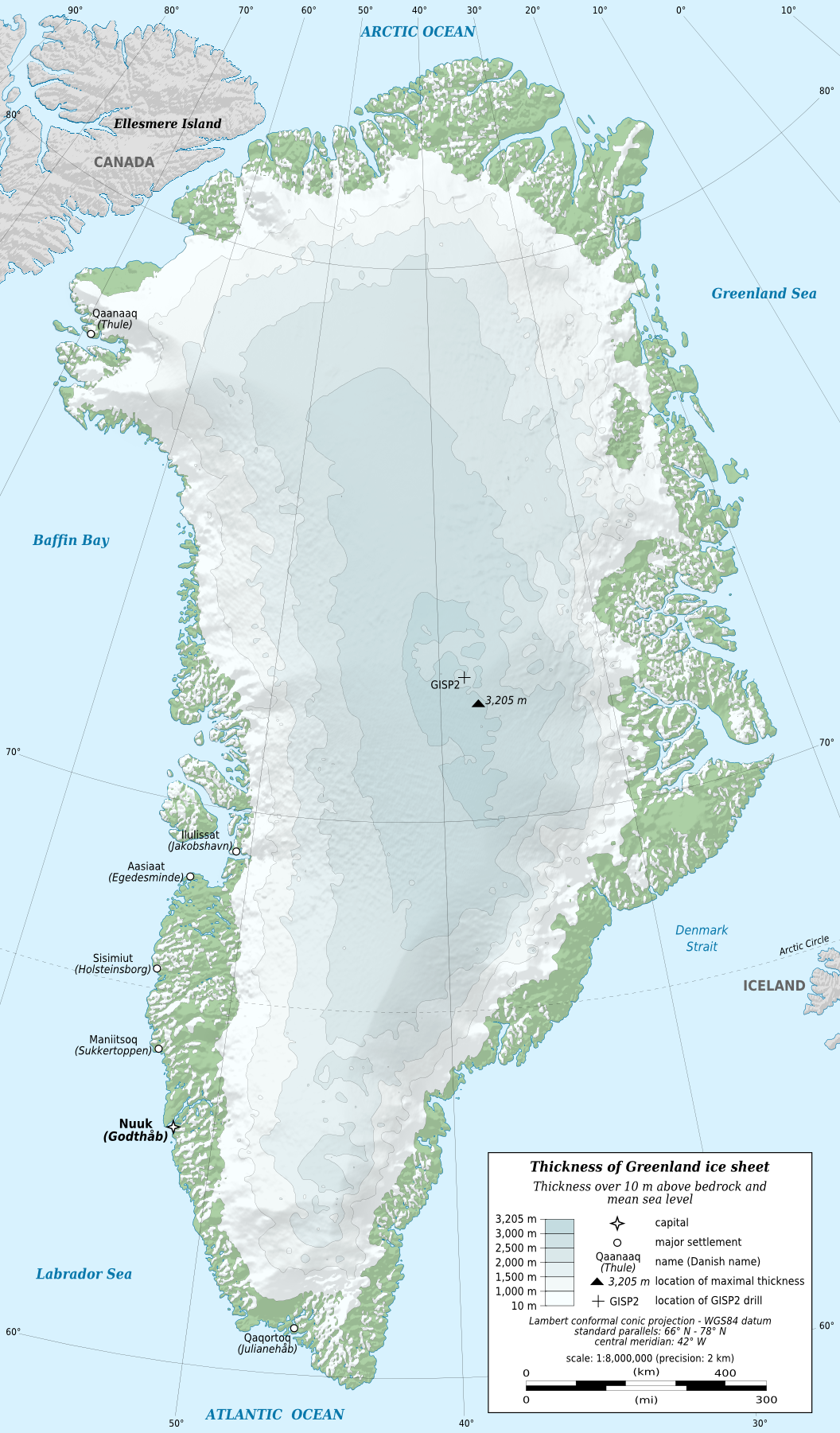
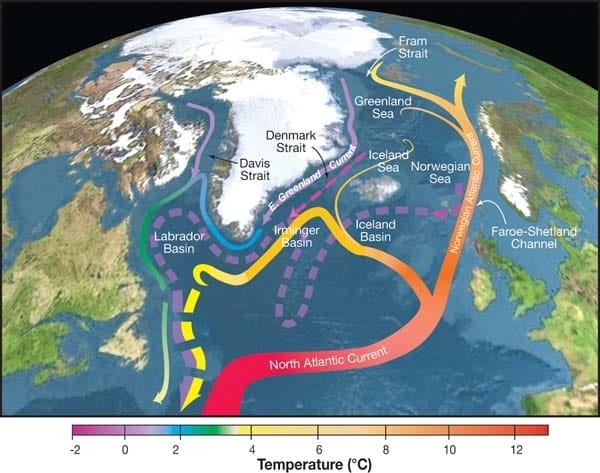
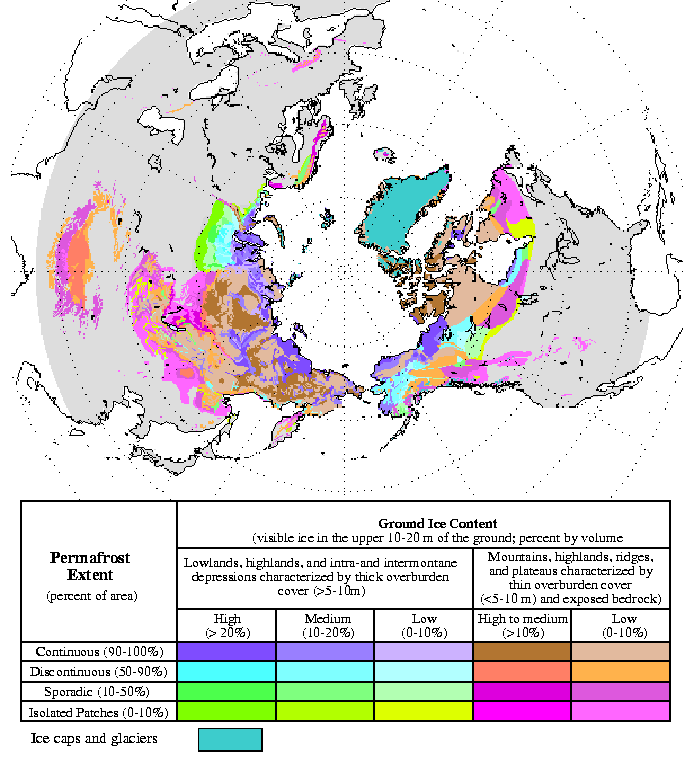
For Greenland the feedback is elevation: as the sheet thins, its surface sits lower in warmer air and melts faster. For the Atlantic overturning circulation the feedback is salinity: freshwater from melting ice dilutes the surface ocean, which slows the sinking that drives the circulation, which changes heat transport, which affects melting. For permafrost it is straightforward: thawing ground releases carbon dioxide and methane, which warms the ground further.
Thresholds are poorly constrained. Published estimates for the same element often span several degrees of warming. A widely cited 2022 assessment placed several thresholds within ranges beginning close to present-day warming, and other researchers regard those central estimates as far more confident than the underlying evidence supports.
Timescales differ enormously from thresholds. Crossing a threshold for the Greenland ice sheet does not mean rapid sea level rise; complete loss would take many centuries to millennia even if the commitment were made now. Conflating an irreversible commitment with an imminent event is the most common misreading, and it runs in both directions, since a slow response is still an irreversible one.
Whether some elements tip at all. The Amazon dieback hypothesis rests on a moisture-recycling feedback whose strength is disputed, and some models show gradual degradation rather than an abrupt shift. For the Atlantic circulation, direct measurement only began in 2004, which is too short a record to establish a trend, and estimates of collapse timing published in recent years have ranged from this century to well beyond it, with the disagreement centring on which proxies are valid.
Cascades. The proposal that one tipping element could trigger another is physically plausible and largely unquantified.
In October 2025 the Global Tipping Points report, assembled by around 160 researchers across 87 institutions, stated that warm-water coral reefs have passed a tipping point: the first time such a claim has been made for a specific system rather than projected for one.
The reasoning is that reef thermal tolerance is exceeded at roughly 1.2 degrees of warming, that observed warming is now above that, and that reefs would continue to decline even if temperature were held at 1.5 degrees. Successive global bleaching events and the scale of mortality recorded since 2023 are offered as the observational basis.
The claim is significant and it is not universally accepted. Coral reefs are the easiest element to declare tipped, because the threshold is low, the response is fast, and the damage is directly observable, none of which is true for ice sheets or ocean circulation. Critics also note that reef systems have recovered from severe mortality before, that thermal tolerance varies substantially between species and populations, and that declaring a system lost carries its own risk of becoming self-fulfilling by redirecting conservation funding away from it.
The same report revised the Amazon threshold downward, placing large-scale transformation to savanna between 1.5 and 2 degrees when deforestation is accounted for alongside warming.
Some researchers hold that tipping language communicates genuine risk of abrupt, irreversible change that gradualist framing obscures. Others argue it encourages fatalism, implies false precision about thresholds nobody can locate, and invites the inference that a missed target means catastrophe is settled, when in reality every increment of avoided warming reduces risk whether or not a threshold exists. Both concerns are held by people who agree entirely on the underlying physics.