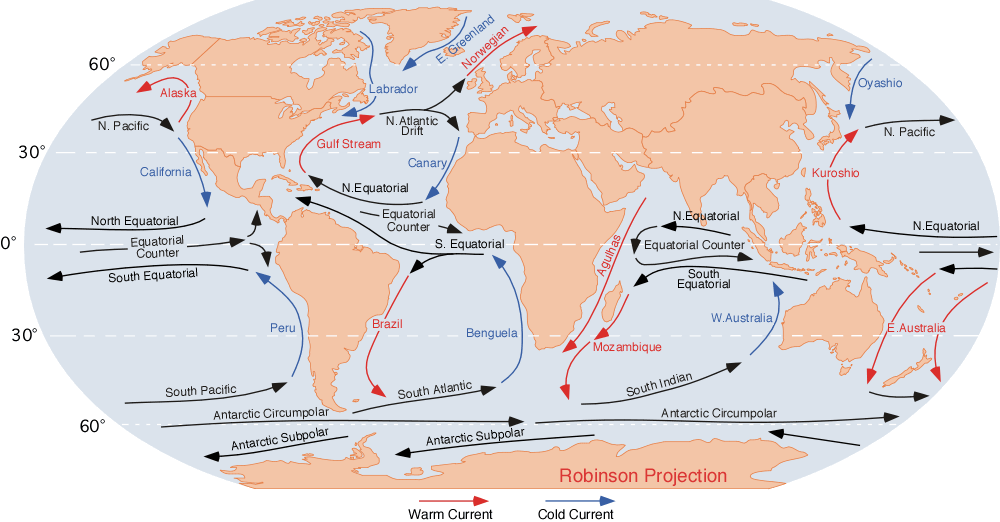
A global system of deep ocean currents driven by differences in water density, which itself depends on temperature and salinity. It moves heat around the planet on a timescale of centuries, and whether it is weakening is one of the more consequential open questions in climate science.
Seawater density rises as it gets colder and as it gets saltier. Where surface water becomes dense enough, it sinks, and water flows in to replace it. That is the engine.
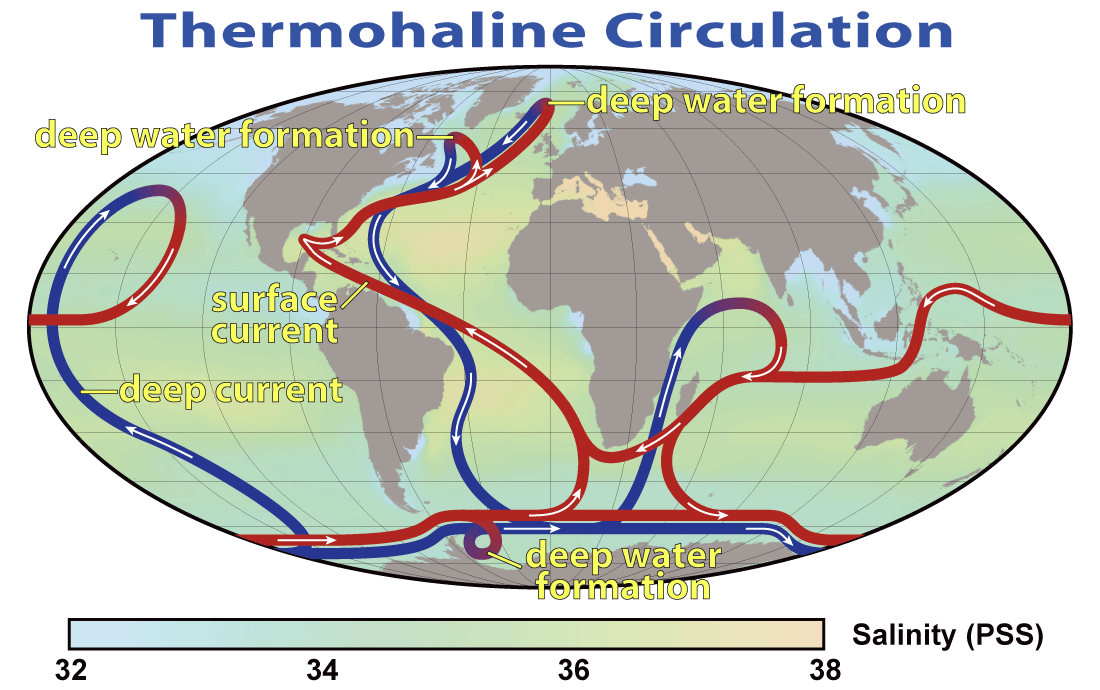
Two regions do most of the sinking. In the North Atlantic, warm salty water arriving from the tropics cools as it travels north, and around Greenland and in the Labrador and Nordic seas it becomes dense enough to descend to depth. Around Antarctica, sea ice formation expels salt into the water beneath it, making it dense enough to sink to the sea floor.
The deep water then spreads through the ocean basins and eventually returns to the surface, largely through wind-driven upwelling and mixing. A complete circuit takes roughly a thousand years.
The name is slightly misleading. Wind and tides supply much of the energy that mixes deep water back upward, so the circulation is not driven by density differences alone, and oceanographers increasingly prefer to describe the Atlantic portion by its measured overturning rather than by the older term.
The Atlantic Meridional Overturning Circulation is monitored continuously by an array of moored instruments across the ocean at 26 degrees north, operating since 2004. It measures transport directly rather than inferring it.
The array records an average northward transport of roughly 17 million cubic metres per second, with large variation between months and years. The heat carried is on the order of a petawatt, which is a substantial fraction of what northwest Europe receives and is why the region is warmer than its latitude would suggest.
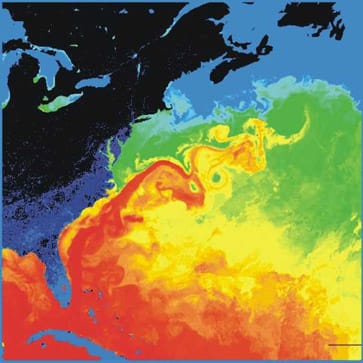
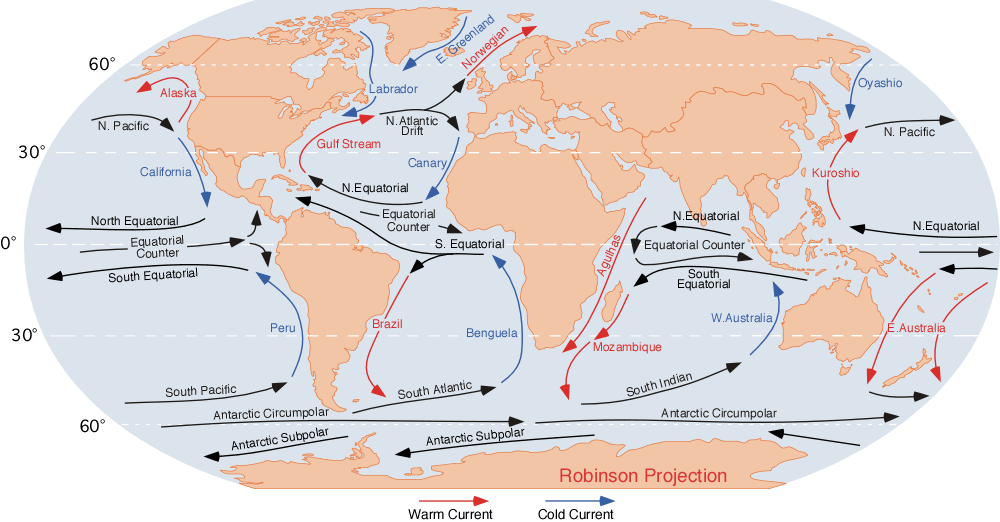
The common statement that the Gulf Stream keeps Europe warm needs care. The Gulf Stream is mostly wind-driven and would continue without the overturning. The overturning contributes an additional northward heat transport on top of it, and modelling work suggests the difference in European temperature attributable to the ocean is real but smaller than popular accounts imply.
Adding fresh water to the North Atlantic reduces salinity and therefore density, which should reduce sinking. Greenland ice loss and increased precipitation both do this, so a weakening is expected on physical grounds.
Whether it has happened is harder, and the answer has moved. For most of the array's lifetime the direct record showed large swings without a trend separable from them.
That position has weakened. Analysis published in 2025 covering moorings at four latitudes along the western boundary, spanning the two decades since 2004, reported weakening at all of them, which is a stronger statement than any single-latitude record supports. Separate work identified a physical fingerprint of slowdown in mid-depth warming of the equatorial Atlantic, between roughly one and two kilometres down, which is a signature that does not depend on the mooring array at all.
Longer reconstructions use proxies: sea surface temperature patterns, deep sea sediment grain sizes indicating current speed, and coral records. Several indicate weakening over the twentieth century, with one widely cited estimate of about fifteen percent since the mid twentieth century, and a suggestion that the circulation is now at its weakest in a millennium.
The disagreement is still real. A high-resolution model study reported a weak twenty-first century response to Greenland meltwater, and a 2024 Nature paper argued the circulation continues even under climate extremes. Coarse models may exaggerate the sensitivity, and the observational record remains short. What has changed is the burden of argument: the null position that nothing measurable is happening is now harder to hold than it was.
Paleoclimate records show the circulation has changed abruptly before. Dansgaard-Oeschger events during the last glacial period involved Greenland temperature changes of several degrees within decades, and are generally attributed to shifts in North Atlantic overturning.
Models indicate a threshold beyond which the circulation could switch to a substantially weaker state and stay there, because the weakened state carries less salt north and so sustains itself. Where that threshold sits, and how close current conditions are to it, is not known with any confidence.
Assessments by the Intergovernmental Panel on Climate Change consider a complete collapse this century unlikely while stating medium confidence that the circulation will weaken. Several individual studies published since 2023 have argued for a much nearer-term risk, and have been contested on their statistical methods.
Two more recent lines are worth separating from that dispute because they concern reversibility rather than timing. Work published in 2025 proposed physically motivated indicators for the onset of a collapse, intended to replace the statistical early-warning signals that drew most of the criticism. And modelling published in 2026 argued that a collapsed circulation would not recover while atmospheric carbon dioxide remained above roughly 350 parts per million, a level already passed in the late 1980s and now exceeded by a wide margin. If that result holds, the question is not whether the system would come back but whether it goes at all.
The consequences of a collapse would be severe and not confined to the Atlantic: substantial cooling in northwest Europe, shifts in tropical rainfall belts affecting monsoon systems, and regional sea level rise along the North American east coast. That is what makes an unresolved question about an ocean current a matter of general interest.