The ocean absorbs roughly a quarter of the carbon dioxide released by human activity, and dissolved carbon dioxide makes seawater more acidic. The chemistry is simple and unambiguous, the measurement is direct, and the biological consequences are the part still being worked out.
Carbon dioxide dissolving in seawater forms carbonic acid, which releases hydrogen ions and lowers pH. The hydrogen ions also react with carbonate ions, reducing the amount available for organisms that build shells and skeletons from calcium carbonate.
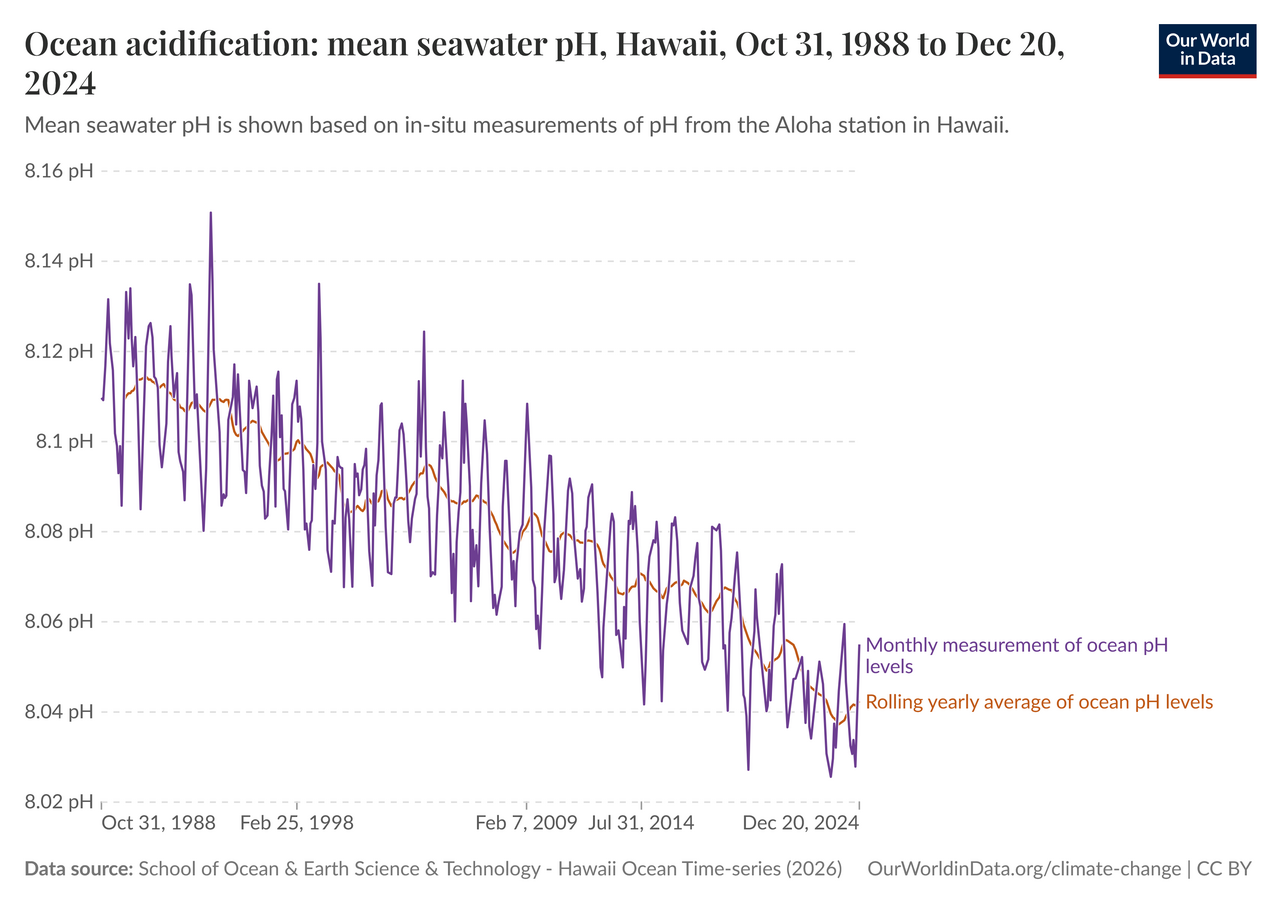
Average surface pH has fallen from about 8.2 before industrialisation to about 8.1. Because the scale is logarithmic, that is around a thirty percent increase in hydrogen ion concentration. The ocean remains alkaline; acidification describes the direction of change, not the arrival at a pH below 7, and the term is sometimes objected to for that reason.
The measurement is not in doubt. Time series at Hawaii and Bermuda have tracked ocean chemistry continuously since the 1980s and show pH falling in step with rising atmospheric carbon dioxide, at a rate matching what the chemistry predicts.
Ocean uptake has slowed warming considerably: without it, atmospheric carbon dioxide would be substantially higher. That service comes at the cost of the chemical change, which is why acidification is often described as the other carbon problem.
It is independent of temperature. Even if warming were somehow prevented, the chemistry would proceed as long as carbon dioxide concentrations rose, which means it cannot be addressed by any measure that does not reduce emissions.
Organisms building calcium carbonate structures face rising energetic costs as carbonate becomes scarcer, and in sufficiently undersaturated water their structures dissolve.
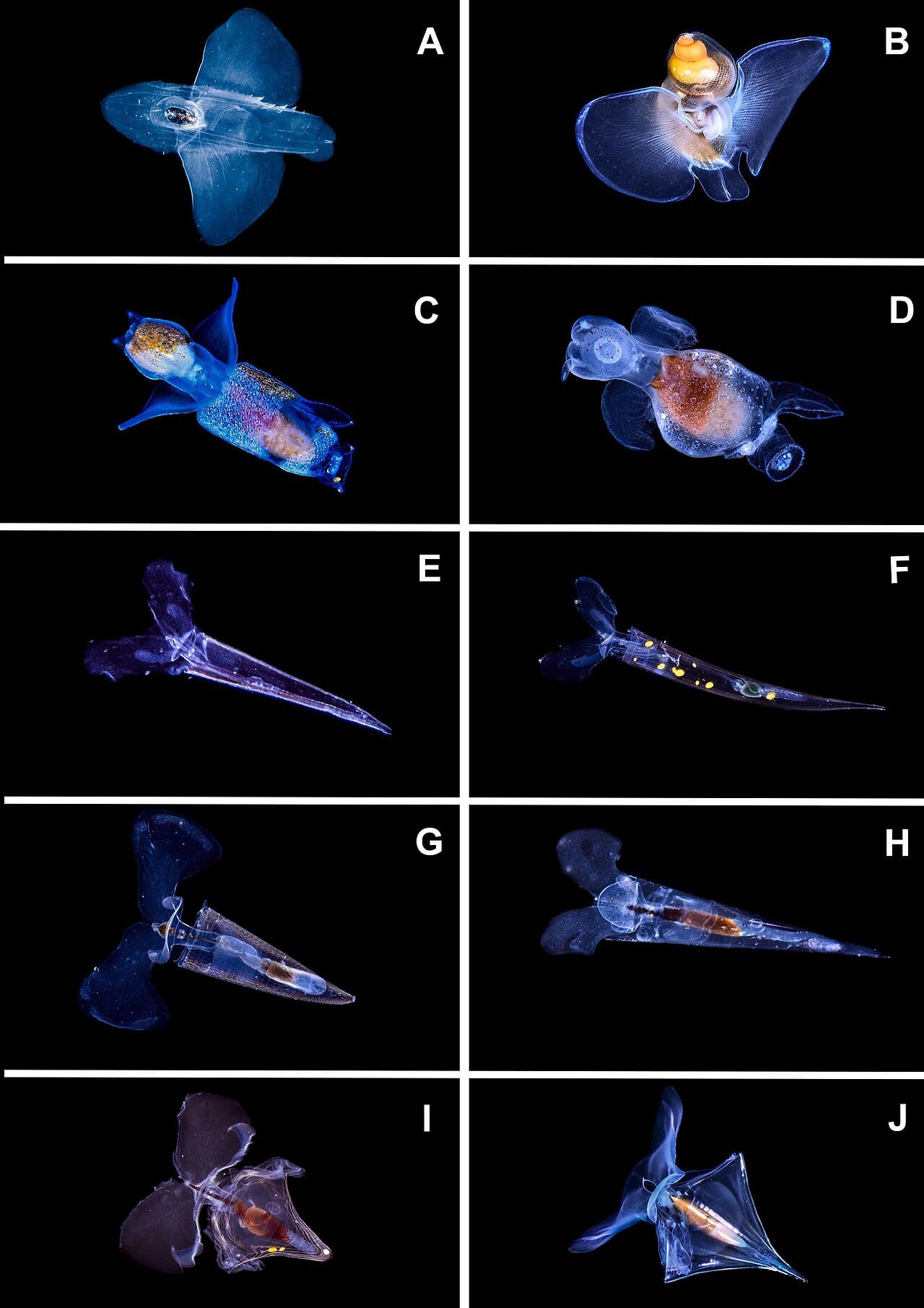
Pteropods, small free-swimming sea snails, are among the clearest cases. Their shells are aragonite, the more soluble form of calcium carbonate, and are thin. Shell dissolution has been observed in pteropods collected from waters off the North American west coast where upwelling brings naturally low-pH water to the surface, and the affected area has expanded.
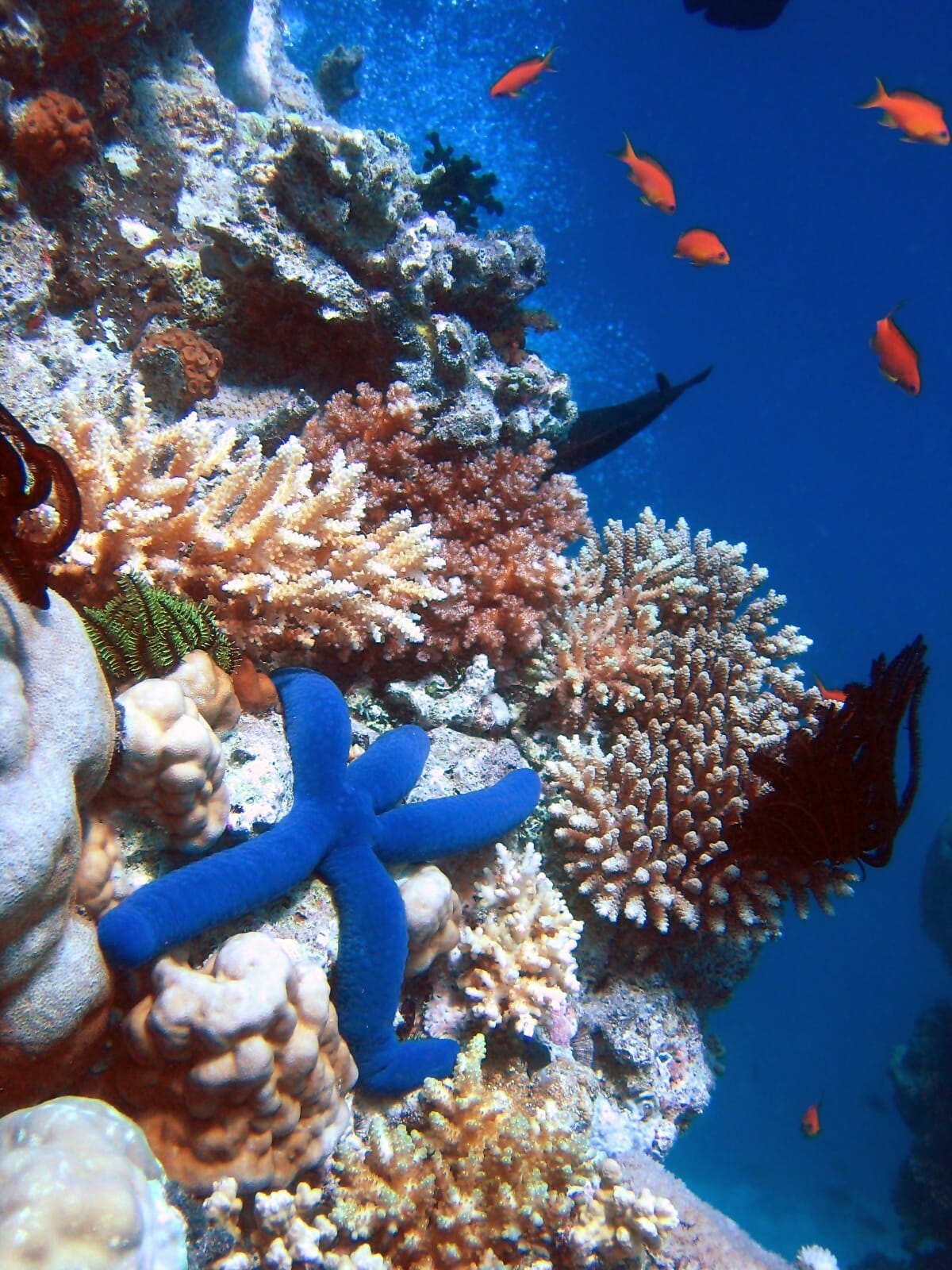
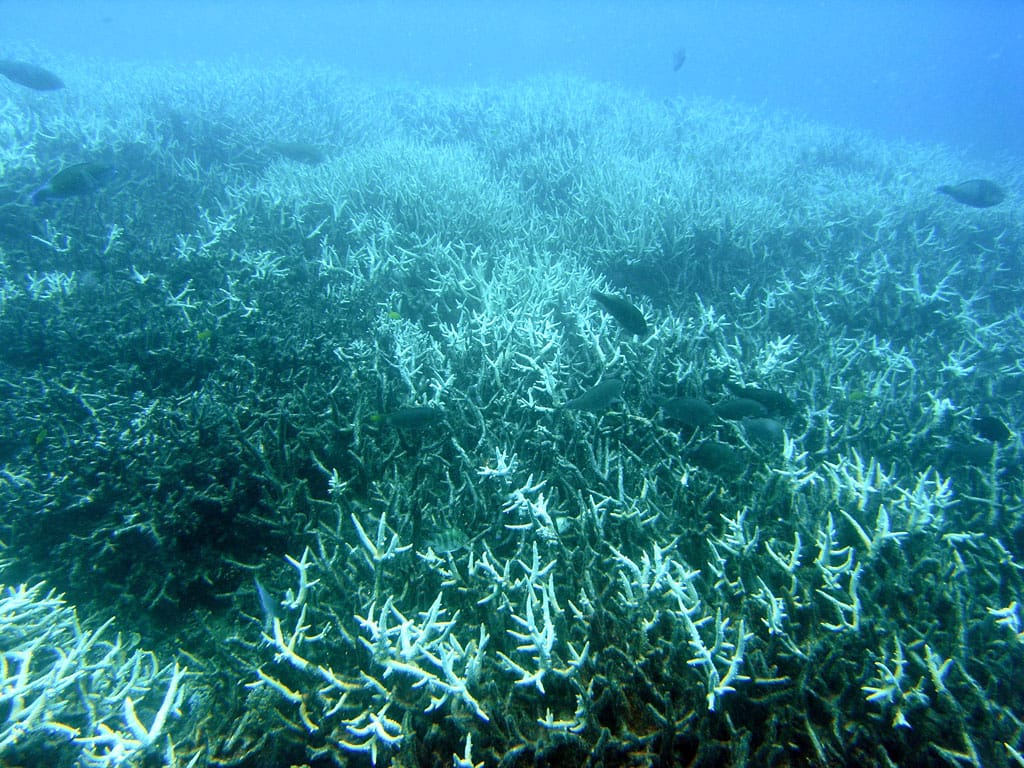
Coral reefs face reduced calcification rates, which slows growth and weakens structures against storms and erosion.
Commercial shellfish have already been affected. Oyster hatcheries in Oregon and Washington suffered severe larval mortality from 2007, traced to upwelled low-pH water, and now monitor incoming seawater and buffer it, which is a direct operational response to a chemical change.
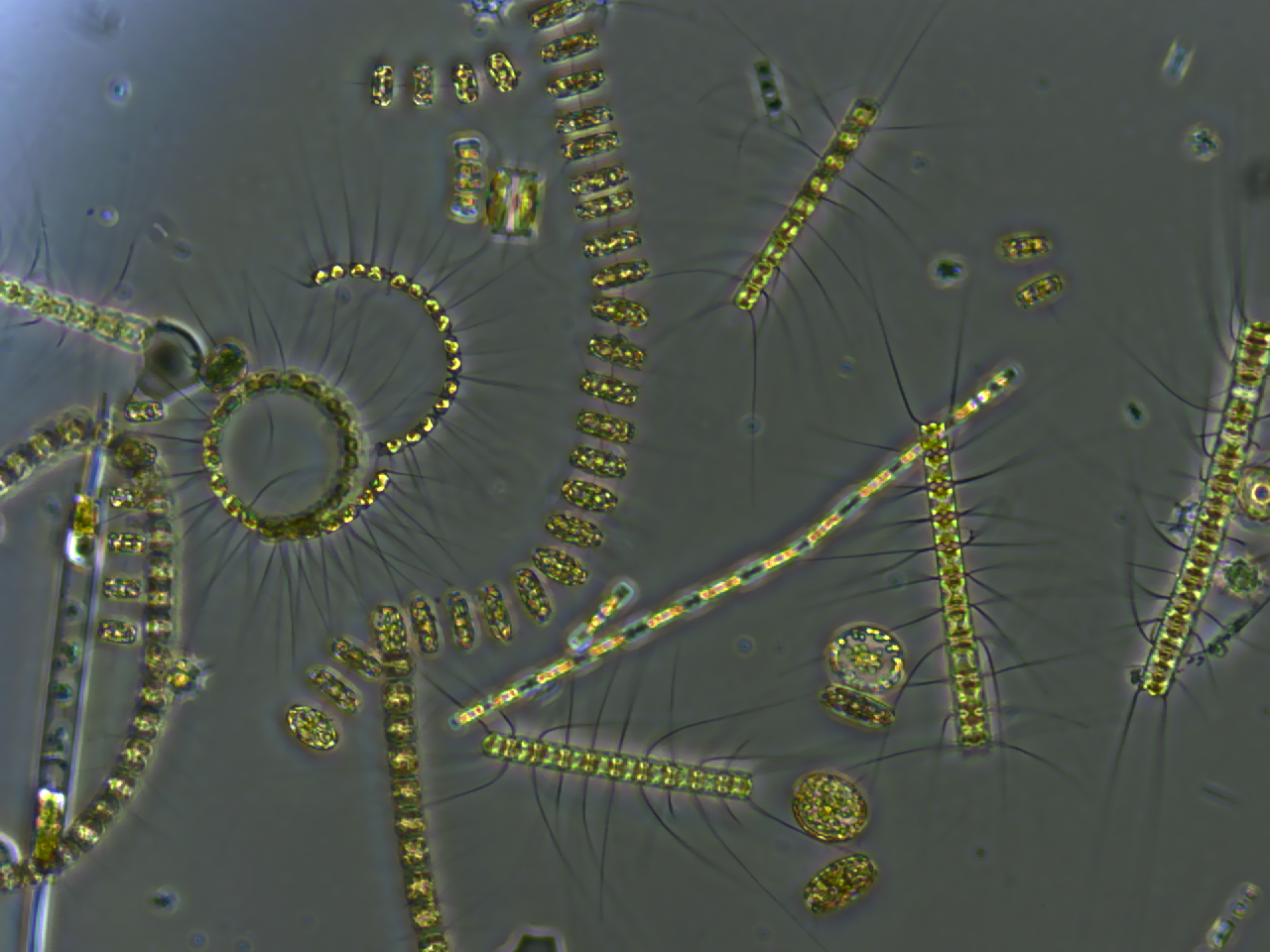
Coccolithophores and foraminifera, which are microscopic and enormously abundant, respond variably, and their response matters disproportionately because they are the base of food webs and a major route by which carbon reaches the deep ocean.
Laboratory experiments are numerous and their results are mixed. Many species show reduced calcification, some show none, and a few calcify faster under moderate elevation. Some organisms adapt across generations, and some populations already living in naturally variable environments prove more tolerant.
Methodological problems are widespread and acknowledged within the field. Many early experiments used carbon dioxide levels far beyond any plausible projection, changed conditions abruptly rather than gradually, ran for a single generation, and studied organisms in isolation from their ecosystems. A 2020 replication attempt failed to reproduce a widely reported finding that acidification disrupts fish behaviour, which prompted a broader reassessment of methods and of publication practices in the area.
The direction of the chemical change is certain and the vulnerability of aragonite-forming organisms is well established. The magnitude of ecosystem-level consequences, and how much adaptation will offset them, is where competent researchers disagree.
In 2025 an assessment against the planetary boundaries framework concluded that ocean acidification has passed its boundary, making it the seventh of nine to be declared crossed, alongside climate change, biosphere integrity, novel entities, land system change, freshwater use and biogeochemical flows.
The finding rests on work reporting that by 2020 average global ocean conditions had already entered the boundary's uncertainty range, and that the subsurface ocean is further past it than the surface, with a substantial fraction of water down to two hundred metres beyond the threshold. That the deeper water is worse affected matters, because much of the calcifying life that the boundary is meant to protect lives below the surface layer.
The planetary boundaries framework is itself contested. Critics argue that the boundary values are chosen with considerable judgement, that a single global threshold obscures enormous regional variation, and that declaring a boundary crossed communicates a precision the underlying science does not have. Defenders reply that the framework was always intended as a risk assessment rather than a measurement, and that the direction and rate of change are not in question even where the threshold value is.
The chemistry is not what is being argued about here. What is argued is whether a global number is the right way to describe it.
Polar waters acidify fastest, because cold water dissolves more carbon dioxide, and parts of the Arctic and Southern Ocean are projected to become undersaturated with respect to aragonite within decades.
Geological comparison offers a warning rather than a precedent. The Paleocene-Eocene Thermal Maximum, about 56 million years ago, involved a large carbon release accompanied by ocean acidification and extinction among deep sea foraminifera. Current emissions are proceeding roughly an order of magnitude faster, which leaves less time for the ocean's slow buffering by rock weathering to keep pace.