Communication by coded electrical signal over wires. It was the first technology to separate the speed of a message from the speed of travel, and that separation changed news, finance, war and empire within about two decades.
For all of history before it, a message travelled at the speed of a person, a horse or a ship. Distance and delay were the same thing.
The telegraph broke that. A message reached the other end of a wire effectively instantly, which meant that for the first time information could arrive somewhere before anyone travelling from its origin could.
The consequences were immediate and are easy to underestimate now. Prices in two markets could be compared before either had moved. A government could give an order to a distant official and receive a reply the same day. A newspaper could report an event that had happened that morning a thousand kilometres away.
Optical telegraphs preceded electrical ones and achieved part of the effect. The Chappe system in France, from the 1790s, used semaphore arms on towers within sight of each other and relayed messages across the country in hours. It required daylight, clear weather and a staffed tower every few kilometres, and it was expensive to run.
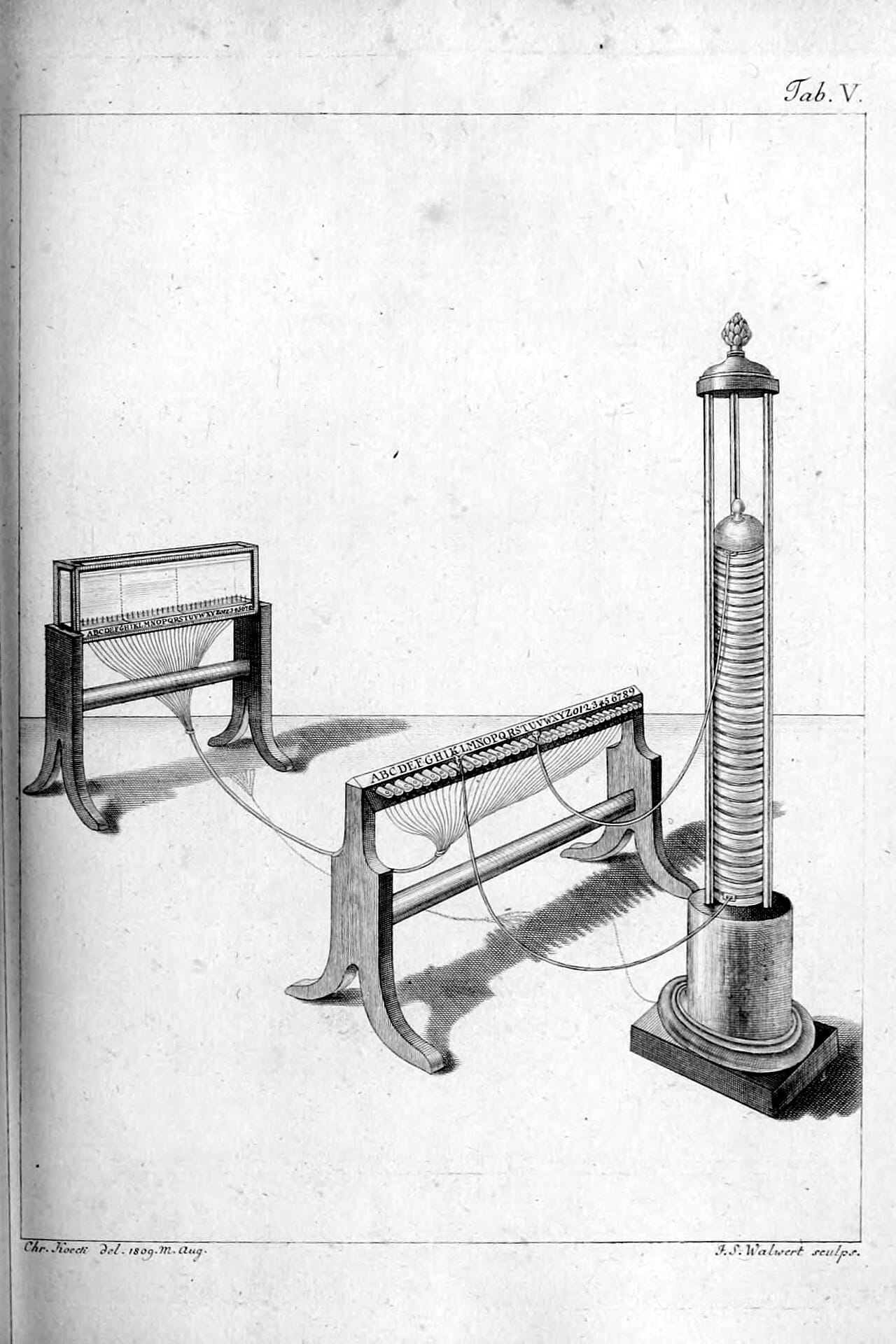
The physical basis is that a current in a wire deflects a magnet, discovered by Ørsted in 1820 and treated in the electromagnetism capsule.
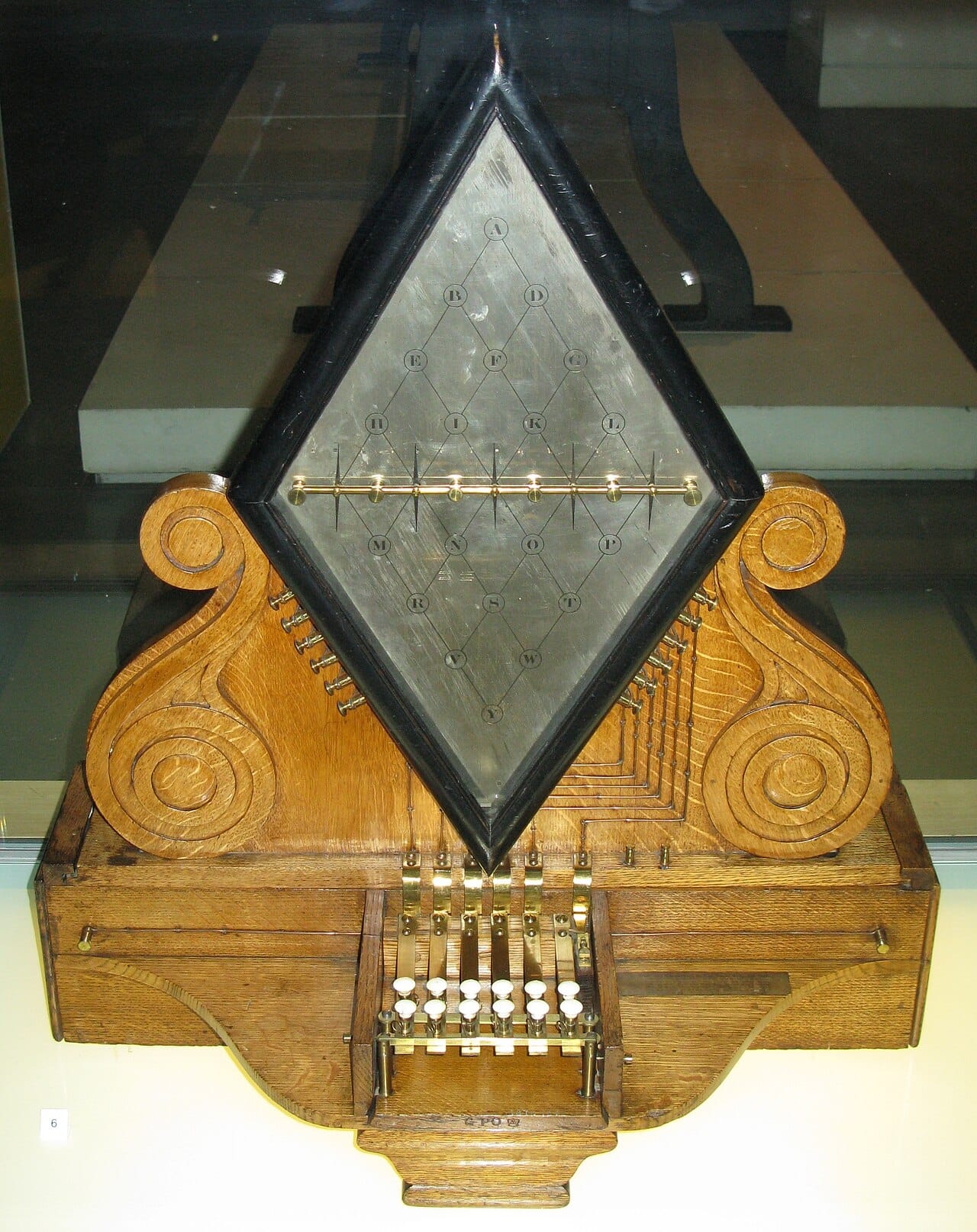
Cooke and Wheatstone's system, patented in 1837 in Britain, used needles that deflected to point at letters on a dial. It required no code to be learned, which made it easy to operate, and it required several wires.
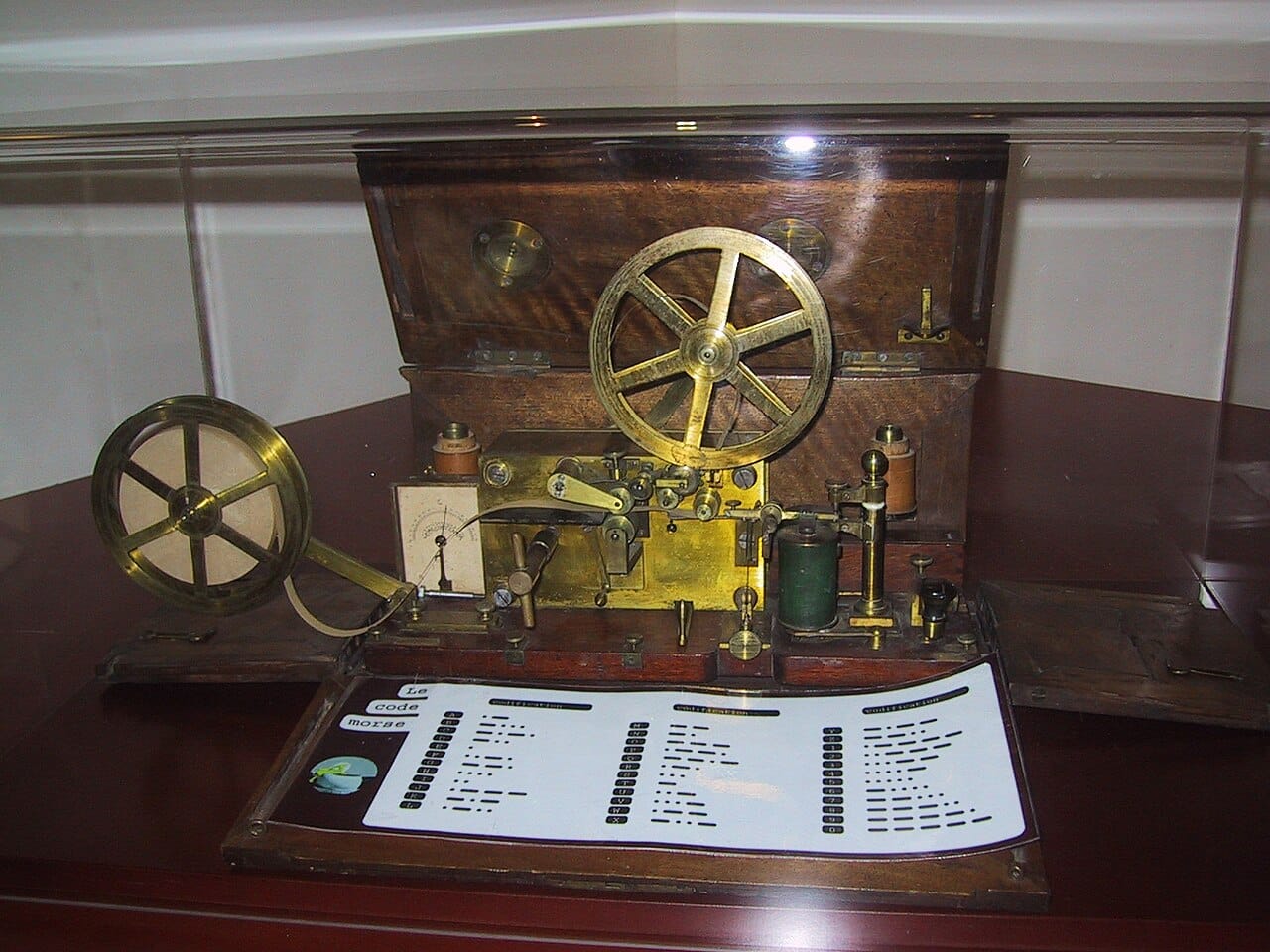
Morse and Vail's system used a single wire and a code of short and long signals. It required operators to learn the code and it was far cheaper to build, and it became the international standard.
Morse code was designed with attention to frequency. The commonest letters have the shortest codes, E being a single dot and T a single dash, which is the same principle later formalised in information theory as efficient encoding.
Relays solved distance. A signal weakens along a wire, and a relay uses the weak signal to switch a fresh local current, regenerating it. This made arbitrarily long lines possible and is conceptually the ancestor of the repeater and of the switching element in every digital circuit since.
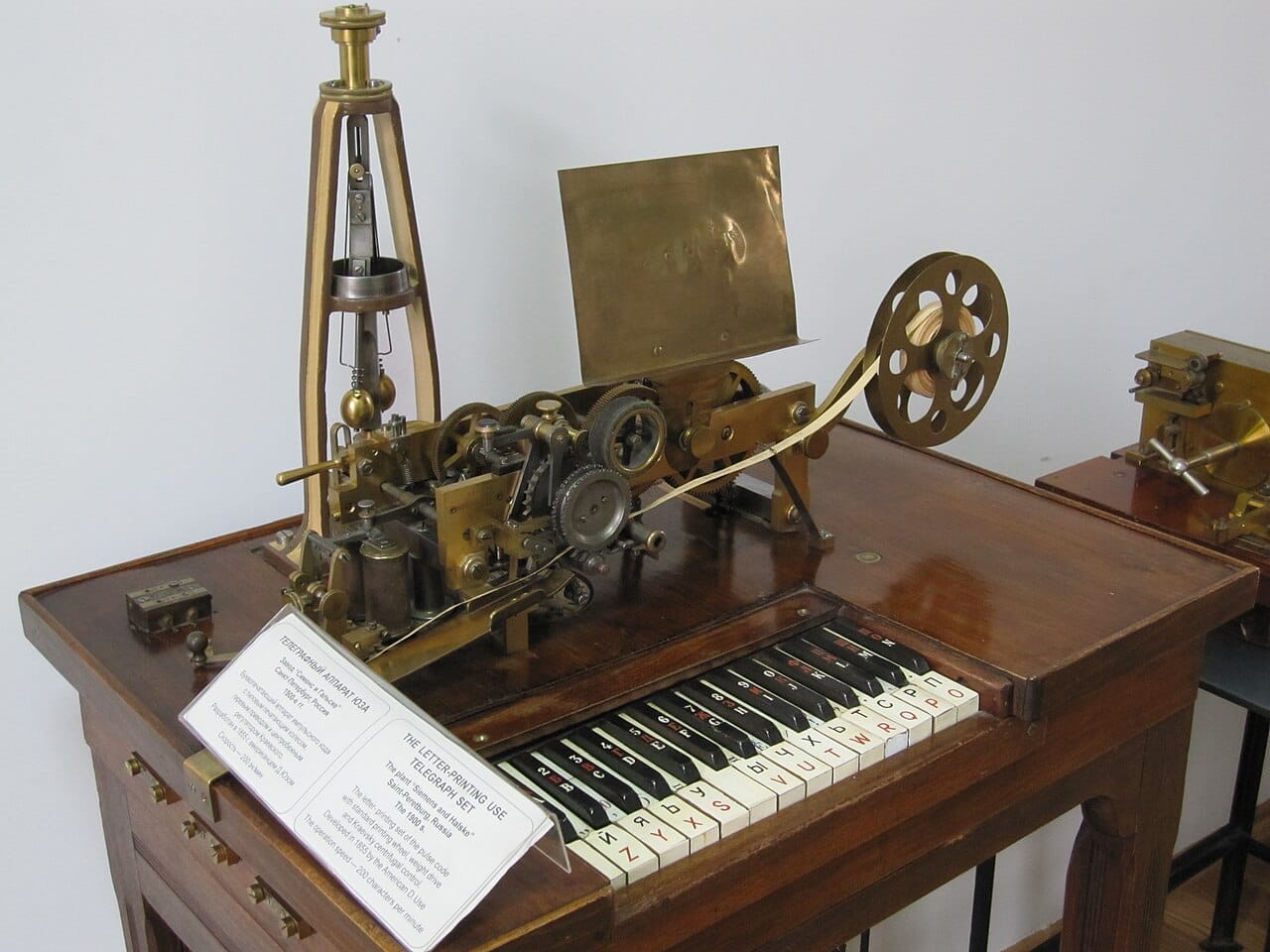
Printing telegraphs and later teleprinters removed the skilled operator at the receiving end, and stock tickers of this type gave financial markets continuous price feeds.
Submarine cables extended the network across water, and the technical problems were severe: insulation, laying without breaking, and signal distortion over great length.
Gutta-percha, a natural latex that is rigid at ordinary temperatures and softens when heated, proved to be the insulator that worked underwater, and demand for it substantially depleted the trees it came from.
The first transatlantic cable was completed in 1858, worked poorly for about three weeks and failed, partly because excessive voltage was applied in an attempt to improve a weak signal. A working cable followed in 1866 after the intervening years produced a proper theoretical understanding of signal propagation.
The effect on transatlantic communication was to reduce message time from around ten days to minutes.
Cables became strategic infrastructure. Britain controlled the majority of the world network, which conferred an intelligence advantage exercised immediately in 1914 when German cables were cut, and the pattern of undersea cable control remains geopolitically significant with fibre optics carrying almost all international traffic today.
News became an industry of speed. Wire services including Reuters and the Associated Press were built on telegraph access, and the cost of transmission by the word produced a compressed, factual writing style that shaped journalism lastingly.
Financial markets integrated. Price differences between distant exchanges collapsed once they could be observed in real time, and arbitrage became a matter of communication speed, which it has remained.
Railways depended on it operationally. Single-track lines require knowing where trains are, and telegraph signalling made that possible, which is why the two networks were built alongside each other.
Warfare changed. Commanders could direct distant forces and were also subject to direction from capitals, which reduced the autonomy that distance had previously guaranteed to field officers.
Empire was administered by it. Instructions that had taken months to reach colonial officials took hours, which tightened metropolitan control considerably.
Standard time followed partly from telegraphy as well as from railways, since a telegraph makes simultaneity observable and therefore makes differing local times a visible problem.
The telegraph established the pattern every later communication technology has followed: a network with switching, coded signals, repeaters, standard protocols and international agreements about how they interconnect. The International Telegraph Union, founded in 1865, still exists as the International Telecommunication Union.
It also produced the first version of an argument that has recurred with every network since. Contemporaries claimed it would end war by making nations understand each other, and it did not, which is worth remembering each time a new medium is credited with the same power.