Violent crime fell steeply across most of the developed world from the early 1990s, in some countries by more than half. The fall is one of the best documented social changes of the period, and there is no agreed explanation for it.
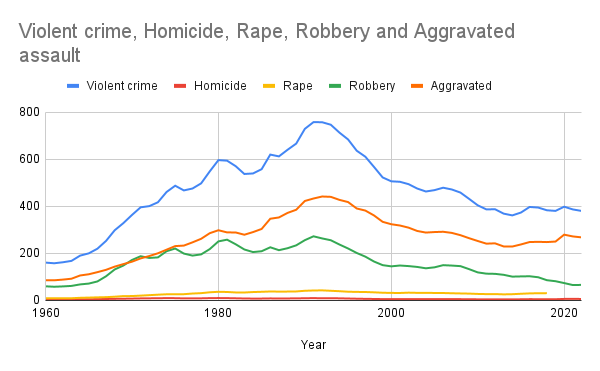
United States homicide roughly halved between 1991 and 2014. Property crime fell further. The pattern appears in police records and, importantly, in victimisation surveys, which ask people directly whether they were victims and are not affected by changes in reporting or police practice. Both show the same decline, which rules out the possibility that it is an artefact of recording.
The fall was not American. Canada, the United Kingdom, France, Germany, Australia, Japan and most of western Europe recorded declines over a similar period, with different starting points and different timing. Any explanation confined to one country therefore has a problem: whatever it identifies would have to have happened everywhere.
New York City's decline was unusually steep and unusually publicised, and the police strategies of the period were widely credited with it.

The difficulty is that cities which did none of it fell too. San Diego reduced its police force and saw comparable declines. Canadian cities with quite different policing fell in parallel. The consensus position is that policing changes contributed something, particularly targeted deployment to high-crime locations, for which the evidence is reasonably good, and that they cannot account for a decline that occurred across countries with unrelated policing.
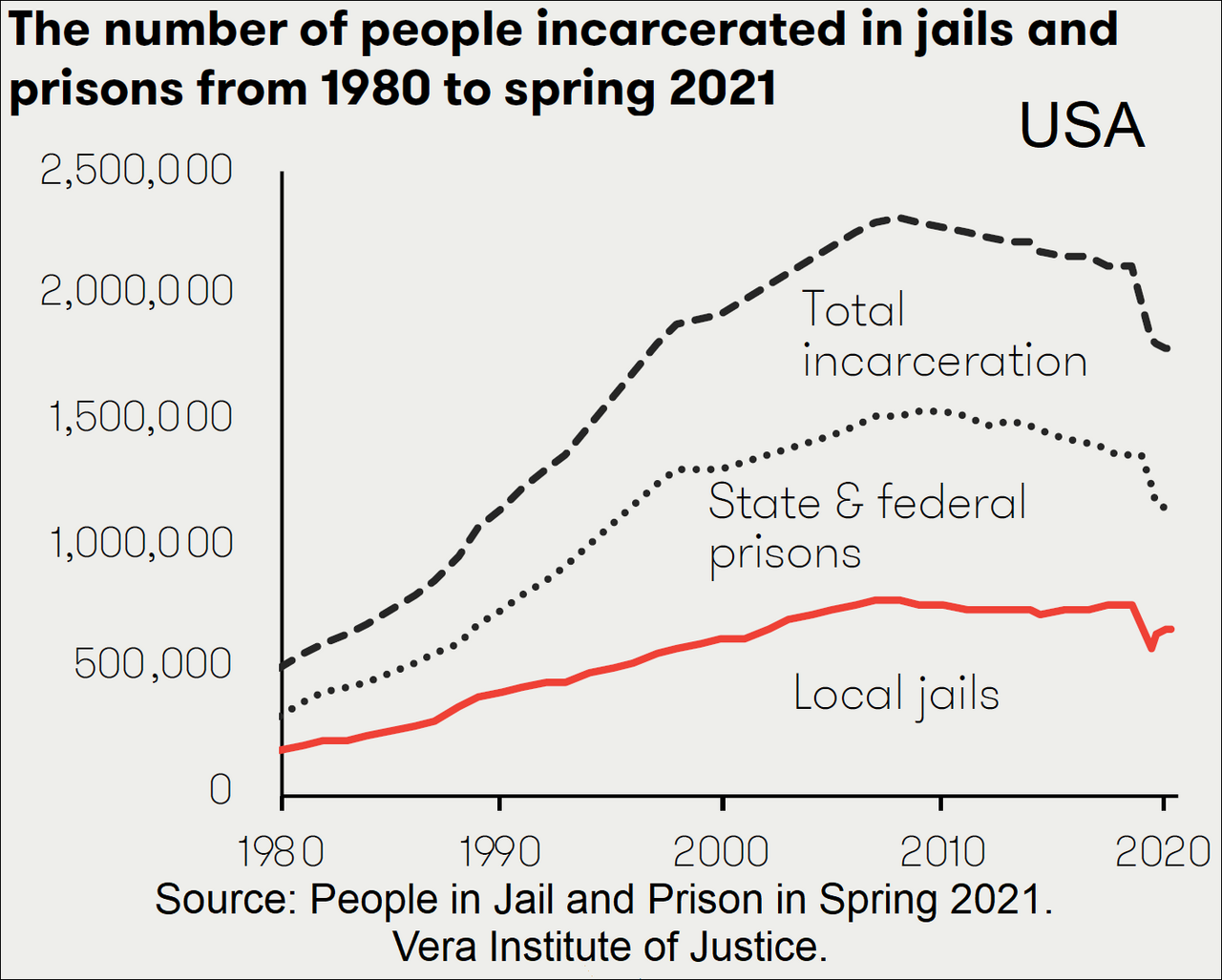
The United States prison population quadrupled from the 1970s. Incapacitation removes people who would otherwise offend, so some effect is expected.
Most estimates attribute between a tenth and a quarter of the American decline to incarceration, with sharply diminishing returns: as imprisonment expands it reaches people less likely to offend, while the disruption to families and communities may increase offending in the longer run. And once again, countries that did not raise imprisonment, including Canada and much of Europe, saw the same fall.
Lead removal from petrol and paint is the most striking correlation, with childhood exposure tracking offending rates roughly two decades later across many countries. It is treated separately in the capsule on the lead-crime hypothesis; the case is stronger than most and is not settled.
Legalised abortion following Roe v Wade was proposed by John Donohue and Steven Levitt in 2001 as reducing the number of unwanted children reaching offending age. The finding attracted immediate methodological criticism, including a coding error identified in 2005, and the effect survives in some reanalyses and not others.
The end of the crack epidemic explains the American timing well, and does not apply elsewhere.
Better security is the most mundane explanation and possibly the strongest for property crime. Immobilisers made car theft difficult, and car theft fell furthest of any category. Alarms, CCTV and cash handling changes followed the same pattern. Improved emergency medicine turns some assaults that would once have been homicides into woundings.
Demographic change, falling alcohol consumption among the young, and the movement of teenage social life onto screens and away from streets have all been proposed and none is well quantified.
The honest position is that no single cause accounts for the fall and that the contributions cannot currently be separated. Many small effects arriving together across many countries is the most likely shape of the answer, and it is a shape that resists measurement.
The uncertainty matters practically, because policies were adopted on the strength of claimed credit for a decline that was happening anyway. That is the strongest reason for describing the question as open rather than resolved.