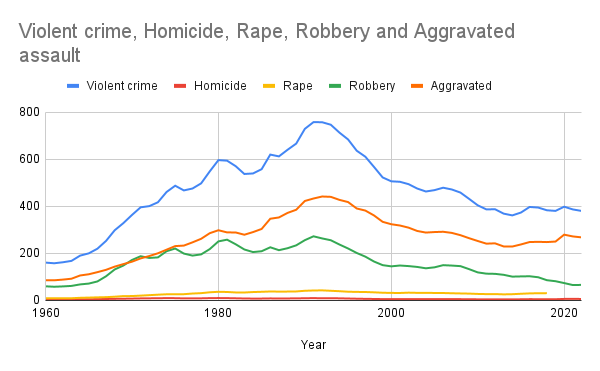
The proposal that childhood exposure to lead, principally from leaded petrol, raised violent crime rates a generation later, and that removing it is a major cause of the crime decline. It has an unusually good correlation behind it and an unresolved problem with causal proof.

Lead is a neurotoxin with no known safe level of exposure. In children it lowers IQ, and it damages the prefrontal cortex, which governs impulse control, planning and the regulation of aggression. These findings are established, are not disputed, and are the mechanism the hypothesis proposes.
Tetraethyllead was added to petrol from 1923 as an anti-knock agent. Its toxicity was known immediately: workers at the plants producing it died in the first year. It was phased out in the United States between 1975 and 1996, and elsewhere at different times, which is what makes the natural experiment possible.
Rick Nevin published the first systematic version in 2000, and Jessica Wolpaw Reyes developed it with American state-level data in 2007.
The pattern is that leaded petrol consumption tracks violent crime with a lag of about twenty years, which is roughly the interval between exposure in early childhood and peak offending age. The correlations are high, and they hold across countries that phased lead out at different times, with crime turning down in each at the corresponding interval afterwards.

That international variation is the strongest part of the case. A confounder would have to have moved in step with each country's own phase-out schedule, which is a demanding requirement.
Reyes estimated that lead removal accounted for over half the American decline in violent crime during the 1990s. Later estimates are generally lower.
The correlation is ecological, comparing group-level rates rather than individuals, and ecological correlations are unreliable for causal claims. Areas with high lead exposure were also poorer, more polluted, more segregated and worse served by schools, and those factors have their own long lags.
The effect sizes are hard to reconcile. Moving from the measured effect of lead on individual behaviour to the size of the aggregate crime decline requires the relationship to be strong at the population level, and some analyses find the implied magnitude larger than the individual-level evidence supports.
Publication and specification issues affect the literature. A 2022 meta-analysis by Anthony Higney and colleagues found evidence of publication bias in the lead-crime literature and reported that the effect, while present, was substantially smaller than headline estimates once corrected.
And the crime decline has many other candidates, treated in the capsule on the great crime decline. Several correlate well over the same period, and correlating well is exactly what is not sufficient here.
Studies following individuals rather than areas provide the most useful evidence, and they are fewer.
A Cincinnati cohort followed from birth with repeated blood lead measurements found higher childhood lead associated with more arrests in adulthood, including for violent offences, after adjustment. Work using Swedish and Danish registry data has found associations with delinquency. A New Zealand cohort study found associations with some outcomes and not with criminal conviction.
The individual-level findings are real but more modest than the aggregate correlations, which is the central tension in the field.
The mechanism is established, the exposure is documented, the timing fits across many countries, and individual studies support a real effect. What is missing is a way to separate the contribution of lead from everything else that changed, and no design currently available does that cleanly.
The practical conclusion does not depend on resolving it. Lead removal was justified by the developmental harm alone, and remaining exposure, in old paint, water pipes, aviation fuel and contaminated soil, is worth eliminating whether or not it affects crime.