The proposal that a crime requires three things to converge in space and time: someone motivated to offend, a suitable target, and the absence of anyone able to prevent it. It shifts the explanation of crime from why people offend to why offences happen where and when they do.
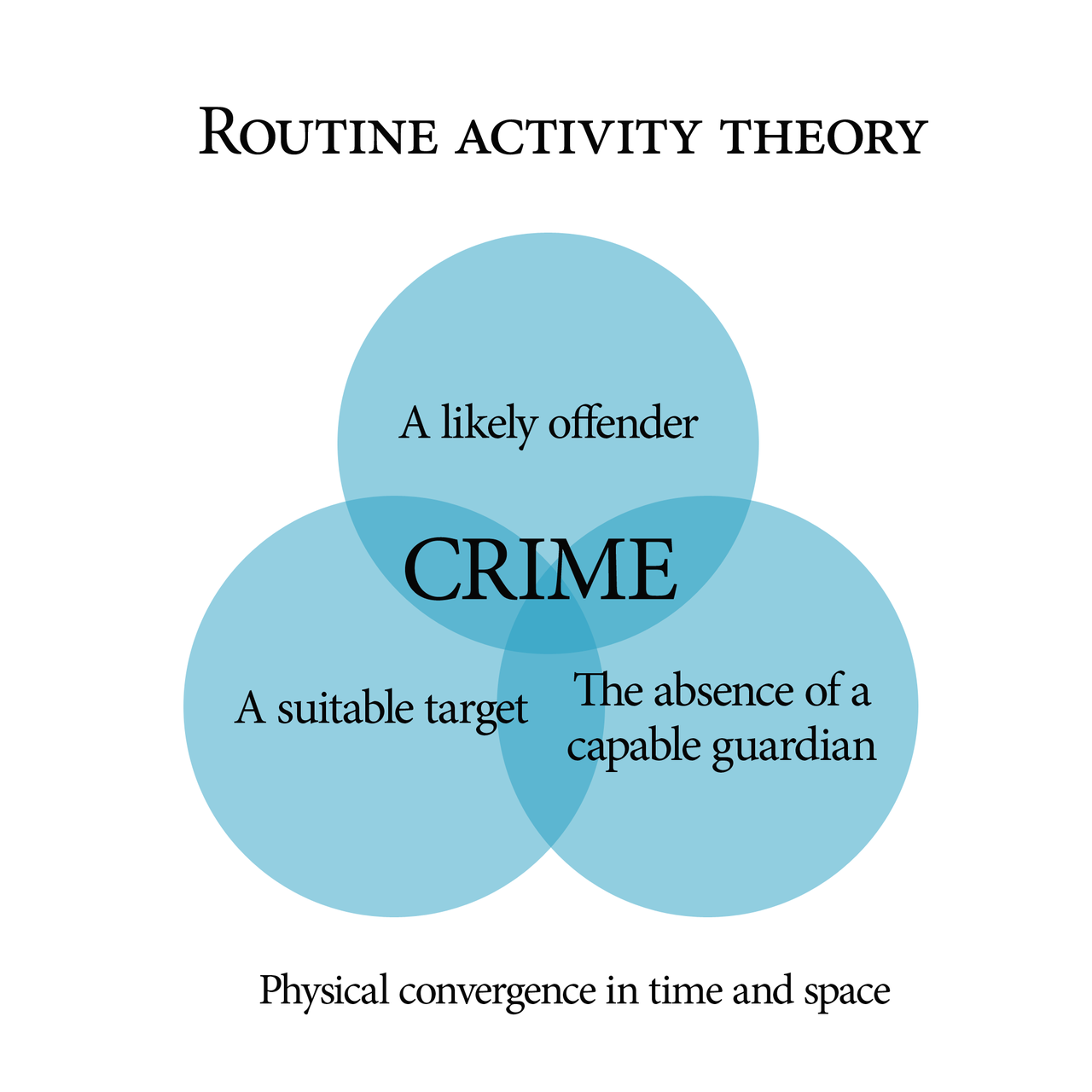
Lawrence Cohen and Marcus Felson set out the framework in 1979. A predatory crime requires a likely offender, a suitable target, and the absence of a capable guardian, all present at the same place and moment.
A capable guardian is not primarily the police. It is far more often an ordinary person whose presence makes an offence inconvenient: a neighbour, a shopkeeper, a passer-by, a colleague. Most crime is prevented by people who have no idea they are preventing it.
Target suitability was summarised with the acronym VIVA: value, inertia meaning how difficult the item is to move, visibility, and access.
The deliberate omission is motivation. The theory takes the supply of motivated offenders as given and asks what determines whether their motivation results in an offence. This is its most criticised feature and also the source of its usefulness.
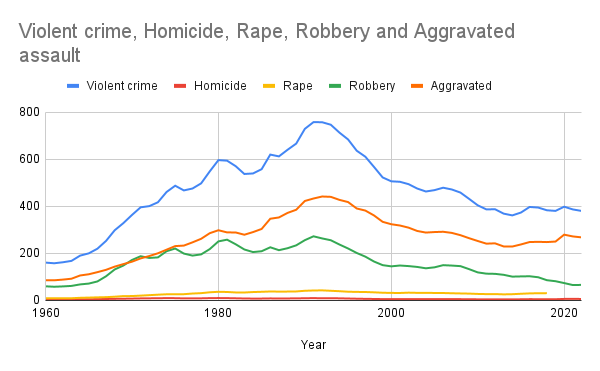
Cohen and Felson were addressing an awkward fact. Crime in the United States rose steeply from the early 1960s through the 1970s, during a period of rising incomes, rising education and expanding social programmes.
Theories explaining crime through deprivation predicted the opposite. If crime is caused by poverty and disadvantage, improving conditions should reduce it, and it did not.
Their answer was that prosperity had changed daily routines in ways that increased opportunity. More women had entered paid employment, so more homes stood empty during the day. More people lived alone. Leisure moved away from the home. And consumer goods became simultaneously more valuable and more portable, as televisions, stereos and later electronics shrank.
The number of motivated offenders need not have changed at all. The number of unguarded, suitable targets rose sharply, and crime followed.
Crime is extraordinarily concentrated in space and time. A small proportion of addresses account for a large majority of calls for service in most cities, a regularity robust enough to be treated as a law of the field. An offender-centred theory does not predict this; an opportunity-centred one does.
Repeat victimisation is strong and predictable. The best single predictor that a house will be burgled is that it has recently been burgled, which follows naturally if suitability and guardianship are properties of places.

The crime drop across most wealthy countries since the early 1990s has been attributed substantially to security improvements rather than to changes in offenders. Vehicle theft is the clearest case: electronic immobilisers, made standard by regulation, coincide with very large falls in car theft, and the decline is concentrated in exactly the vehicles and years the security hypothesis predicts. This is treated further in the capsule on the crime drop.
Situational crime prevention, developed by Ronald Clarke, is the applied form. It works on specific offence types by increasing effort, increasing risk, reducing reward and removing excuses, and it has an extensive record of measured effects.

Design of the built environment follows the same logic, arranging sightlines, entrances and activity so that ordinary occupants can see what is happening.
Displacement is the standard criticism: preventing crime in one place may simply move it. The evidence indicates displacement is real but partial, usually much less than the prevention achieved, and that the opposite effect, a diffusion of benefits to nearby areas not treated, is also commonly observed.
Ignoring motivation limits the theory's reach. It explains distribution well and says nothing about why some people offend, which means it cannot inform policy on the causes of criminality. Its defenders treat this as a division of labour rather than a defect.
Victim blaming is a serious concern in application. A framework built around guardianship and target suitability can slide into holding victims responsible for their own victimisation, particularly for sexual offences, and the theory itself does not prevent that misuse.
Fit varies by offence type. It performs well for property crime and street crime and poorly for domestic violence, offences within institutions, and much white-collar crime, where the offender and target are in sustained contact and guardianship works differently. Extensions have adapted the framework to online offences, where physical convergence does not apply and the three elements have to be redefined.
Routine activity theory made crime prevention a practical discipline rather than a branch of social reform. If offences require opportunity, then opportunity can be engineered away by people with no ability to change anyone's disposition.
It also reframes what the crime rate measures. On this account it is not solely a readout of how criminal a society is, but partly a description of how that society arranges its daily life, its buildings and its possessions.