Implements made by deliberately fracturing stone. They are the earliest and by far the most abundant surviving evidence of human technology, covering more than three million years, and their progression is the main framework for prehistory.
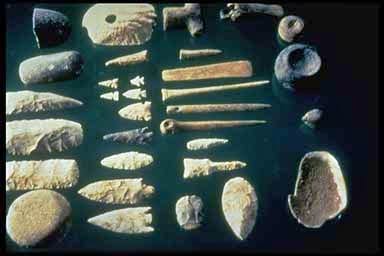
Knapping works by controlled fracture. Striking suitable stone at the correct angle removes a flake and leaves a scar, and repeated removals shape the piece.
Suitable stone is fine-grained and breaks conchoidally, meaning in smooth curved surfaces rather than along grain. Flint, chert, obsidian and quartzite are the usual materials, and obsidian produces edges sharper than surgical steel.
Both parts are useful. The flake removed has a sharp edge and is often the intended product, while the remaining core may itself be shaped into a tool.
Distinguishing a made tool from a naturally broken rock is a real problem in early archaeology, and it is resolved by looking for evidence of intention: repeated removals from the same platform, a consistent working edge, and refitting flakes back onto a core to reconstruct the sequence.
The Oldowan is the earliest widely accepted industry, from about 2.6 million years ago in East Africa, consisting of simple cores and flakes struck with a hammerstone. Older material from Lomekwi in Kenya, claimed at about 3.3 million years, is argued about.
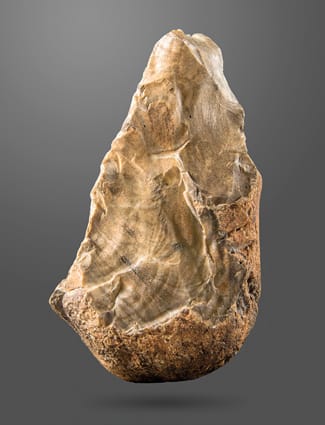
The Acheulean, from roughly 1.7 million years ago, is defined by the handaxe: a large, symmetrical, bifacially worked tool. Its symmetry exceeds what cutting requires, which has prompted arguments that it reflects an aesthetic or social element as well as a functional one.
Its most striking feature is stability. The form persists with little change across Africa, Europe and Asia for well over a million years, which is a duration no later technology approaches and which is difficult to reconcile with rapid cultural learning.
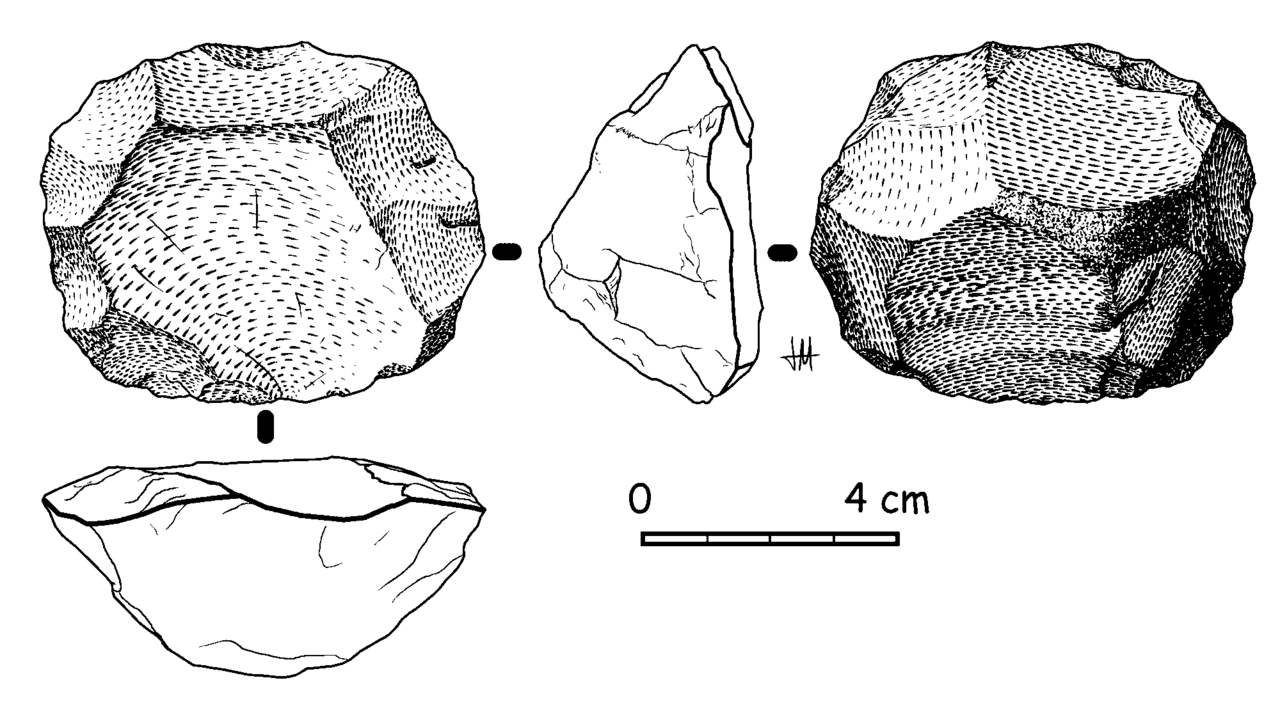
The Levallois technique, from around 300,000 years ago, prepares a core so that a single flake of predetermined shape can be detached. This is a substantial cognitive step, since the knapper works toward a result that does not exist until the final blow.
Upper Palaeolithic industries, from about 50,000 years ago, produce long narrow blades from prepared cores, which yields far more cutting edge per unit of stone. Tools become specialised and standardised, and bone, antler and ivory are worked alongside stone.
Neolithic assemblages include ground and polished stone axes, made by abrasion rather than fracture, which suits woodland clearance and agriculture.
Stone survives when almost nothing else does, so the record is heavily biased toward it. Wooden tools were certainly more numerous and are preserved only in exceptional conditions, and the few surviving examples, including wooden spears from Schöningen in Germany dated to around 300,000 years, indicate sophistication that stone alone would not reveal.
Cut marks on animal bone establish diet and butchery, and their dates extend the record of tool use beyond the tools themselves.
Raw material sourcing establishes movement and exchange. Stone can be matched to its geological origin, and finding material far from its source demonstrates transport, contact between groups, or both.
Use-wear analysis examines microscopic polish and damage on edges to determine what a tool was used on, distinguishing hide, wood, bone and plant material.
Experimental replication, in which modern knappers reproduce the techniques, established how the tools were made and how long it takes, which is how the cognitive demands of each tradition were assessed.
Stone tools predate the genus Homo. The earliest accepted industries are older than the earliest fossils confidently assigned to it, so the makers were probably australopithecines or an early Homo form not yet identified.
Tool use itself is not unique to hominins. Chimpanzees use hammerstones to crack nuts, and capuchin monkeys produce flakes incidentally that resemble simple tools, which complicated the criteria for identifying deliberate manufacture.
What distinguishes hominin knapping is the systematic production of a cutting edge by controlled fracture, sustained across generations and elaborated over time.
Stone tools are the only continuous record of technology across almost the whole of human evolution, and the sequence from simple flakes to prepared cores to standardised blades tracks changes in planning, foresight and social learning that leave no other physical trace.
They also demonstrate how much the archaeological record omits. A period represented entirely by stone was certainly full of wood, fibre, hide and language, none of which survives, and reasoning about it requires keeping that absence in view.