The claim that Homo naledi, a small-brained hominin, deliberately buried its dead in a South African cave system, and made engravings and used fire there. It would push mortuary behaviour far outside the lineage it has been associated with, and after three years of dispute it is neither established nor closed.
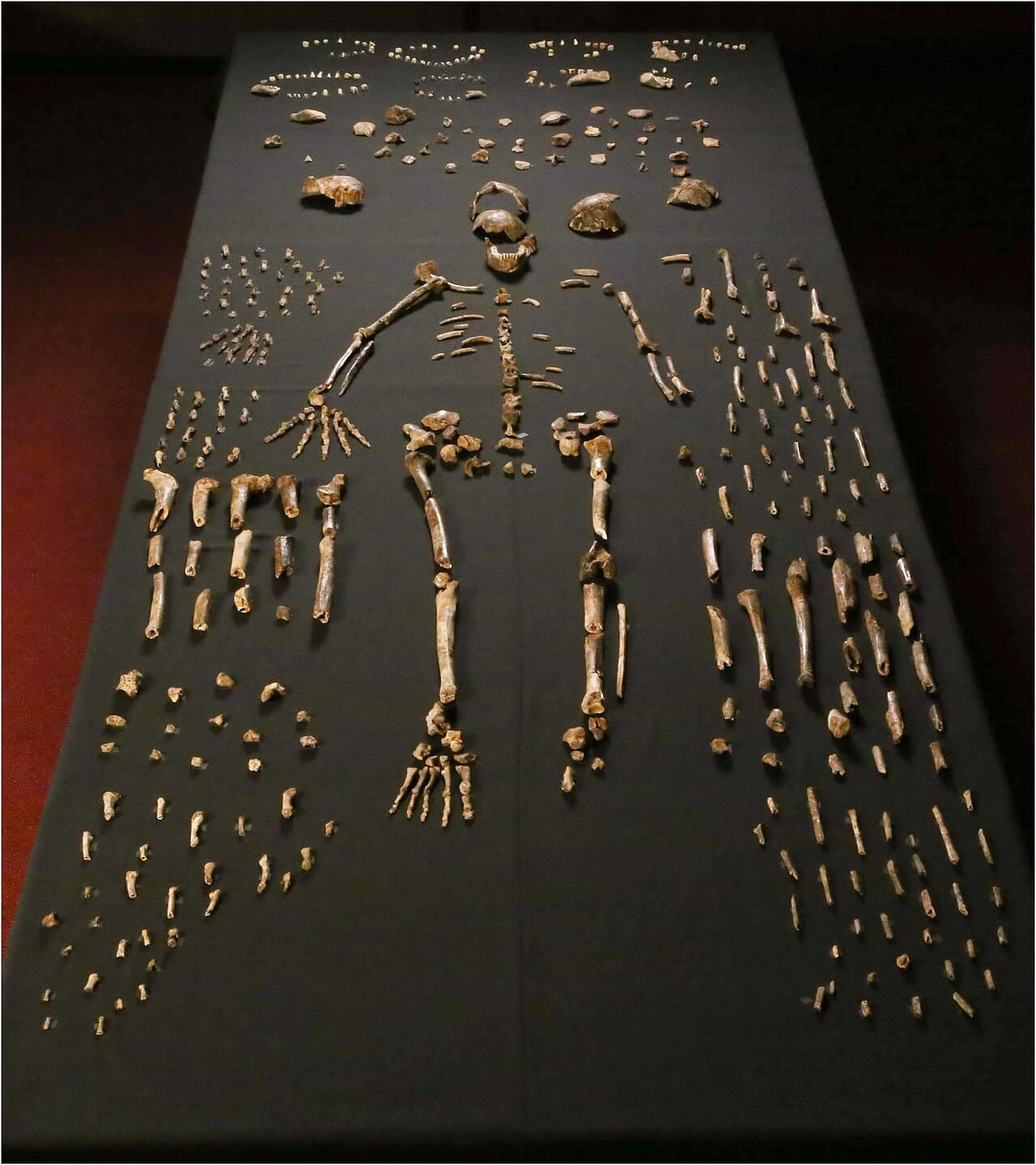
Homo naledi was described in 2015 from the Rising Star cave system in South Africa. It combines features across the hominin range: a brain of roughly 465 to 610 cubic centimetres, about a third the size of a modern human's, with hands and feet closer to our own.
The dating, published in 2017, was the first surprise. The remains are between about 335,000 and 236,000 years old, which is far more recent than a brain that size had been expected to persist, and places the species as a contemporary of early Homo sapiens in Africa.
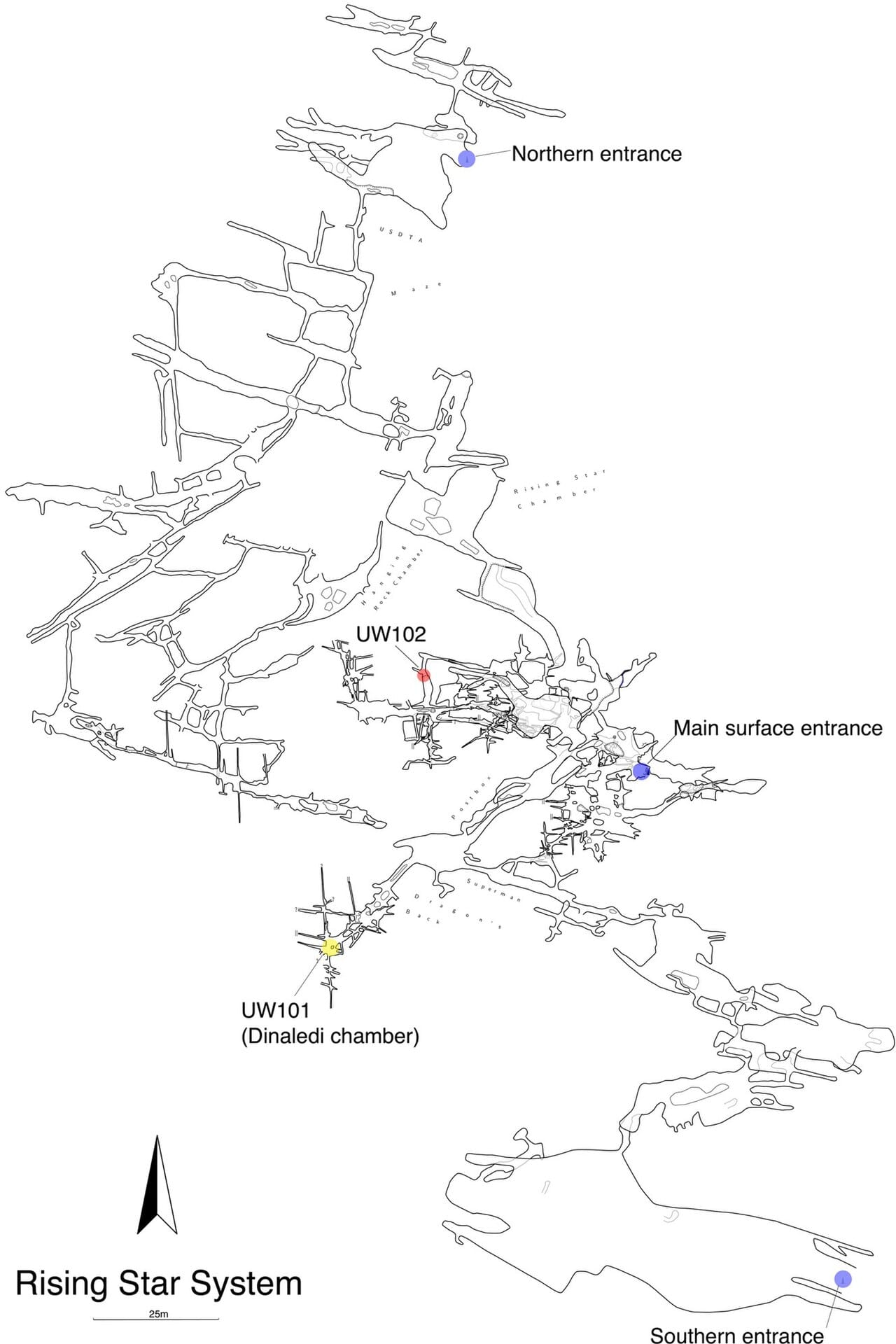
The Dinaledi Chamber holds the remains of many individuals, and the route to it is extraordinarily difficult, involving a vertical drop and a squeeze narrow enough that the original excavation team was recruited partly on the basis of body size. How so many bodies came to be deep in a cave that hard to reach is a genuine problem, and it is the problem every explanation must address.
In 2023 the Rising Star team, led by Lee Berger, released preprints arguing three things: that bodies had been deliberately interred in dug graves, that engraved markings on the cave walls were made by naledi, and that fire had been used to light the passages.
The announcement was accompanied by extensive press coverage and a documentary before peer review was complete, which became part of the controversy rather than incidental to it.
The reviews, published openly under the eLife model, were close to uniformly negative. Reviewers held that the evidence presented was incomplete and inadequate for the claims being made, and that alternative explanations had not been excluded.
A detailed rebuttal followed in 2024 in PaleoAnthropology, arguing that there was no sedimentological evidence for deliberate burial and that the team's own data, analysed against standard field practice, did not support the interpretation. The criticism was methodological: identifying a grave requires demonstrating a cut feature, a fill distinguishable from surrounding sediment, and a body position consistent with deliberate placement, and the critics argued none had been shown to the required standard.
The team revised extensively. A substantially rewritten version was published on 1 September 2025, with improved documentation, stratigraphic context and discussion of alternatives.
The current position is genuinely mixed rather than settled either way. One reviewer of the revised work considers the case for deliberate and repeated burial to have been made. Another remains unpersuaded, citing among other things the unresolved question of how naledi reached so inaccessible a chamber at all.
The alternatives to burial are not trivial, and each has its own difficulties.
Bodies may have been deposited in the chamber without burial, dropped or placed there, and subsequently covered by natural sediment movement. This accounts for the accumulation without requiring digging, and it still requires deliberate transport of the dead into the cave, which is itself mortuary behaviour of a kind.
Accidental entry, in which individuals became trapped, struggles with the demography of the assemblage, which includes infants and older individuals in proportions unlike a group of explorers.
A death trap, in which individuals entered seeking water or shelter and could not leave, has been proposed and is difficult to reconcile with the state of the remains.
Transport by water or by carnivores is largely excluded by the sediments and by the absence of tooth marks.
The reason this matters beyond one cave is that deliberate burial has been treated as a marker of symbolic thought, and symbolic thought has been associated with large brains.
If a hominin with a brain a third the size of ours buried its dead, the link between brain size and that class of behaviour is weakened considerably.
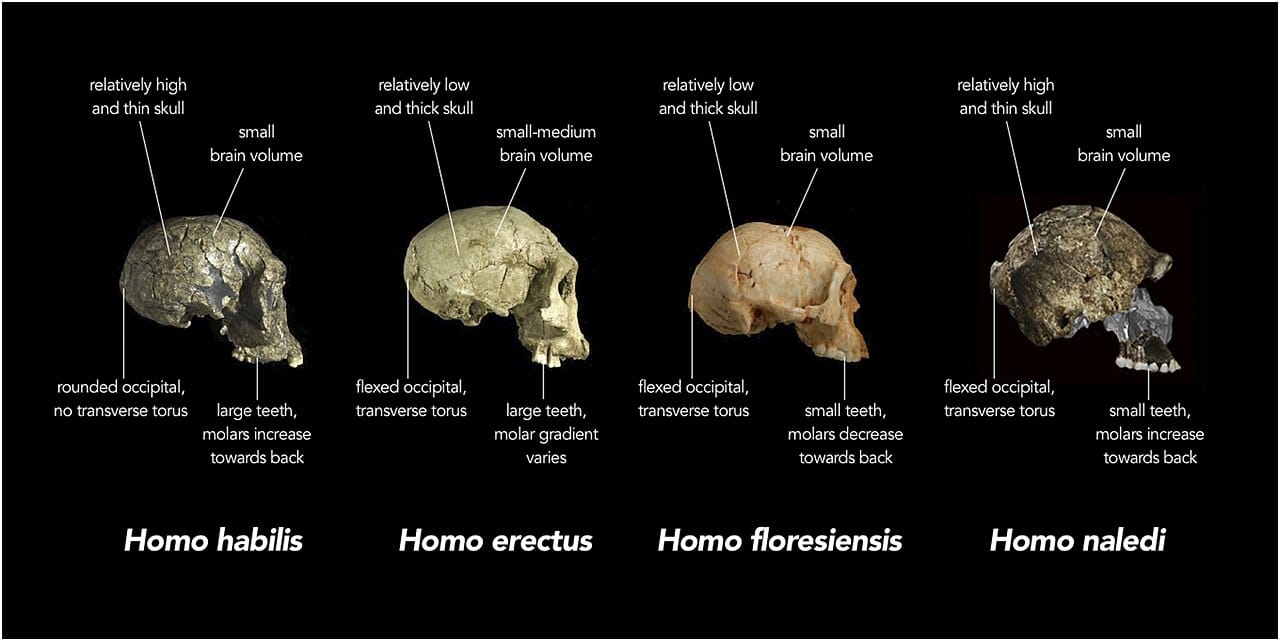
That is also why the evidentiary bar is being set high by critics, and the team has argued that the bar is being set higher for naledi than it has been for Neanderthal burials accepted on comparable evidence. That argument about consistency of standards is a real part of the dispute and is not merely rhetorical.
The episode is as much about how claims are made as about what naledi did. Publication by press release ahead of review, on a claim that would revise a central assumption of palaeoanthropology, produced a reaction that has taken years to work through and is still working.
It is also a case of open peer review functioning visibly. The reviews, the rebuttal and the revision are all public, which is why the state of the argument can be described precisely rather than guessed at.