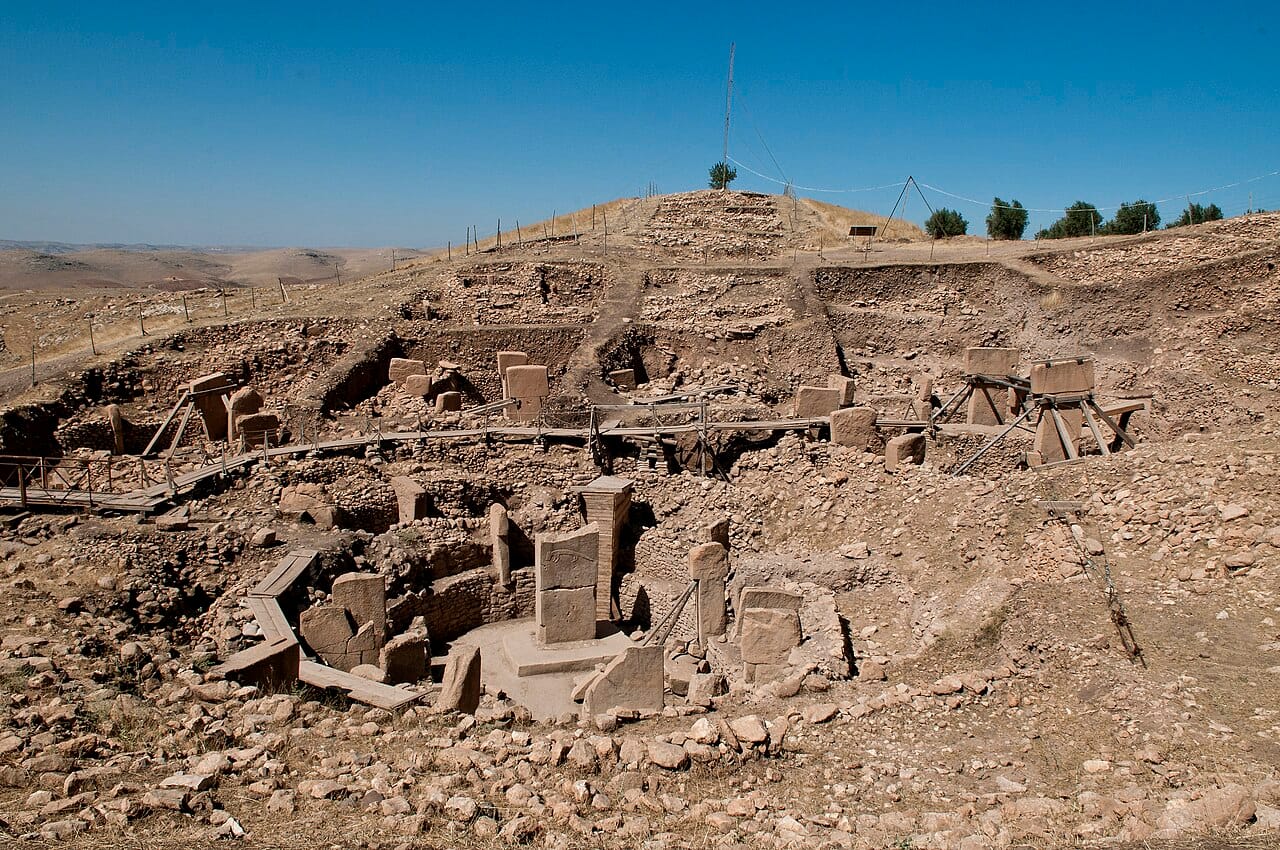
Gobekli Tepe is a complex of monumental stone enclosures in southeastern Turkey, built around eleven thousand years ago by people who had not yet adopted farming. That combination, monumental architecture before agriculture, is why it matters and why what it means is argued about.
The site consists of circular and oval enclosures of massive T-shaped limestone pillars, the largest around five metres tall and weighing several tonnes, carved in relief with foxes, snakes, boars, cranes, scorpions, and abstract symbols. The pillars have arms and hands rendered on their sides, suggesting stylised human or more-than-human figures. Excavation began under Klaus Schmidt in 1995, and the site was inscribed as a UNESCO World Heritage Site in 2018. Only a fraction has been excavated.
The dating is secure and is the source of the site's significance: construction began in the tenth millennium BC, before pottery, before metal, and before domesticated plants and animals in the region.
Schmidt's interpretation, which made the site famous, was that it was a sanctuary rather than a settlement, built by mobile hunter-gatherers who gathered periodically, and that the labour of building and feeding the builders created pressure to secure a reliable food supply. On this reading religion drove agriculture rather than agriculture enabling religion, reversing the standard sequence.
That reading is now substantially disputed by later excavation at the site itself. Evidence of domestic occupation has been reported, including cisterns, grinding equipment in quantity, and traces of dwellings, which suggests a settled or semi-settled community rather than an empty ritual centre visited by pilgrims. Some researchers argue the temple-versus-village dichotomy is itself the error, and that in a society without our categories a building could be both.
Whether the builders were purely hunter-gatherers is also less clear than the popular account suggests. The plants they ate were wild, but wild cereals were being intensively gathered and processed in the region, which is the stage immediately preceding domestication rather than a world innocent of it.
The most important development since the site became famous is that it is not unique. Excavation across the surrounding region, coordinated since 2021 as the Tas Tepeler project, has identified more than a dozen contemporary sites, of which Karahan Tepe is the most substantial.
This changes the interpretation considerably. A single extraordinary monument invites extraordinary explanations; a network of related sites built over centuries looks instead like a regional tradition, which is a more ordinary and more tractable thing to study.
The carved pillars have also become less anonymous. In October 2025 excavators at Karahan Tepe reported a standing stone about 135 centimetres tall bearing a detailed human face, the first time a face has been found integrated directly into a monumental pillar rather than rendered as an abstracted form. At Gobekli Tepe itself a life-size human statue was found deliberately set into a wall between two of the enclosures. Both findings support reading the T-shaped pillars as stylised human or ancestral figures, which had been argued from their arms and belts and now has more direct evidence behind it.
The site attracts an unusual volume of claims outside the archaeological literature, including proposals that it records a comet impact, encodes astronomical alignments, or evidences a lost civilisation. These are not the mainstream position and generally rest on selective use of the carvings, whose iconography is not deciphered and may not be a notation at all. The genuine debate is narrower and more interesting: not whether a lost civilisation built it, but whether monumental religion preceded farming, followed it, or grew alongside it.