Air is nearly eighty percent nitrogen and almost nothing can use it. Breaking the bond that holds the molecule together is what makes proteins and DNA possible, and roughly half the nitrogen in a living human today was fixed in an industrial reactor.
Nitrogen gas is two atoms joined by a triple bond, one of the strongest in chemistry. The molecule is inert: it will not react with much of anything at ordinary temperatures.
That is why nitrogen is simultaneously the most abundant element in the atmosphere and the most common limiting nutrient in ecosystems. It surrounds every plant and none can use it directly. Plants need nitrogen in a reduced or oxidised form, as ammonium or nitrate, and getting it there requires breaking the triple bond.
Only certain prokaryotes can, using the enzyme nitrogenase. No plant, animal or fungus can fix nitrogen; every organism that appears to is hosting bacteria that do.
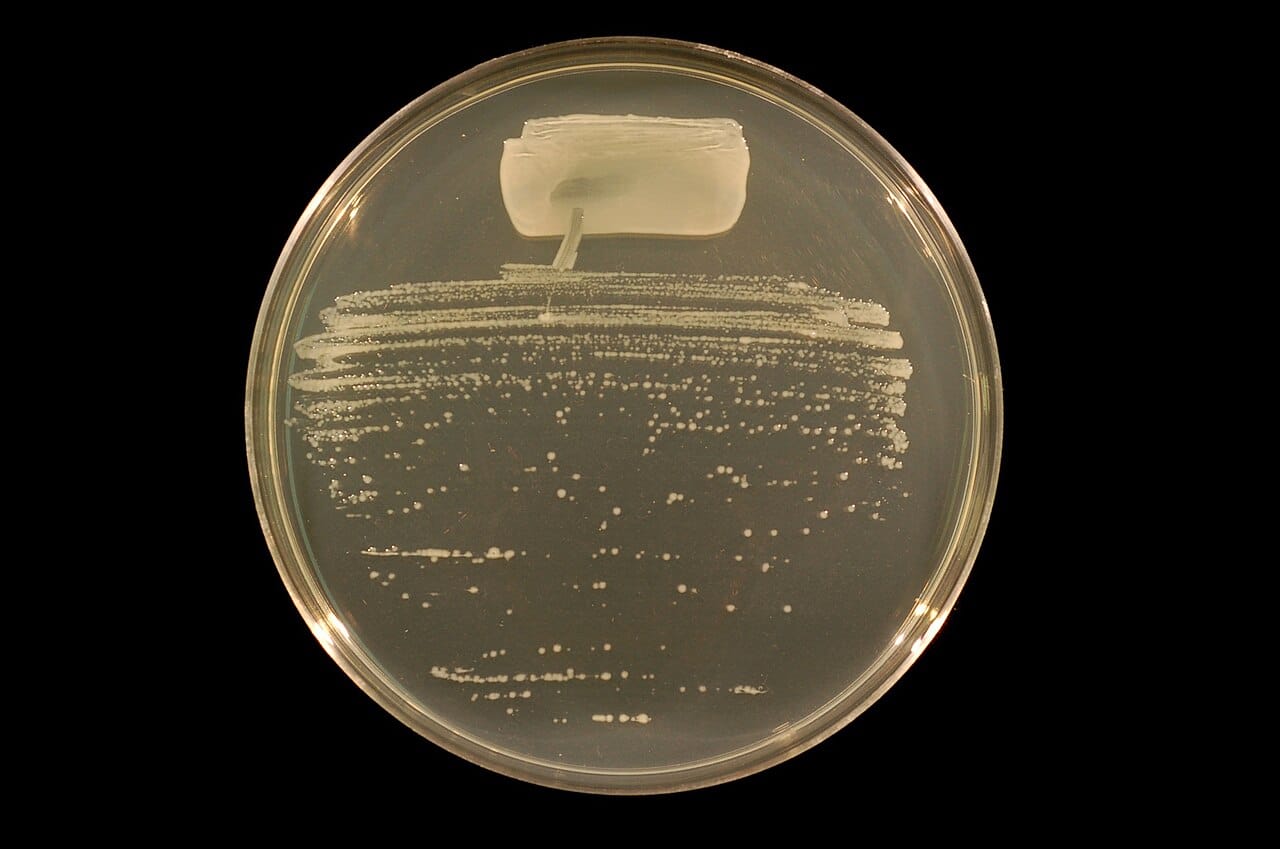
Nitrogenase contains iron and molybdenum at its active site and is extraordinarily demanding to run. It consumes sixteen molecules of ATP per molecule of nitrogen fixed, which is a very large energy cost, and it is destroyed by oxygen.
That last constraint shapes the biology. Free-living fixers solve it in various ways: some cyanobacteria build specialised oxygen-free cells called heterocysts; others fix only at night.
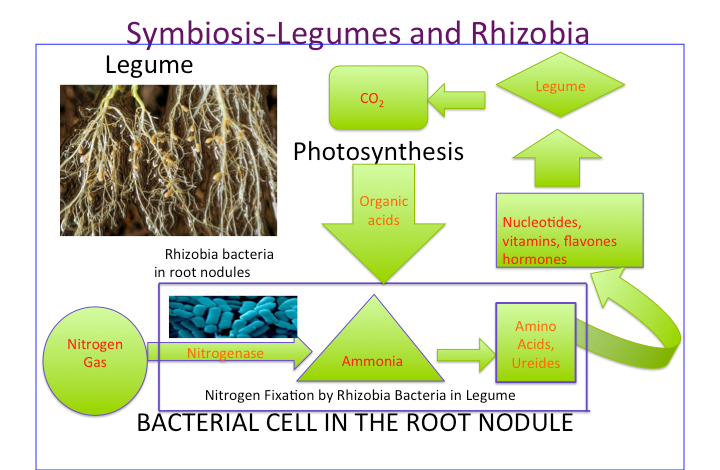
The symbiosis with legumes is the most consequential arrangement. The plant builds nodules on its roots housing Rhizobium bacteria, supplies them with sugars, and produces leghaemoglobin, a protein closely related to the haemoglobin in blood, which binds oxygen and keeps its concentration low enough for nitrogenase to work while still permitting respiration. The bacteria supply fixed nitrogen in return.
This is why crop rotation with legumes restores soil fertility, a practice used for thousands of years before anyone knew why.
Fritz Haber demonstrated in 1909 that nitrogen and hydrogen could be combined into ammonia directly, at around 400 to 500 degrees, a few hundred atmospheres, and over an iron catalyst. Carl Bosch engineered it to industrial scale, which required pressure vessels beyond anything previously built.
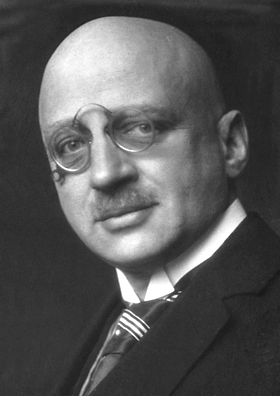
Both received Nobel Prizes, Haber in 1918 and Bosch in 1931.
The process consumes on the order of one to two percent of world energy and around three to five percent of natural gas production, which supplies the hydrogen. It is responsible for a comparable share of global carbon dioxide emissions.
The frequently quoted estimate is that around half the nitrogen atoms in the average person's body passed through this process, and that the food supply for something like half the world's population depends on it. Neither figure is exact and the order of magnitude is not disputed.
Haber's biography resists tidy summary and is worth stating rather than omitting.
He made the process feeding billions possible. He also directed Germany's chemical weapons programme in the First World War, personally supervising the first large-scale chlorine attack at Ypres in 1915. His wife Clara Immerwahr, herself a chemist, died by suicide days afterwards.
He was Jewish, converted, and was forced out of Germany in 1933. Zyklon B, developed from insecticide work carried out at his institute, was later used to murder members of his extended family in the camps.
Industrial fixation has roughly doubled the amount of reactive nitrogen entering the biosphere annually, which is among the largest human alterations of a global chemical cycle.
Nitrogen not taken up by crops runs off. The results are eutrophication of rivers and lakes, algal blooms, and coastal dead zones where decomposition strips the water of oxygen. Nitrous oxide from soils is a greenhouse gas roughly three hundred times more potent than carbon dioxide per molecule and depletes stratospheric ozone.
The planetary boundaries framework treats biogeochemical flows, principally nitrogen and phosphorus, as one of the boundaries already crossed by a wide margin.
The difficulty is that the alternative is not obvious. Efficiency can be improved substantially, and precision application, better timing and legume rotation all help. Feeding the current population without industrial fixation is not something anyone has shown how to do, and this is one of the clearest cases where an environmental problem and a humanitarian requirement point in opposite directions.
Research on transferring nitrogen fixation to cereal crops directly, or on engineering nitrogenase to work outside its native context, has been pursued for decades and has not succeeded.