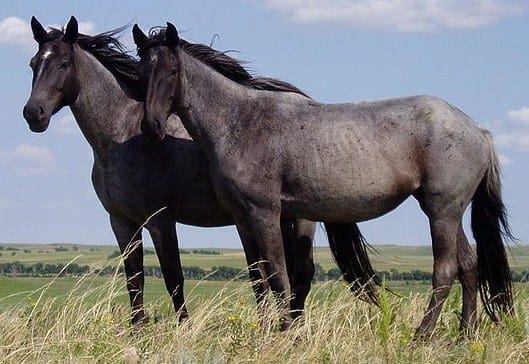
The horse, Equus ferus caballus, is a large grazing mammal domesticated on the Eurasian steppe and, for roughly four thousand years, the fastest way a human being could travel over land. Almost every horse alive today descends from a single lineage that spread across Eurasia with startling speed, and the story of how that was established is a recent and instructive one.
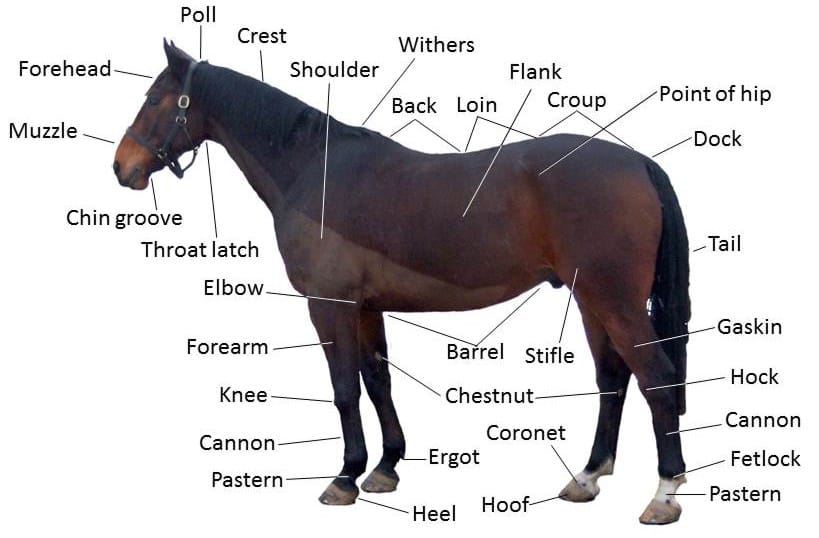
A horse stands on one toe. The single hoof is the enlarged third digit, and the splint bones alongside the cannon are the reduced remains of the second and fourth. This is the endpoint of a long reduction in the equid line, and it trades manoeuvrability for efficiency on open ground.
The legs contain almost no muscle below the knee and hock; movement is transmitted by long tendons from muscle high in the limb, and elastic energy is stored and returned in those tendons with each stride. A standing horse can lock its stifle with the stay apparatus and doze upright.
Horses are hindgut fermenters, digesting cellulose in an enlarged caecum and colon rather than a rumen. The consequence is that they process large volumes of low-quality forage quickly and less completely than a cow, and must eat close to continuously.
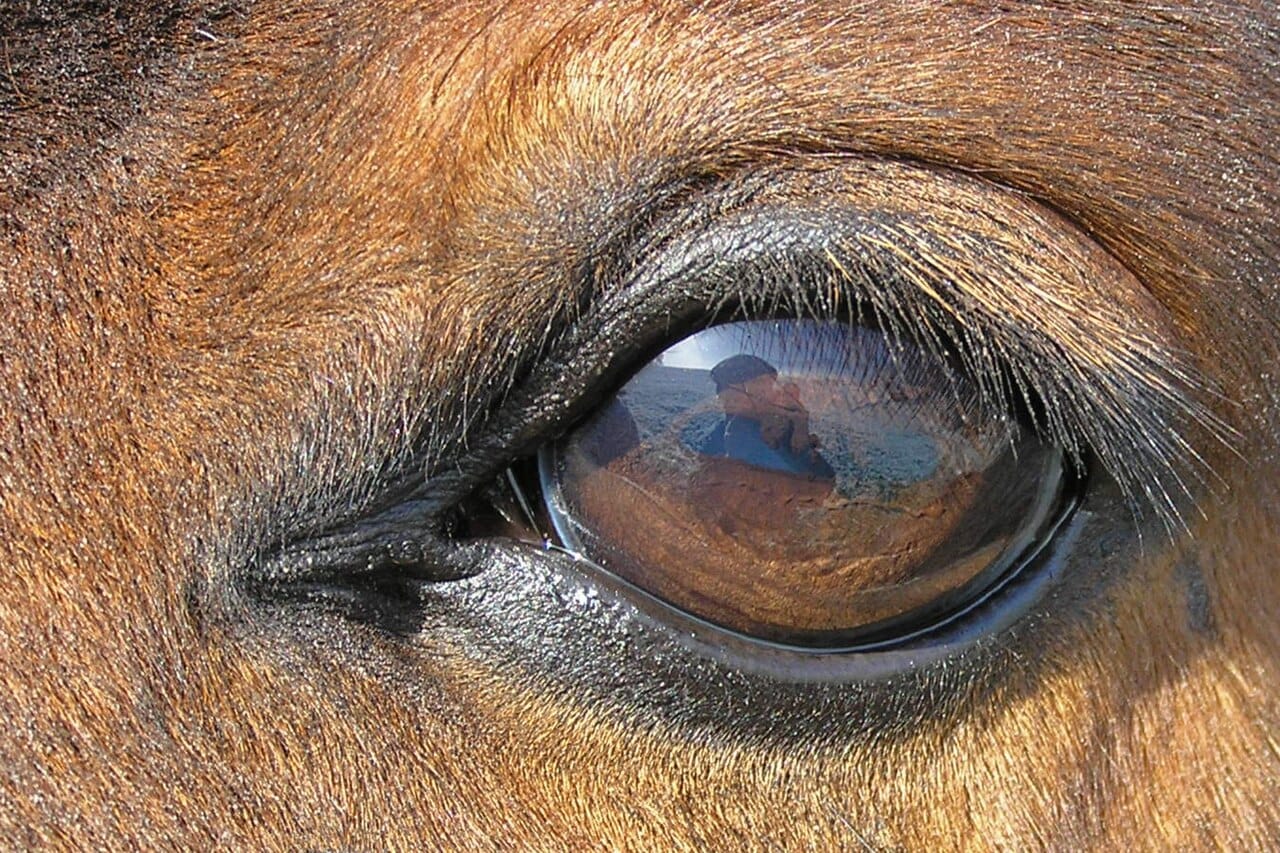
The eyes sit high and to the sides, giving nearly panoramic vision with narrow binocular overlap ahead. This is prey animal architecture, and it explains a great deal of horse behaviour that people read as skittishness: an animal built to detect movement across almost the whole horizon and to leave immediately.
For most of the twentieth century the standard account placed horse domestication at the Botai culture of northern Kazakhstan around 3500 BCE, where the evidence includes bit wear on teeth, corral soil chemistry and mare's milk residues in pottery.
Ancient DNA overturned it. A 2018 study found that Botai horses are not the ancestors of modern domestic horses but of Przewalski's horse, which had been assumed to be the last truly wild horse and now appears to descend from Botai stock. A 2021 study in Nature by Librado and colleagues located the ancestry of essentially all modern domestic horses, the lineage called DOM2, in the western Eurasian steppe around the lower Volga and Don, spreading across Eurasia from about 2200 BCE with wheeled vehicles and, shortly afterwards, chariot burials.
That spread was extraordinarily fast and near-total: DOM2 replaced local horse populations across the continent within a few centuries.
The argument has not stopped. Work published from 2024 onward has pressed the case that horses of several genetic backgrounds were being kept, milked and ridden well before 2200 BCE, and that the DOM2 event marks the emergence of one successful lineage rather than the invention of horse-keeping. Whether Przewalski's horse was ever domesticated at all is separately disputed, with William Taylor among those arguing it was not.
The honest summary is that a confident textbook account was replaced by a better-evidenced one that is itself now under active revision.
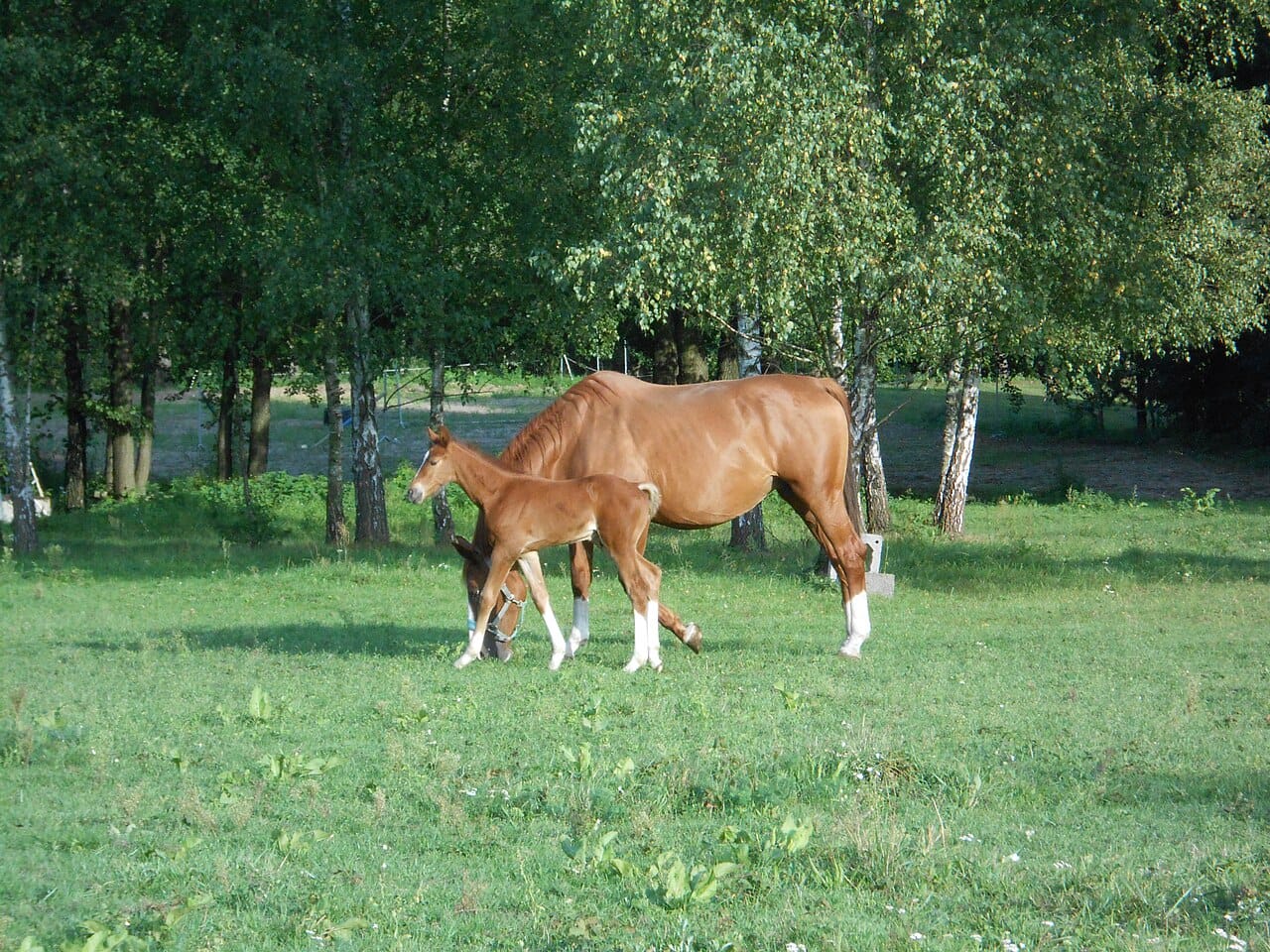
Domestic horses differ from wild equids in temperament, coat colour variation, and two features identified in the 2021 genomic work: variants associated with a more docile disposition and with a stronger back, both plausibly selected once horses were being ridden.
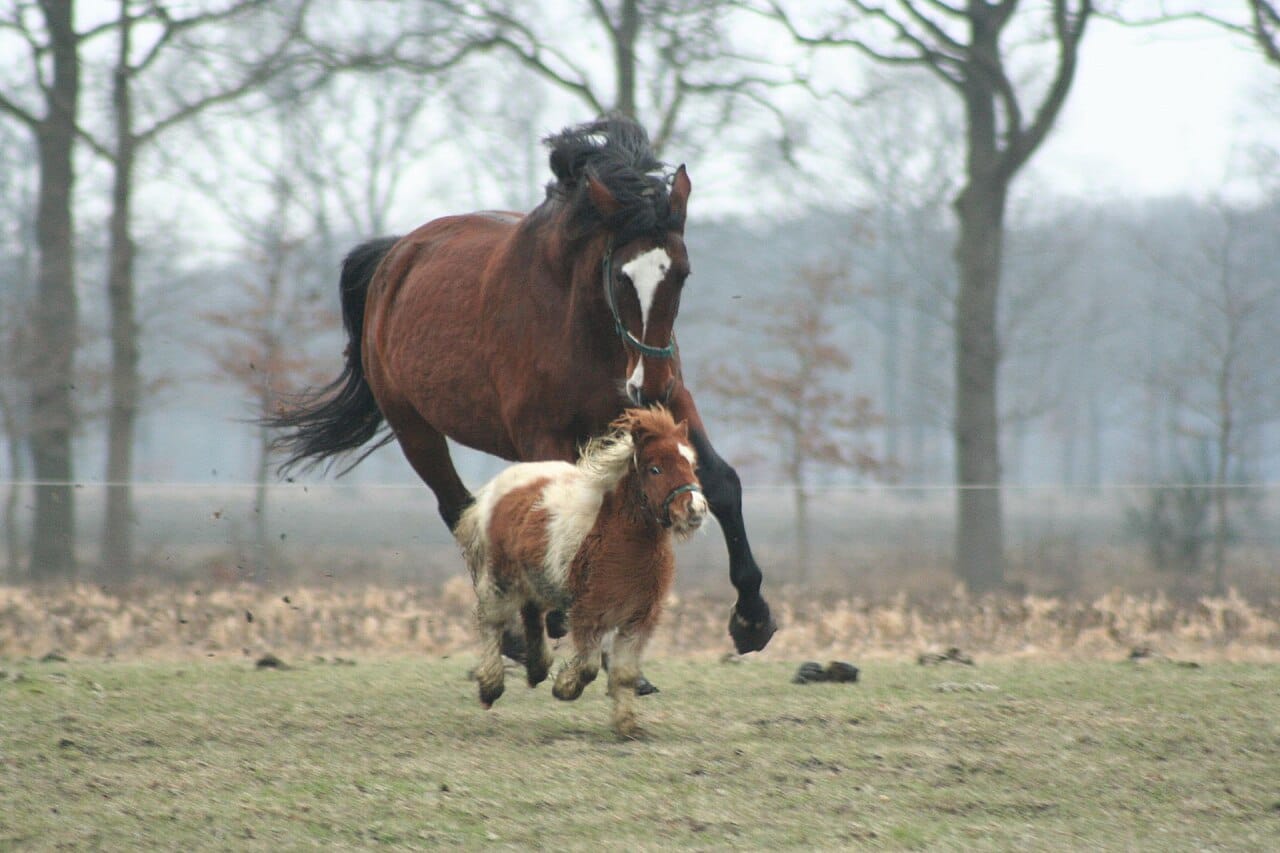
Selective breeding since has produced a range of size and build far wider than in any wild equid, from Shetland ponies under a metre at the shoulder to draught breeds over eighteen hands and a tonne in weight.
The horse is the single most consequential domestic animal for the shape of political history, and the reason is simple: until the railway, a mounted messenger was the upper bound on the speed of information and a mounted army was the upper bound on the speed of force.
Chariotry from around 2000 BCE, cavalry from the first millennium BCE, the stirrup from the early centuries CE, and the horse collar in Europe from about the ninth century each changed what was possible militarily and agriculturally. The steppe empires from the Scythians to the Mongols were built on a logistical advantage that was fundamentally equine.
The reintroduction of the horse to the Americas after 1519 transformed the societies of the Great Plains and the Argentine pampas within a few generations. Horses had evolved in North America and become extinct there around ten thousand years ago; their return was a homecoming that functioned as an invasion.
Mechanisation removed the horse from transport and agriculture across most of the world within about fifty years, from roughly 1900 to 1950, which is among the fastest displacements of a domestic animal on record. The global population did not collapse: horses moved into sport, recreation and racing, and remain working animals across much of Central Asia, Mongolia and parts of Africa and Latin America.
Przewalski's horse, extinct in the wild by the 1960s, was reintroduced to Mongolia from zoo stock beginning in 1992 and now numbers in the hundreds in the wild, all descended from about a dozen founders.
The horse is the clearest case of an animal whose biology set the limits of a civilisation. How far an army could march, how quickly a message could cross an empire, how much land one family could plough: all of it was an equine quantity for four thousand years, and it stopped being one within a single human lifetime.