Neutrinos change identity as they travel, converting between three types. The discovery resolved a thirty-year discrepancy in measurements of the Sun and proved that neutrinos have mass, which the Standard Model of particle physics said they did not.
Neutrinos are electrically neutral particles that interact only through the weak nuclear force and gravity, which makes them almost undetectable. Roughly sixty billion pass through every square centimetre of your body each second, arriving from the Sun, and essentially all of them continue through the Earth without touching anything. A wall of lead a light year thick would stop about half.
Wolfgang Pauli proposed the particle in 1930 to account for missing energy in beta decay, and apologised in writing for postulating something he thought could never be detected. It was detected in 1956 by Clyde Cowan and Frederick Reines using a nuclear reactor as the source.
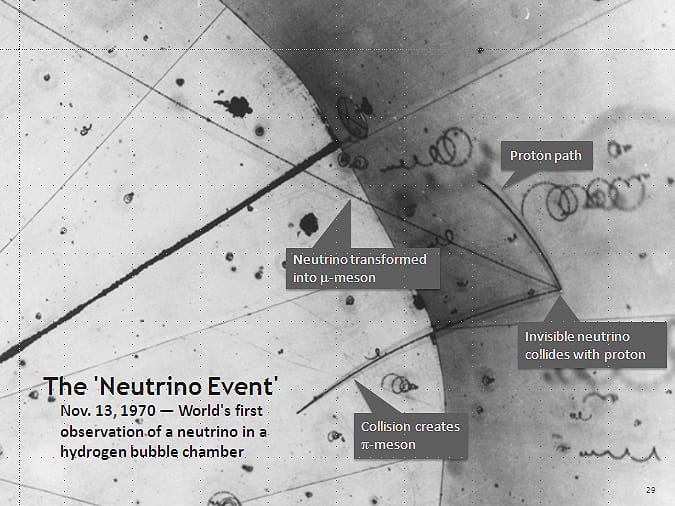
Three types are known, each paired with a charged particle: electron, muon and tau neutrinos.
The Sun is powered by fusion, and fusion produces electron neutrinos at a rate that stellar models predict precisely. Because neutrinos escape the core directly rather than taking a hundred thousand years to diffuse out as light does, counting them is the only direct look at the Sun's interior available.
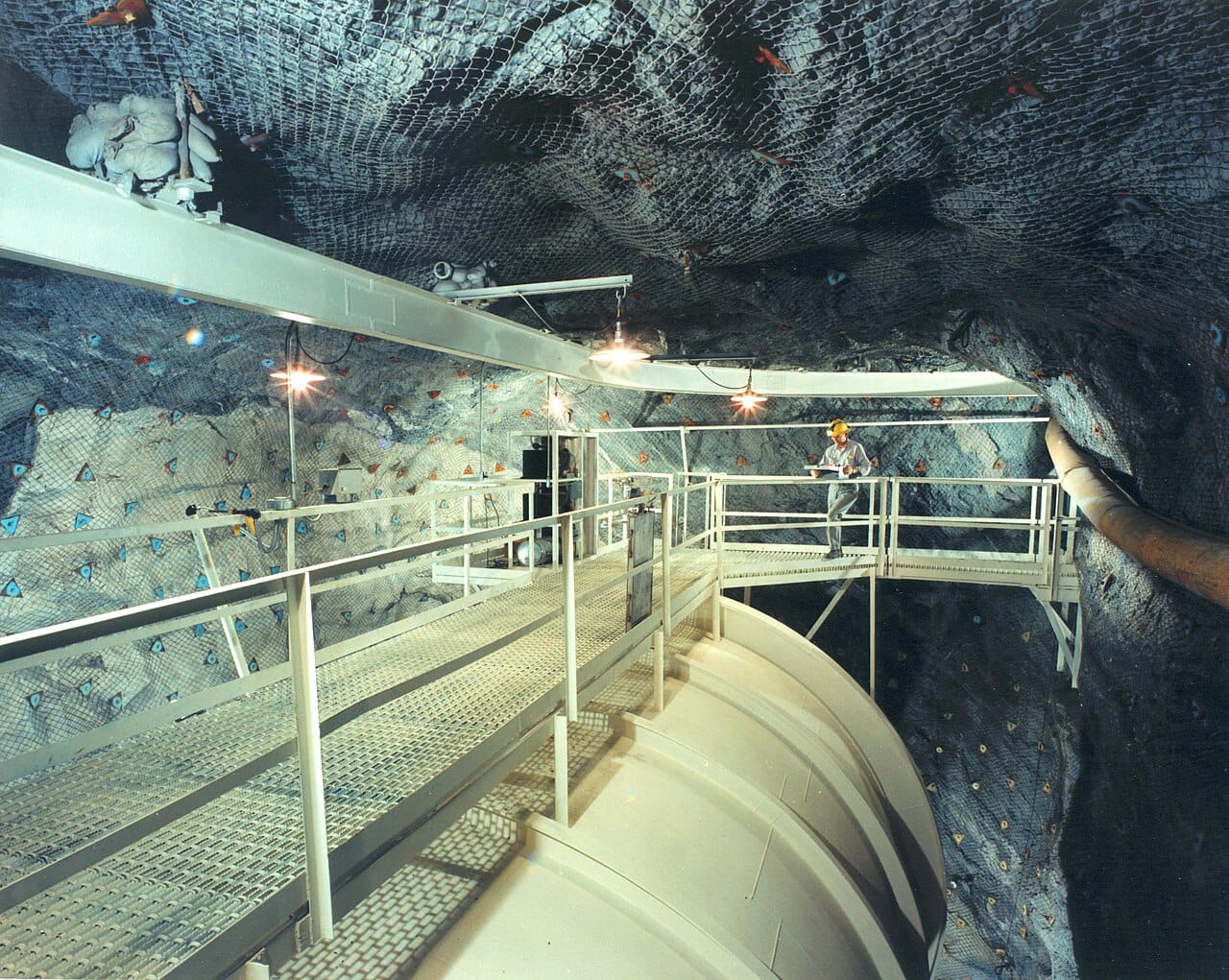
Raymond Davis began counting in the 1960s in a tank of dry cleaning fluid in the Homestake gold mine in South Dakota, a mile underground to shield it from cosmic rays. He detected roughly one third of the predicted number.
The result was checked for thirty years. Astrophysicists suspected the detector; physicists suspected the solar model. Both were correct in their measurements and both were wrong about the discrepancy, because the neutrinos were arriving and had stopped being the kind Davis could see.
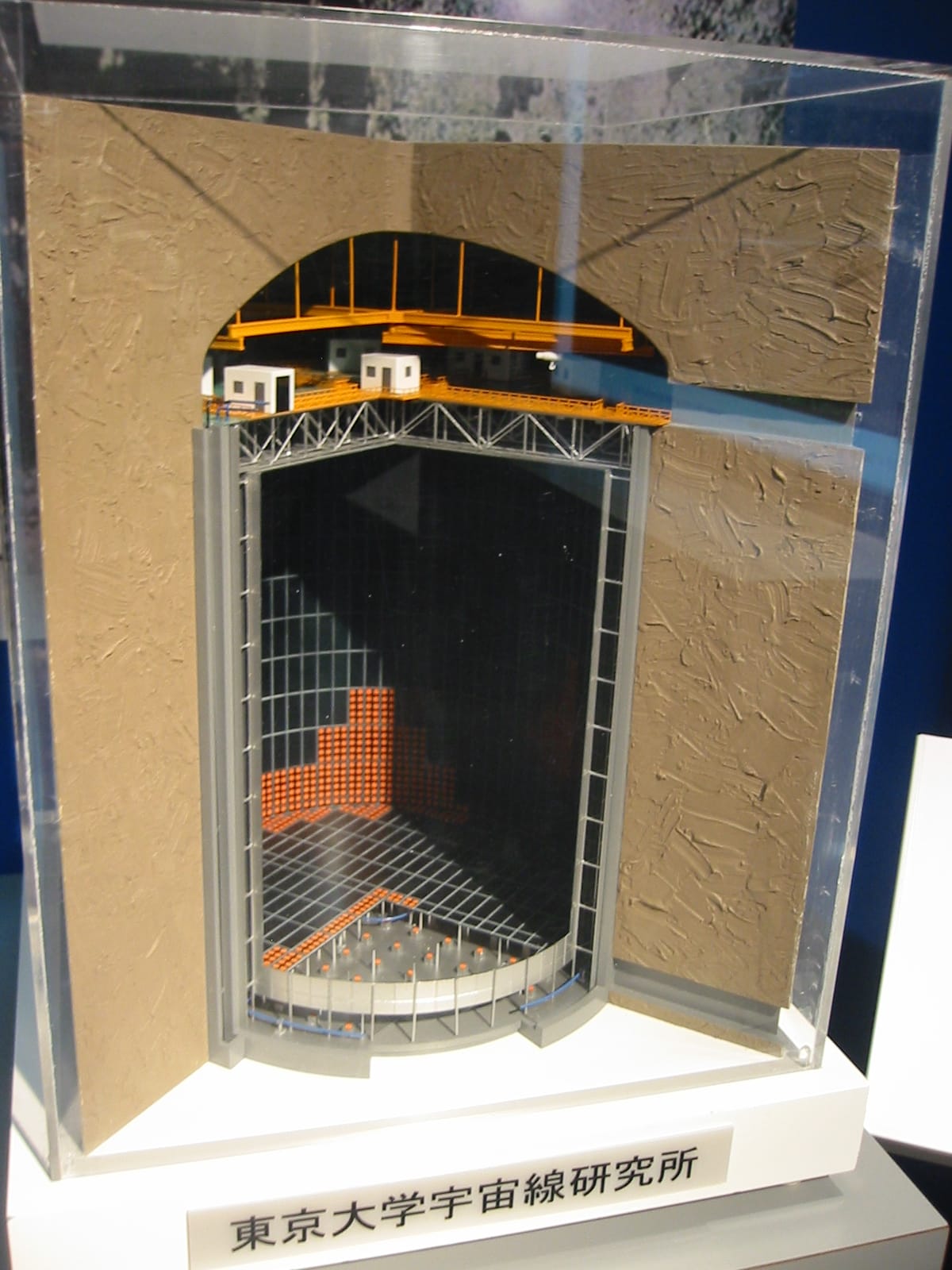
Super-Kamiokande, a fifty thousand tonne tank of ultrapure water lined with photomultiplier tubes in a Japanese mine, announced in 1998 that muon neutrinos produced by cosmic rays in the atmosphere arrived in different proportions depending on direction. Those from overhead had travelled twenty kilometres; those from below had crossed the entire Earth, thirteen thousand kilometres. Fewer arrived from below. The deficit depended on distance travelled, which is the signature of a particle changing en route rather than being absorbed.
The Sudbury Neutrino Observatory in Canada closed the argument in 2001. Using heavy water, it could count electron neutrinos separately from the total of all three types. The electron neutrino count matched Davis. The total matched the solar model exactly. The missing two thirds had become muon and tau neutrinos on the way.
Takaaki Kajita and Arthur McDonald shared the 2015 Nobel Prize in Physics.
A neutrino is produced in a definite type, and it propagates as a combination of states with definite mass. If those masses were identical, the combination would stay in step and the type would never change. Oscillation occurs precisely because the mass states move at slightly different rates and drift out of phase, so the type detected depends on how far the particle has travelled.
Observing the change therefore proves the masses differ, which proves at least two are not zero.
The Standard Model was constructed with massless neutrinos, so this is the first confirmed experimental result requiring physics beyond it. That is why the discovery matters beyond neutrino physics.
Oscillation measures differences between squared masses, not the masses themselves, so the absolute scale remains unknown. Cosmological observations bound the sum at a fraction of an electronvolt, meaning a neutrino is at least a million times lighter than an electron, and nobody knows why.
Which mass state is heaviest, the ordering problem, is unresolved, and three experiments are being built or commissioned to settle it. JUNO, a twenty thousand tonne liquid scintillator detector in southern China, began full operation in 2025 and measures reactor antineutrinos over a baseline of about fifty kilometres. Hyper-Kamiokande is expected to begin taking data around 2028, and DUNE, firing a beam from Illinois to a detector in South Dakota, around 2031. DUNE in particular should resolve the ordering within roughly a year of running.
Whether neutrinos are their own antiparticles is unresolved and is being tested by searches for neutrinoless double beta decay. And whether neutrinos and antineutrinos oscillate differently is under active measurement, because such an asymmetry is one of the few available candidates for explaining why the universe contains matter and almost no antimatter.