In 1887 two men in a basement in Cleveland tried to measure the Earth's motion through the medium light was assumed to travel in. They found nothing. It is the most consequential null result in the history of physics.
Light was known to be a wave, and every wave known at the time travelled through something. Sound needs air, ocean waves need water. Light was therefore assumed to move through a medium filling all space, the luminiferous aether, which was necessarily rigid enough to carry transverse waves at enormous speed and yet offered no detectable resistance to the planets moving through it. The awkwardness was noticed; no alternative was available.
If the aether exists and the Earth moves through it, light should travel at different speeds in different directions, just as a swimmer crossing a river and returning takes longer than one swimming the same distance across the current and back. The Earth orbits at about thirty kilometres per second, which is a ten-thousandth of the speed of light, so the effect would be small. Small is not zero.
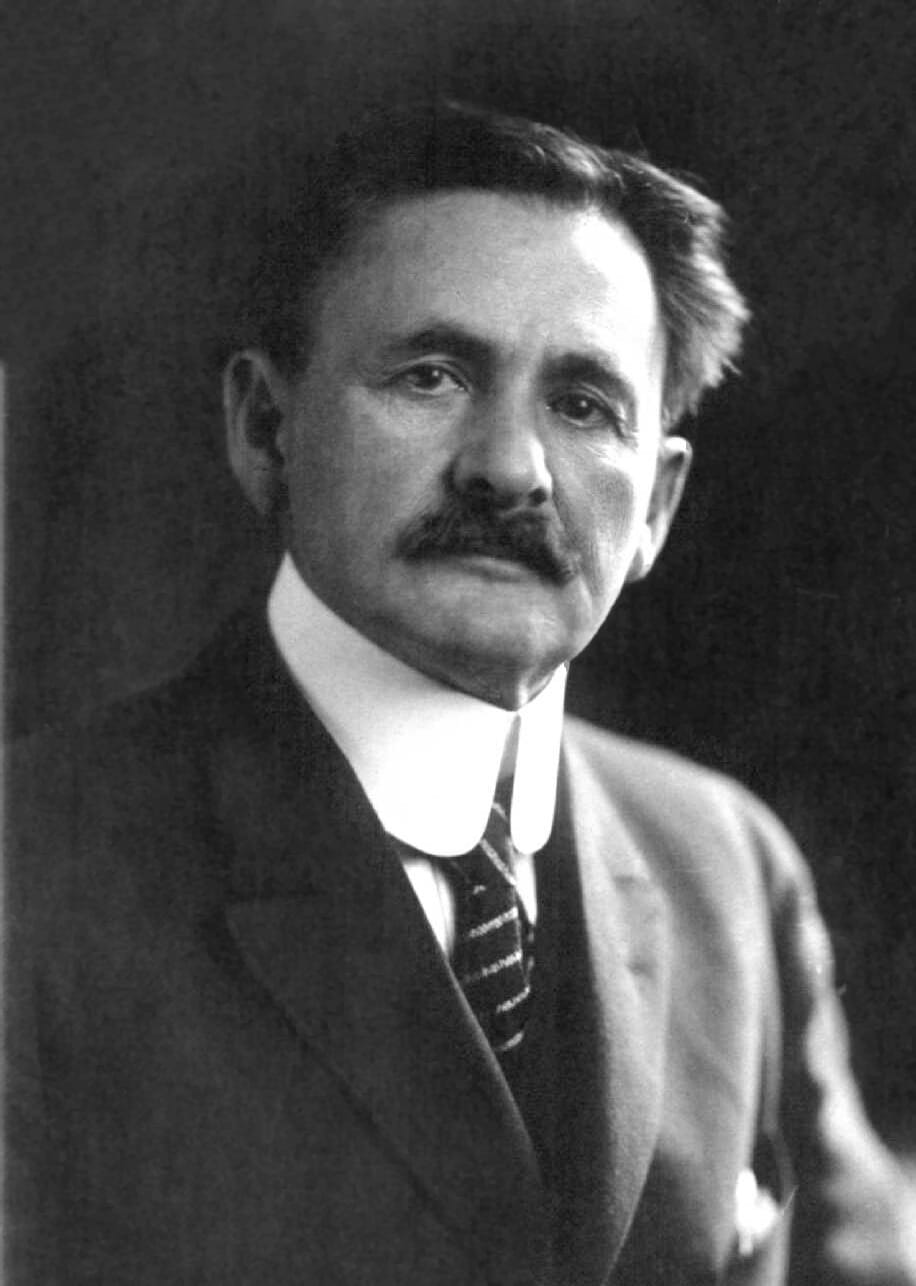
Albert Michelson had already built an instrument of the required sensitivity. With Edward Morley he built a better one and mounted it on a stone slab floating in a trough of mercury, so the whole apparatus could be rotated smoothly without vibration or flexing.
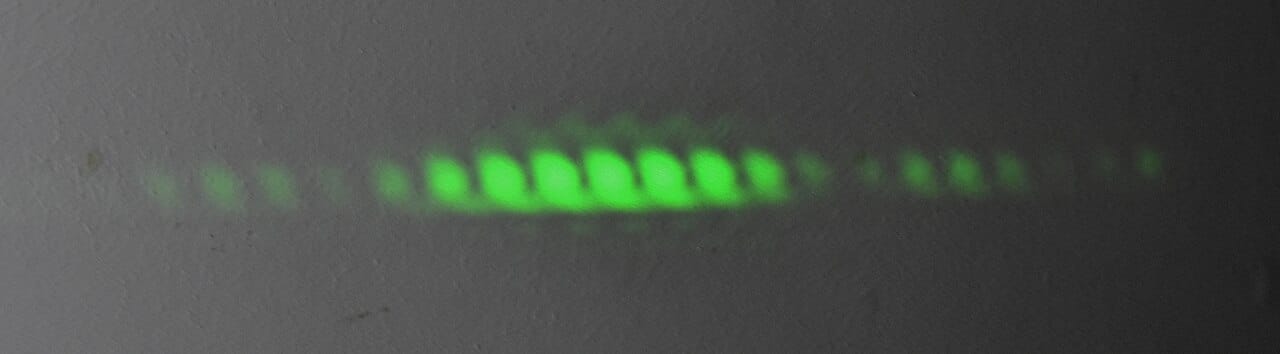
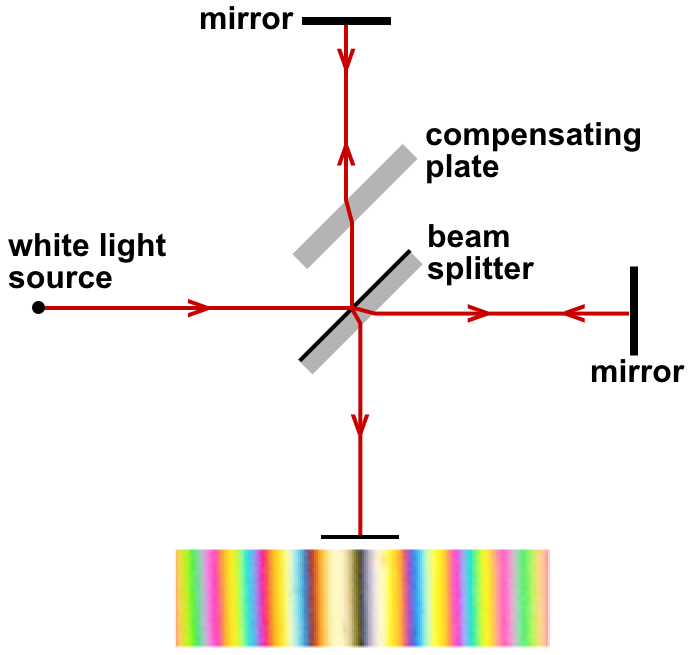
A beam of light was split in two, sent down perpendicular arms, reflected back by mirrors, and recombined. Recombined light waves interfere, producing a pattern of bright and dark fringes whose position depends with exquisite sensitivity on the difference in travel time between the two paths. Multiple reflections extended each arm to about eleven metres.
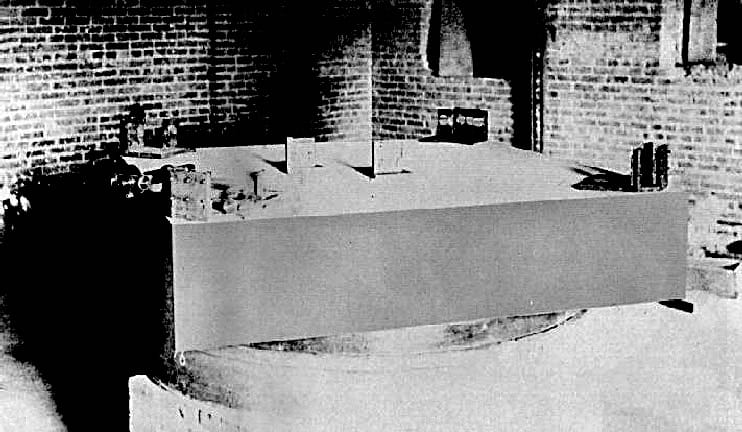
Rotating the apparatus should swing the arms between alignment with and perpendicularity to the Earth's motion, shifting the fringes by about four tenths of a fringe width. The instrument could resolve a hundredth. The measurement had a margin of forty to one.
The fringes did not move. Not by four tenths, not by anything the apparatus could detect. Michelson and Morley reported a displacement smaller than a fortieth of what was predicted, and considered the result a failure.
They repeated it at different times of year, in case the Earth happened to be momentarily at rest relative to the aether at the first attempt. Nothing changed. The experiment has since been repeated with lasers and optical cavities, and the modern limit on any such effect is smaller than the original prediction by seventeen orders of magnitude. It is among the most stringently tested null results in science.
The immediate response was rescue. George FitzGerald and Hendrik Lorentz independently proposed that objects moving through the aether contract along the direction of motion by exactly the amount needed to cancel the effect. This was mathematically successful and physically unmotivated, an adjustment whose only justification was that it saved the result.
Einstein's 1905 paper took the other route. Rather than explaining why the aether cannot be detected, he discarded it and took the constancy of the speed of light as a postulate: light travels at the same speed for every observer, whatever their motion. Everything strange in special relativity, time dilation, length contraction, the relativity of simultaneity, follows from that postulate and from the principle that physics is the same in all inertial frames.
The Lorentz contraction survives in relativity, no longer as a mechanical squeezing by an aether but as a consequence of the geometry of spacetime.
Einstein's own accounts of how much the experiment influenced him are inconsistent, and historians have argued the point for decades. He was certainly aware of the general failure to detect the aether, and he emphasised the theoretical asymmetries in electromagnetism as his starting point rather than any single experiment.
The experiment's importance does not depend on that question. It made the aether untenable to anyone attending to the evidence, and it remains the standard illustration of a fact worth stating plainly: an experiment that finds nothing, when something was firmly expected, can be worth more than one that finds what it was looking for.