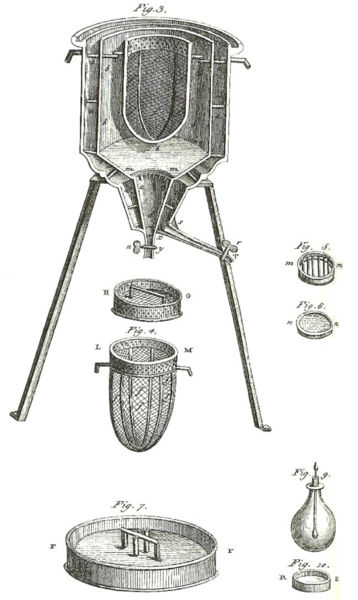
Firing alpha particles at gold foil and finding that a few bounced back. The result destroyed the prevailing model of the atom, established that nearly all its mass sits in a tiny central nucleus, and is the origin of every scattering experiment since.
J. J. Thomson had discovered the electron in 1897 and proposed the plum pudding model: a diffuse sphere of positive charge with electrons embedded in it, the whole thing roughly the size of the atom.
The model was reasonable. It accounted for the atom's neutrality and size and had no obvious competitor.
It makes a clear prediction about alpha particles, which are helium nuclei and were known to be fast and relatively massive. Passing through a diffuse cloud of charge, they should be deflected slightly and continuously, emerging at small angles like a bullet through fog.
Hans Geiger and Ernest Marsden performed the work at Manchester from 1909, under Ernest Rutherford's direction. Marsden was an undergraduate.
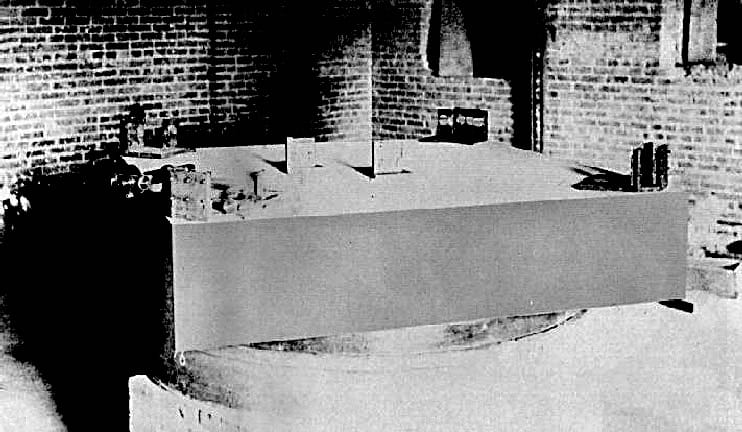
A radioactive source produced a collimated beam of alpha particles directed at a gold foil a few thousand atoms thick. A movable screen coated in zinc sulphide flashed when struck, and the flashes were counted by eye in a darkened room, which required the observers to sit in the dark for half an hour beforehand to adapt.
Most particles passed nearly straight through, as expected. A small fraction were deflected through large angles, and a very small fraction, roughly one in eight thousand, came back toward the source.
Rutherford's remark is the most quoted in experimental physics: it was, he said, about as credible as firing a fifteen-inch shell at tissue paper and having it come back and hit you.
A diffuse charge cannot reverse a fast massive particle. Turning one around requires an enormous force in a very small region, which means the positive charge and essentially all the mass must be concentrated in a tiny volume.
Rutherford worked out the mathematics in 1911, deriving how the number of particles scattered should vary with angle if the deflection came from a point charge obeying the inverse square law. The prediction matched the measurements across a large range of angles, which is what turned a striking observation into a quantitative result.
The nucleus is roughly one ten-thousandth the diameter of the atom, so it occupies about a trillionth of the volume. An atom is overwhelmingly empty. The reason matter feels solid is electromagnetic repulsion between electron clouds, not any physical filling of space.
Rutherford's atom had a problem he acknowledged. Electrons orbiting a nucleus are accelerating charges, and accelerating charges radiate energy. A classical orbiting electron would spiral into the nucleus in a fraction of a nanosecond.
Niels Bohr, who had worked in Rutherford's laboratory, proposed in 1913 that electrons occupy only certain allowed orbits and radiate only when moving between them. This was an assertion rather than an explanation, and it worked: it predicted the hydrogen spectrum accurately. The proper account came with quantum mechanics a decade later.
The technique is now the standard way of investigating anything too small to see. Fire particles at a target, measure how they scatter, and infer the structure that produced the pattern.
The same logic, at vastly higher energies, revealed that protons and neutrons themselves contain quarks: deep inelastic scattering at Stanford in the late 1960s found a hard sub-structure inside the proton, and the analysis was recognisably Rutherford's. Every particle collider since is a descendant of a foil, a screen, and two people counting flashes in the dark.