An intrinsic form of angular momentum carried by particles, with no counterpart in classical physics. Nothing is rotating, the quantity is quantised, and it determines the structure of matter and the periodic table.
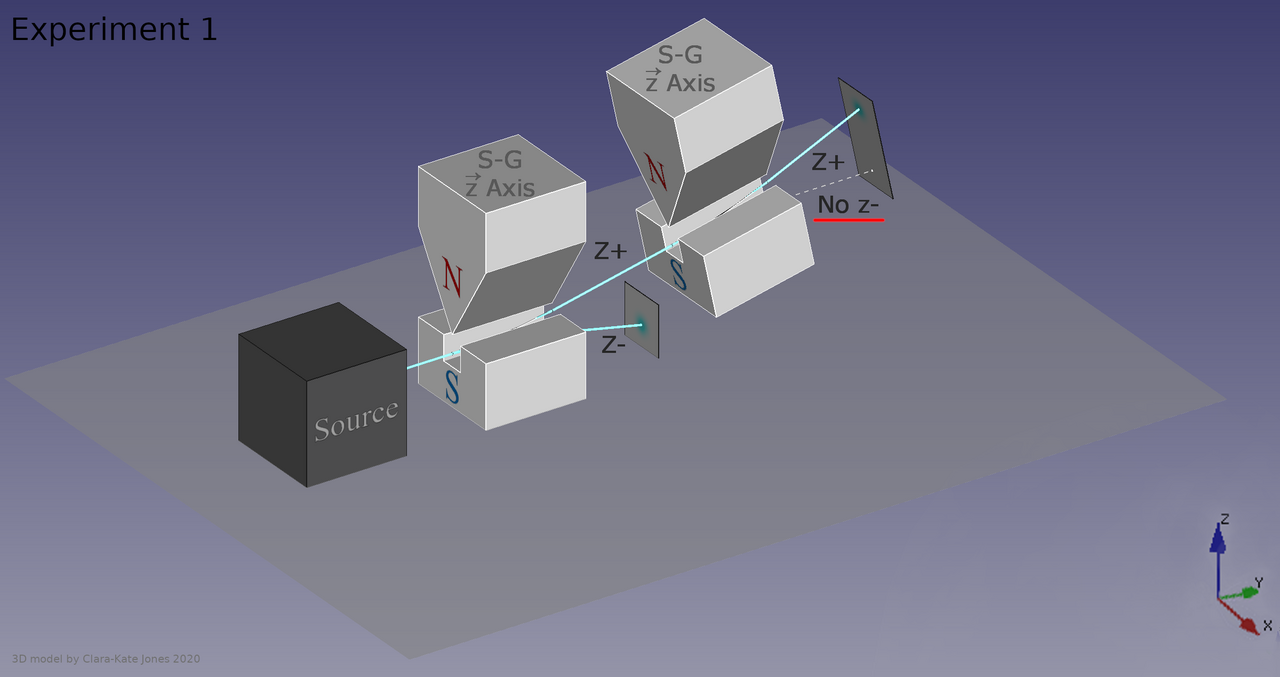
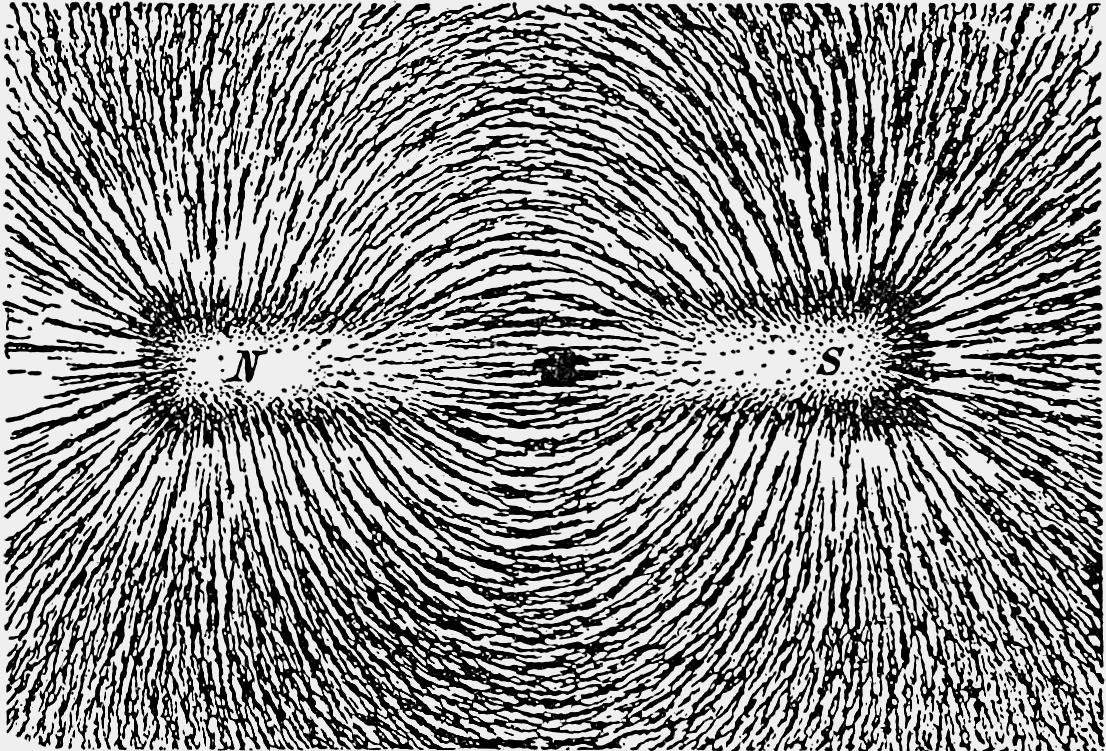
Otto Stern and Walther Gerlach passed a beam of silver atoms through a non-uniform magnetic field in 1922.
Classically, atoms with magnetic moments oriented at random should be deflected by a continuous range of amounts, producing a smear on the detector.
The beam split into two discrete spots.
This established that the magnetic moment takes only two values along the measurement axis. Something about the atom is quantised in a way that permits exactly two outcomes.
The result predates the interpretation. Spin was proposed in 1925 by George Uhlenbeck and Samuel Goudsmit to explain features of atomic spectra, and Wolfgang Pauli had already introduced a two-valued quantum number without a physical picture for it.
The name is misleading and the misleading picture is worth removing explicitly.
Spin is not rotation. Uhlenbeck and Goudsmit initially proposed a spinning electron, and the idea fails quantitatively: for an electron of any plausible size to carry the observed angular momentum, its surface would have to move far faster than light. Pauli objected on exactly this ground.
The electron is also a point particle as far as experiment can determine, with no measured internal structure, so there is nothing to rotate.
Spin is an intrinsic property, like charge or mass. A particle has it in the way it has a charge, not as a consequence of doing anything.
It nonetheless behaves as angular momentum in every respect that matters: it adds to orbital angular momentum, it is conserved, and it produces a magnetic moment.
Spin is measured in units of the reduced Planck constant and takes values that are either integers or half-integers.
Electrons, protons and neutrons have spin one half. Photons have spin one. Composite particles have spin determined by their constituents.
Measured along any axis, a spin-one-half particle gives one of exactly two results, conventionally up or down. This holds for any axis chosen, and measuring along one axis destroys information about the others, which is a direct instance of the uncertainty principle treated in its own capsule.
The division of particles into two classes by spin is among the most consequential facts in physics.
Fermions have half-integer spin and obey the Pauli exclusion principle: no two identical fermions can occupy the same quantum state.
Bosons have integer spin and are subject to no such restriction, and can occupy the same state in unlimited numbers.
The consequences of the first are enormous. Electrons in an atom must occupy different states, which is why they fill successive shells rather than all collapsing into the lowest. The entire structure of the periodic table, and therefore all of chemistry, follows from this.
It is also why matter is rigid. Solid objects resist being pushed into one another because their electrons cannot occupy the same states, not because of electrostatic repulsion alone.
At astronomical scale, the same principle supports white dwarfs and neutron stars against gravity, as the neutron stars capsule describes.
Boson behaviour produces the opposite: lasers, in which many photons occupy one state, and superfluidity and Bose-Einstein condensates, in which large numbers of atoms do the same.
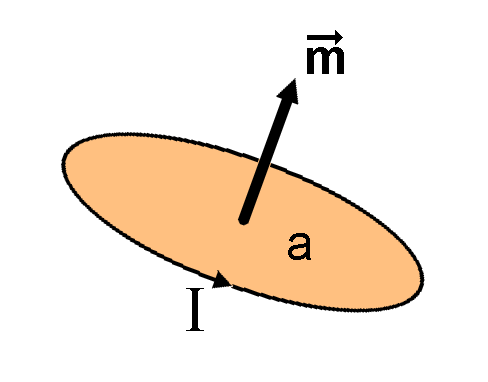
Magnetic resonance imaging depends on it directly. Hydrogen nuclei have spin, align in a strong magnetic field, and are tipped by radio pulses; the signal emitted as they realign is the image. The brain imaging capsule describes the application.
Nuclear magnetic resonance spectroscopy uses the same physics to determine molecular structure, and is a standard chemical technique.
Magnetism in materials arises from the alignment of electron spins, and ferromagnetism is a collective alignment.
Data storage in hard drives encodes information in magnetic domains, and giant magnetoresistance, which made high-density drives possible, is a spin effect and earned the 2007 Nobel Prize.
Spintronics aims to use spin rather than charge to carry information in devices, and quantum computing uses spin states as one physical implementation of a qubit.
Spin is the clearest case of a quantum property with no classical analogue whatsoever, which cannot be explained by analogy and must be accepted as a description of what particles are.
It is also the property from which the structure of ordinary matter follows. That atoms have shells, that the periodic table has the shape it does, and that solid objects cannot pass through one another are all consequences of a two-valued quantity that was first noticed as a beam of silver atoms splitting in two.