Send particles one at a time through two narrow openings and they build up a pattern that only waves can produce. Watch which opening each one goes through and the pattern disappears. Richard Feynman called it the only mystery in quantum mechanics, and said everything else could be derived from thinking hard about it.
Thomas Young performed the original in 1801 to settle whether light was a wave or a stream of particles.
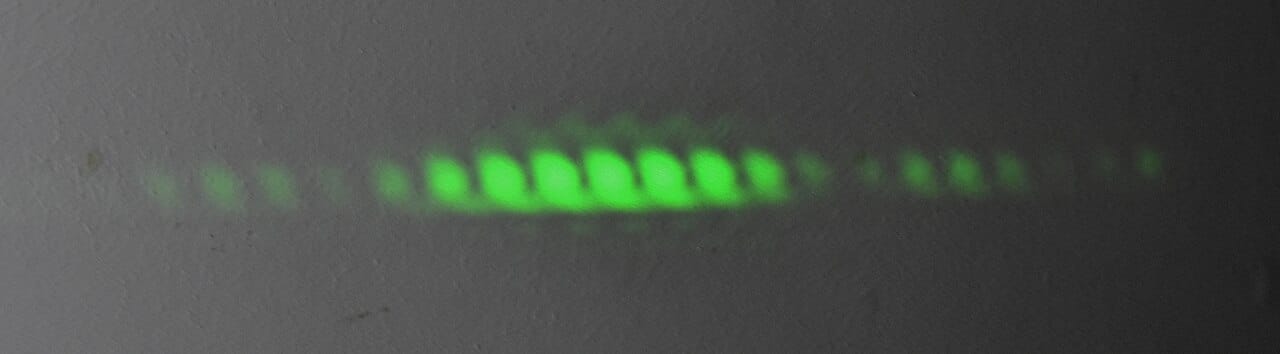
Light through two closely spaced slits produced alternating bright and dark bands on a screen behind. Bands are what waves do: where crests meet crests the light reinforces, where a crest meets a trough it cancels. Particles travelling in straight lines would produce two bright strips and nothing else.
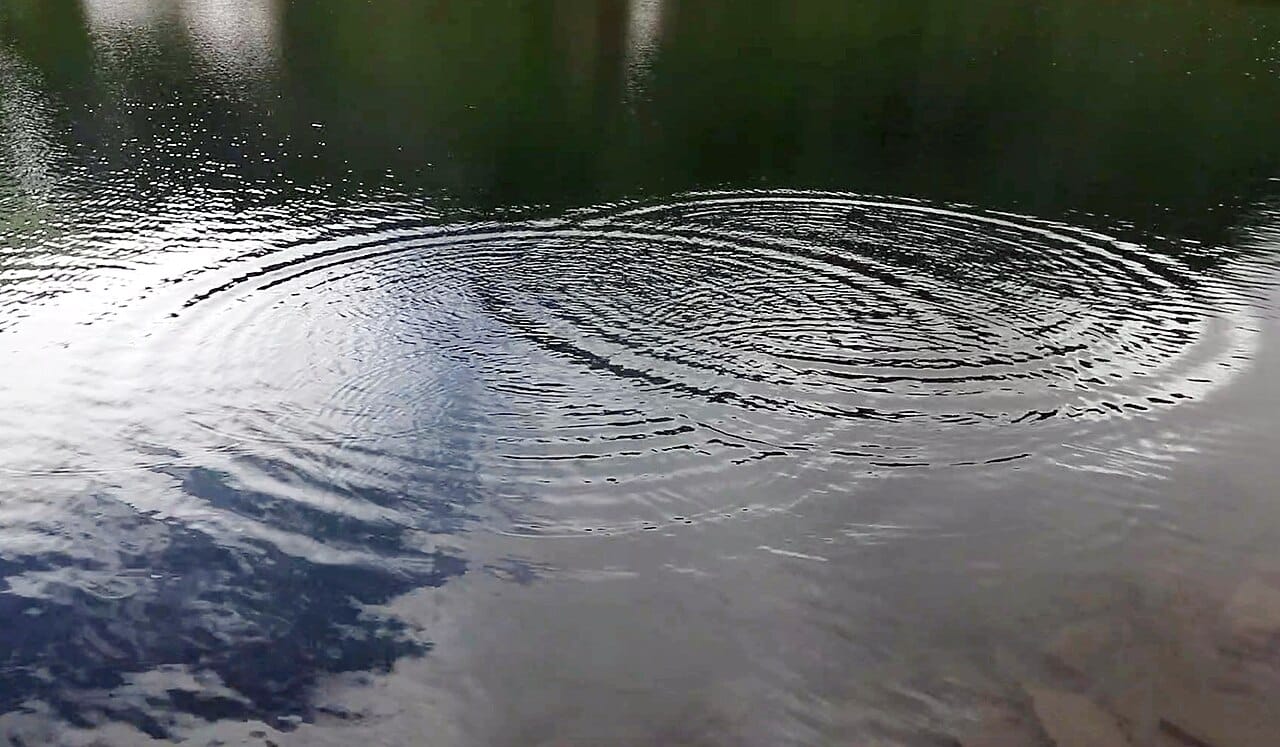
Young's result was taken as settling the question. Light was a wave, and the corpuscular theory Newton had favoured was finished.
The interesting version fires particles individually, so that only one is in the apparatus at a time and none can interfere with another.
Each particle arrives at a single point on the detector, as a particle must. But the accumulated pattern of thousands of individual arrivals is the interference pattern, bands and all.
This has been done with electrons, first convincingly by Claus Jonsson in 1961 and then one electron at a time by Akira Tonomura's group in 1989, whose film of the pattern assembling from apparently random dots is the standard demonstration. It has since been done with neutrons, atoms, and molecules as large as several hundred atoms, including molecules of over 2,000 atoms in 2019.
The size record matters because it shows the effect is not a peculiarity of tiny things. It is the general behaviour, and it becomes unobservable for large objects only because their wavelength shrinks below anything measurable.
Place a detector at the slits to record which one each particle passes through, and the interference pattern vanishes. What remains is two strips, the classical particle result.
This is not a matter of clumsy measurement disturbing a delicate system, which was the early explanation and is not adequate. The pattern is destroyed by the availability of the information, not by the momentum imparted in obtaining it.
Quantum eraser experiments demonstrate this directly. The which-path information is recorded and then destroyed before the results are examined, and the interference returns. The physical interaction at the slits was identical in both cases; only whether the path information survived was different.
Delayed-choice versions, proposed by John Wheeler and performed since, make the decision to record path information after the particle has already passed the slits. The outcome still corresponds to the choice made. This does not mean the past is changed; it means the question of which slit the particle went through has no answer until the measurement determines what question was asked.
Two things, and they are worth separating from the interpretations attached to them.
Quantum objects are described by amplitudes that add, and the observed probability is the square of the summed amplitude rather than the sum of squared amplitudes. That is the whole of the mathematics, and it is not controversial.
The description available depends on what measurement is performed. There is no consistent story in which each particle went through one definite slit and the pattern arose anyway, and this has been checked with considerable care.
The mathematics is agreed and the results are reproduced routinely in undergraduate laboratories. What is happening is not agreed.
The Copenhagen reading holds that the wavefunction is a tool for computing probabilities and that asking which slit the particle went through is not a meaningful question. Many-worlds holds that both outcomes occur in branches that no longer interact once the path is recorded. Pilot wave theory holds that the particle does go through one slit while a real wave passes through both and guides it, which reproduces every result at the cost of explicit non-locality.
No experiment yet distinguishes them. The interpretations capsule treats this at length; the experiment itself is what all of them must account for, which is why it remains the standard place to begin.