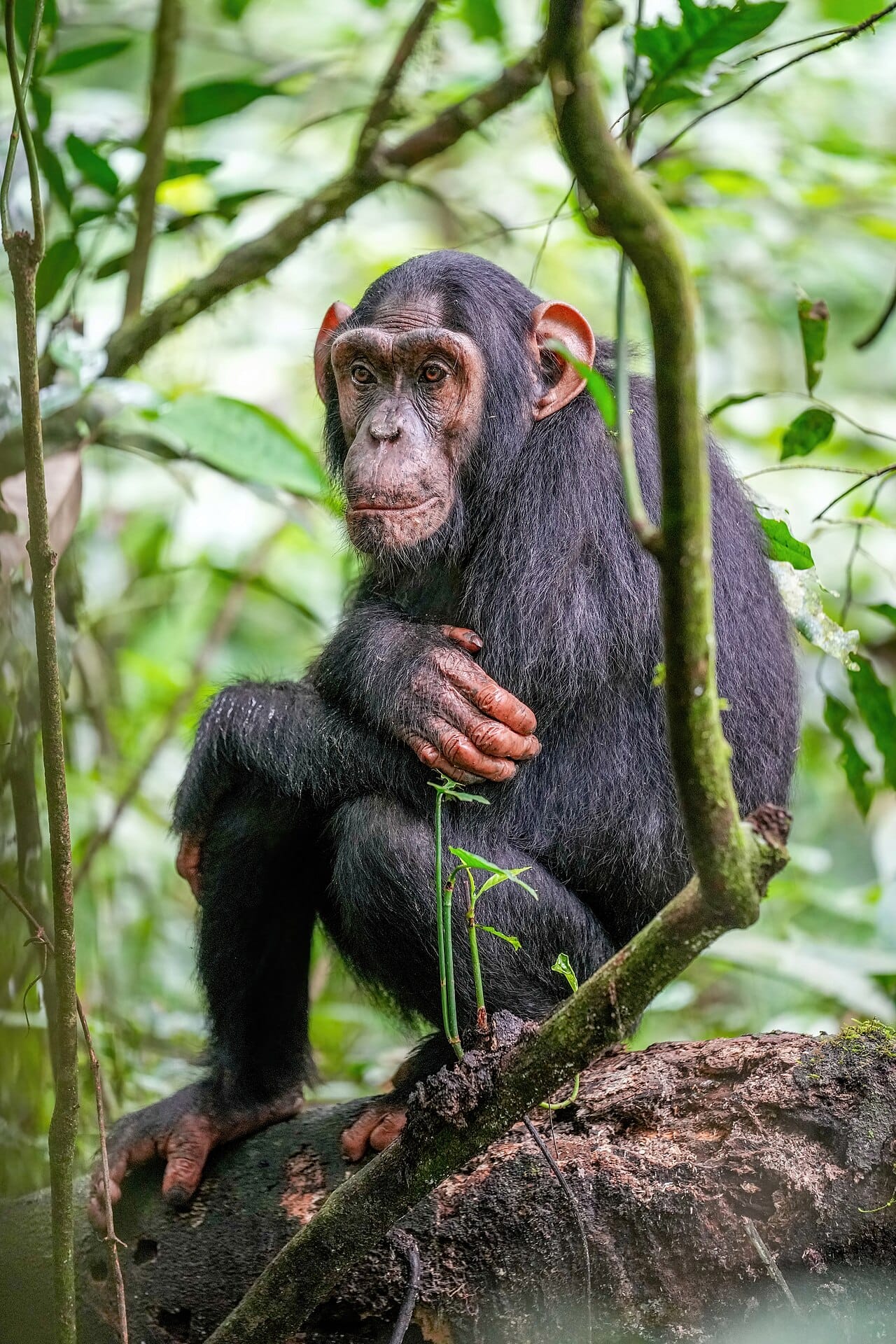
The chimpanzee, Pan troglodytes, is one of the two species of the genus Pan and, with the bonobo, the closest living relative of human beings. It is a forest and woodland ape of equatorial Africa, it makes and uses tools, it has local traditions that differ between neighbouring groups, and it is endangered.
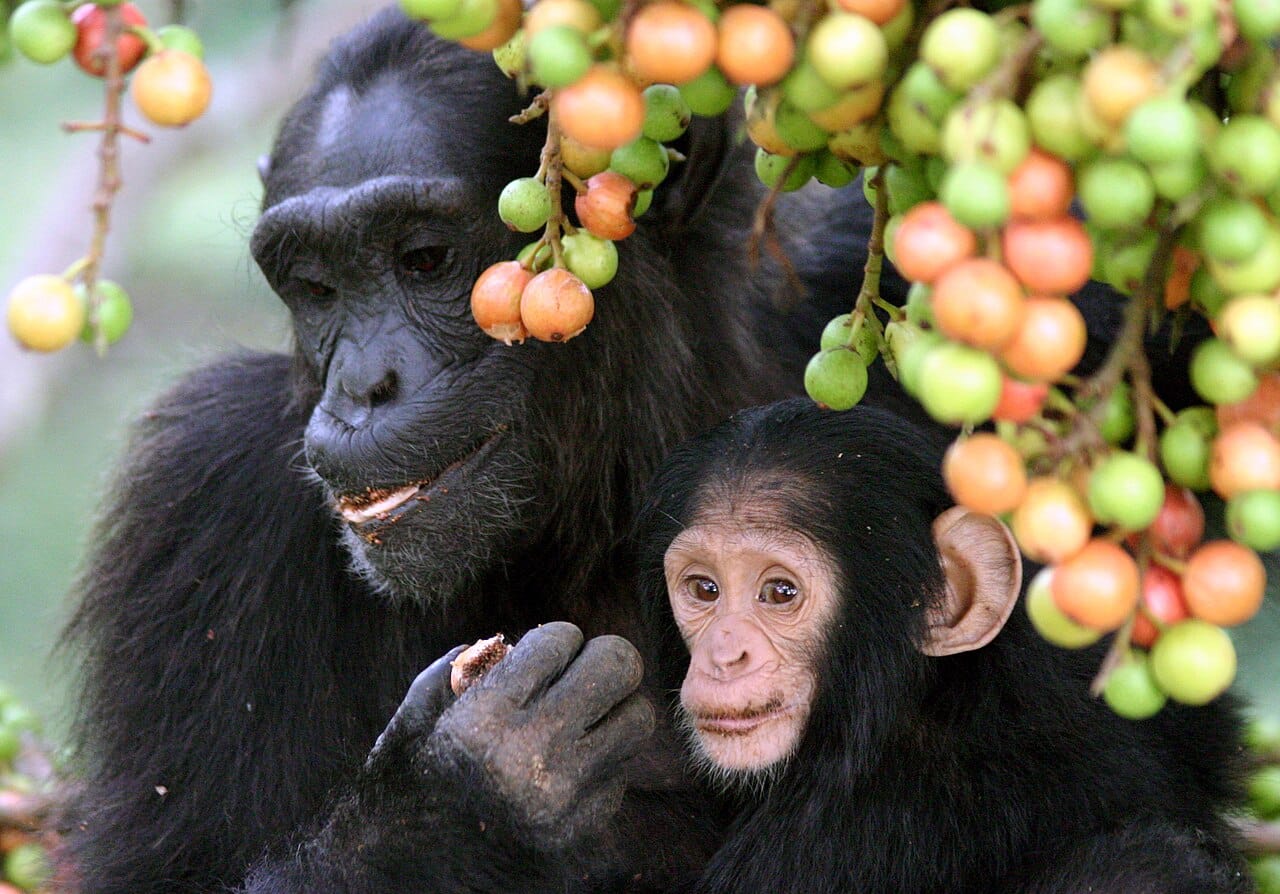
Chimpanzees are large apes, with adult males typically 40 to 60 kilograms in the wild and females somewhat smaller. They are strong for their mass in ways that are often exaggerated in popular accounts but are real: muscle fibre composition differs from ours, with a higher proportion of fast-twitch fibre, and the trade-off is endurance.
They move on the ground by knuckle-walking and climb readily, feeding and nesting in trees. Every chimpanzee builds a fresh sleeping nest in a tree most nights, bending and weaving branches, which is among the most consistent behaviours in the species.
The diet is omnivorous and mostly fruit, with leaves, pith, seeds, insects and meat. Hunting is real and social: groups of males pursue red colobus monkeys in coordinated fashion, and the meat is shared in patterns that track social relationships rather than who made the kill.
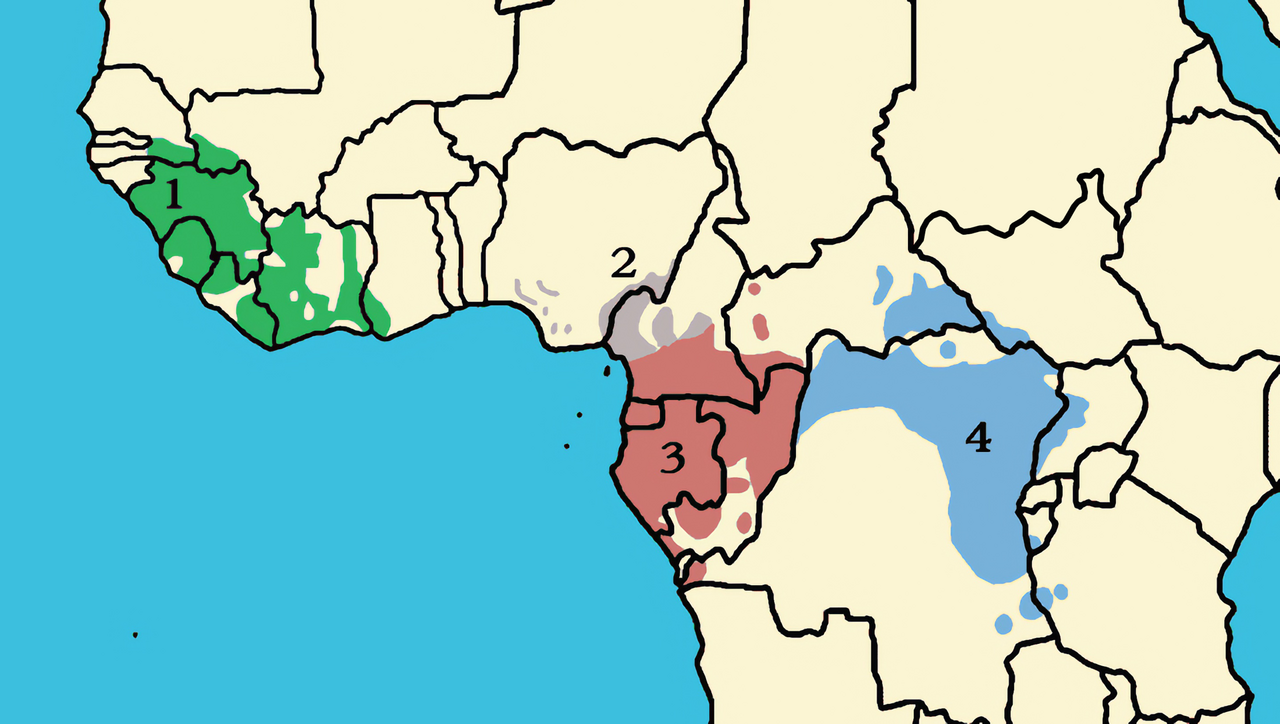
The range runs across equatorial Africa from Senegal in the west to Tanzania in the east, in rainforest, forest mosaic and, at the dry margins, wooded savanna. Four subspecies are recognised, and the western chimpanzee of upper Guinea is the most threatened of them.
The savanna-living populations, at Fongoli in Senegal and elsewhere, are of particular interest because they occupy the kind of open, hot, water-scarce habitat that early hominins are thought to have used, and they do things forest chimpanzees do not, including soaking in water and hunting bushbabies with sharpened sticks.
The claim that chimpanzees make and use tools was Jane Goodall's from Gombe in 1960, and it forced a redefinition of what had been taken as the boundary of the human. Her observation was of termite fishing: stripping a grass stem and inserting it into a mound.
The list has grown long. Chimpanzees crack nuts with stone and wooden hammers on anvils, dip for ants with wands of graded length, sponge water with chewed leaves, use leaf pads to sit on wet ground, and in some populations use a two-part tool set in sequence, which is a genuinely different cognitive proposition from a single tool.
What matters more than the list is that the behaviours differ by group in ways that ecology does not explain. Nut-cracking is universal in some West African populations and absent in East African ones living with the same nuts and the same stones. Those differences are learned and transmitted socially, which is what the word culture means here, and chimpanzee culture is now the standard framing rather than a contested one.
Chimpanzees live in communities of roughly twenty to more than a hundred and fifty, which split and rejoin in smaller parties through the day. This fission-fusion pattern means an individual rarely sees all of its community at once and must keep track of relationships across time.
Males are philopatric and stay in their birth community; females usually transfer out at adolescence. Male dominance hierarchies are real, contested, and heavily political: alliances between males decide outcomes that individual strength does not, and a coalition of two can and does unseat a larger animal.
Lethal intergroup violence is well documented. Males patrol territorial boundaries and attack lone individuals of neighbouring communities, sometimes over years, and the four-year destruction of the Kahama community at Gombe in the 1970s remains the best documented case. Whether this is normal chimpanzee behaviour or a consequence of human disturbance and provisioning was argued for decades; a large multi-site analysis published in 2014 found the pattern tracked ecological factors rather than human impact, and the naturalistic reading is now the majority one.
Chimpanzee and human genomes are commonly quoted as about 98.8 per cent identical. The figure is real but describes only single-base substitutions in alignable sequence. Counting insertions and deletions brings the divergence to roughly four or five per cent, and neither number tells you much on its own, because what matters is which sequences differ and what they regulate.
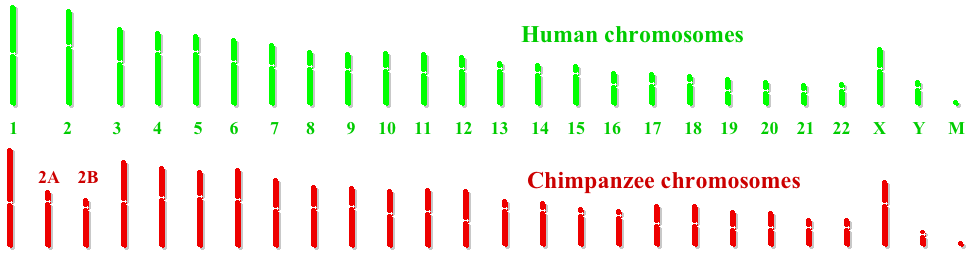
The clearest structural difference is chromosomal. Humans have 23 pairs of chromosomes and chimpanzees, gorillas and orangutans have 24. Human chromosome 2 corresponds to two separate chimpanzee chromosomes fused end to end, and the fusion site retains the telomere sequences and a vestigial second centromere that mark exactly what happened. This was a testable prediction of common ancestry that could have failed and did not.
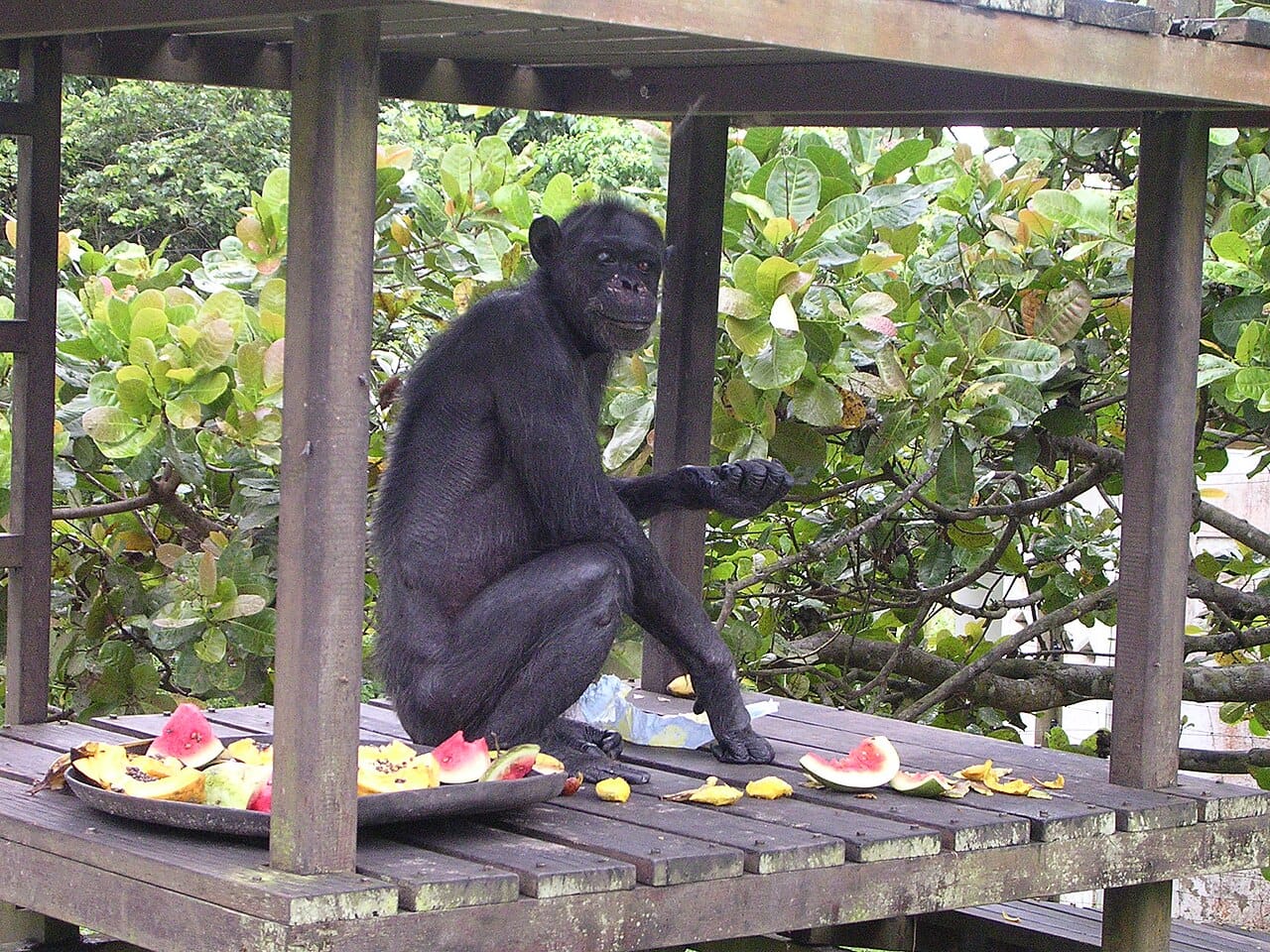
That chimpanzees are intelligent is not in dispute. What is disputed is whether they have a theory of mind: whether they represent what another individual believes, rather than tracking what another individual can see and predicting from behaviour.
Decades of experiments have gone both ways. Chimpanzees clearly track visual access and use it competitively, taking food a dominant cannot see. Experiments using anticipatory looking published from 2016 onward suggested apes anticipate an actor's mistaken search, which would imply representing a false belief. Critics argue those results are better explained by simpler mechanisms of behaviour reading, and that the field has repeatedly mistaken sophisticated prediction for mental attribution.
The question is not settled, and its stakes are larger than the experiments, because the answer bears directly on how the difference between chimpanzees and people is described.
The chimpanzee is Endangered. Numbers have fallen steeply through habitat loss to logging and agriculture, hunting for bushmeat, and disease. Ebola has killed very large numbers of apes in central Africa, and human respiratory viruses transmitted by researchers and tourists are a documented cause of death at study sites.
The western chimpanzee was reclassified as Critically Endangered in 2016 after an estimated decline of about eighty per cent in twenty-five years.
The chimpanzee has served, unhelpfully, as a mirror. For most of the twentieth century it was read as a demonstration of whatever a writer already believed about human nature, either the violent ape beneath the civilised surface or the gentle vegetarian corrupted by us. It is neither. It is a species with its own long history, doing things that are difficult to see clearly precisely because we keep looking for ourselves in it.