Procedures for selecting officeholders by vote. The rules by which votes are converted into outcomes are not neutral machinery: different systems produce different results from identical votes.
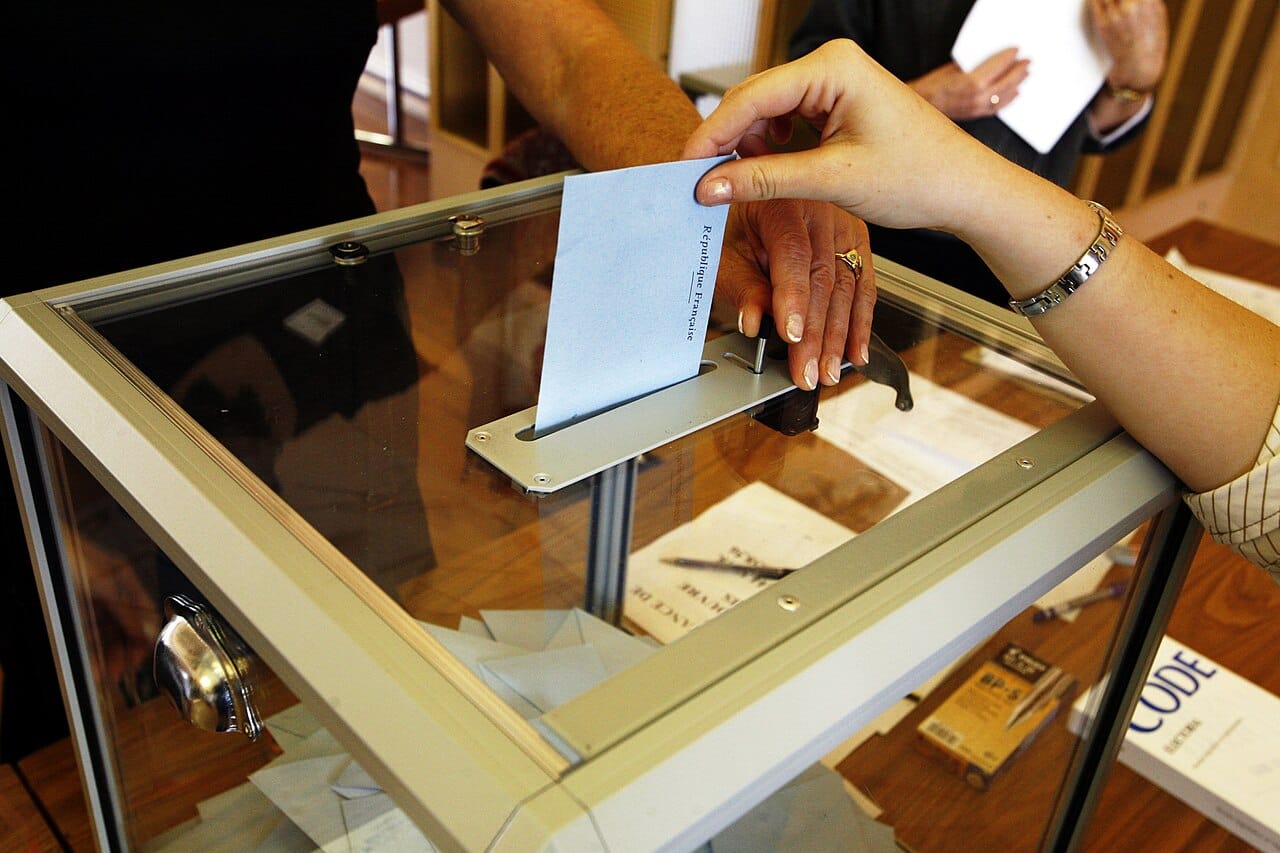
An election must establish who may vote, how preferences are expressed, how votes are aggregated, and how disputes are resolved.
Each of those is a design decision with consequences, and the choices interact. A system is judged on several criteria that cannot be satisfied simultaneously: proportionality between votes and seats, a clear link between a representative and a locality, the production of stable governing majorities, and simplicity for voters.
First past the post elects whoever receives most votes in a single-member district, with no requirement for a majority. It is simple, produces a clear local representative, and translates votes into seats poorly: a party with widely spread support can win many votes and few seats, while regionally concentrated support is rewarded.
Two-round systems hold a runoff between the leading candidates if nobody reaches a majority, ensuring the winner has majority support in the final round.
Ranked choice, also called instant-runoff or alternative vote, has voters rank candidates, with the lowest eliminated and their votes redistributed until someone has a majority. It removes the need for a second election and allows support for a preferred candidate without wasting a vote.
Proportional representation allocates seats in proportion to votes, generally in multi-member districts or from party lists. It produces close correspondence between votes and seats and commonly requires coalition government, and it weakens the link between a representative and a specific locality.
Mixed systems combine local single-member seats with a proportional component, as in Germany and New Zealand.
The Single Transferable Vote uses ranking in multi-member districts, achieving proportionality while retaining ranked individual candidates rather than party lists.

Duverger's law, treated in its own capsule, holds that first past the post tends toward two-party competition while proportional systems sustain more parties. The mechanism is that voters abandon candidates who cannot win locally, and smaller parties are squeezed.
District boundaries matter enormously in single-member systems. Drawing them to advantage one party, known as gerrymandering, can produce legislative majorities from minorities of votes, and is done by concentrating opposing voters into a few districts or spreading them thinly across many.
Thresholds in proportional systems exclude parties below a minimum share, which prevents fragmentation and excludes support.
None of these is a defect to be engineered away. Every system embeds a judgement about what representation is for, and the trade between proportionality and stable majorities has no technical solution.
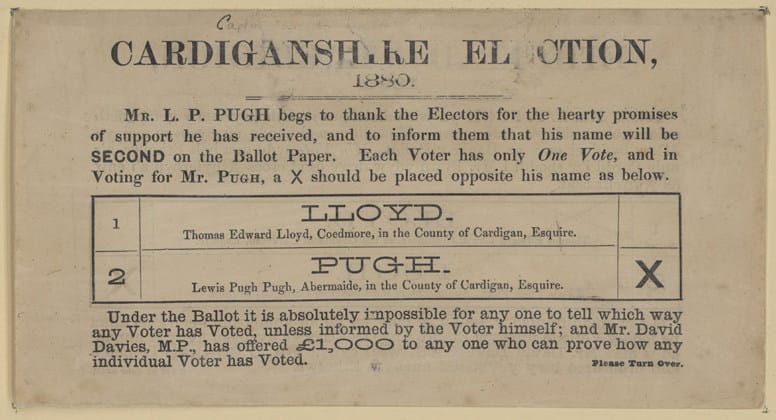
Voting was historically public in many systems, either declared aloud or cast using papers supplied by parties in distinguishable colours.
Public voting permits intimidation and vote buying, since compliance can be verified. The secret ballot removes that verification, which is what makes it effective.
The Australian ballot, a uniform paper printed by the state listing all candidates and marked in private, was adopted from the 1850s and spread widely over the following decades.
Secrecy remains a live issue with postal and electronic voting, since a ballot completed outside a polling station cannot be guaranteed free from observation.
Holding an election is not sufficient, and the distinction between elections and democratic elections is the substance of a great deal of election observation.
Competitiveness requires that opposition candidates can stand, campaign and reach voters.
Administration must be impartial, with registration, counting and dispute resolution not controlled by an interested party.
Information must be available, which requires media that are not entirely controlled.
Acceptance of results, and the transfer of power following defeat, is the outcome that demonstrates the rest was genuine.
Authoritarian states hold elections routinely, and their function is to demonstrate support and to distribute patronage rather than to risk power, which is why the presence of an election says little on its own.
Elections are the mechanism by which democratic legitimacy is claimed, and the rules converting votes into outcomes determine what that legitimacy amounts to.
The practical point is that electoral system design is a political question presented as a technical one. Identical votes produce different governments under different rules, and whoever chooses the rules is making a choice about outcomes.