Duverger's law states that an electoral system in which the single candidate with the most votes wins each district tends to produce two dominant parties, while proportional systems tend to produce multi-party politics. It is among the most cited generalisations in political science and among the most argued over.
Maurice Duverger set the argument out in the 1950s, and it rests on two effects working together.
The mechanical effect is arithmetic. In first-past-the-post, votes for anyone but the local winner elect nobody, so a party with substantial support spread evenly across a country can win few seats or none. Seat shares are therefore far more concentrated than vote shares.
The psychological effect follows from the mechanical one. Voters who understand that a third party cannot win locally switch to whichever of the leading two they prefer, rather than waste a vote. Donors and candidates make the same calculation. The effect is self-reinforcing, since expectations of futility produce the futility.

The correlation is strong and holds broadly. The United States has an unusually stable two-party system under first-past-the-post. Proportional systems in continental Europe, Israel, and elsewhere reliably return many parties and coalition government. Countries that have changed system have generally seen their party systems change accordingly, and New Zealand's move from first-past-the-post to a mixed proportional system in 1996 is the cleanest natural experiment: the party system fragmented and coalitions became the norm, as predicted.
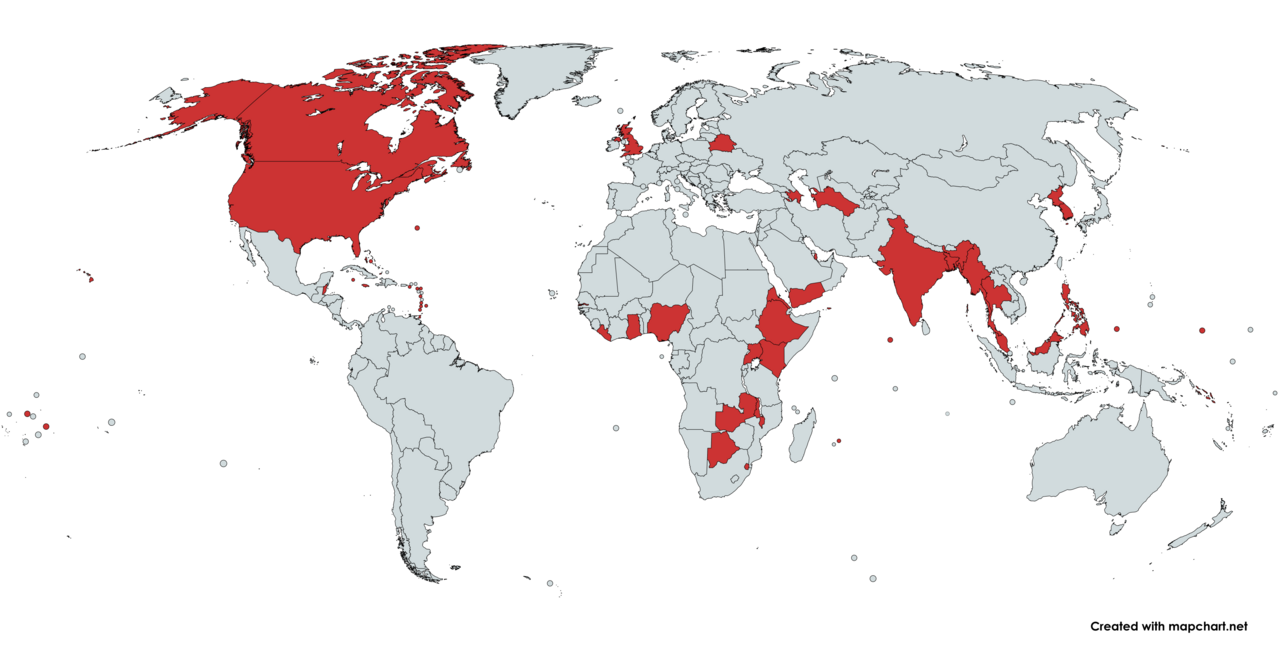
India and Canada. Both use first-past-the-post and sustain more than two significant parties nationally. The usual response is that Duverger's law operates at district level, and that a country can have many parties nationally while each district contests between two, provided the parties are regionally concentrated. Critics regard this as a substantial weakening, since it makes the law compatible with almost any national outcome.
The United Kingdom. Long treated as a two-party case, it has sustained a significant third party and strong nationalist parties for decades, again regionally patterned.
Direction of causation. Societies with two dominant cleavages may adopt majoritarian systems, rather than the system producing the parties. Political systems are usually chosen by the parties already in existence, which have an obvious interest in the rules.
Not a law. Duverger himself described it as a sociological tendency rather than a law in the physical sense, and William Riker's influential reassessment concluded it holds as a probabilistic tendency with real exceptions rather than as a deterministic rule. The name has arguably done the idea a disservice.
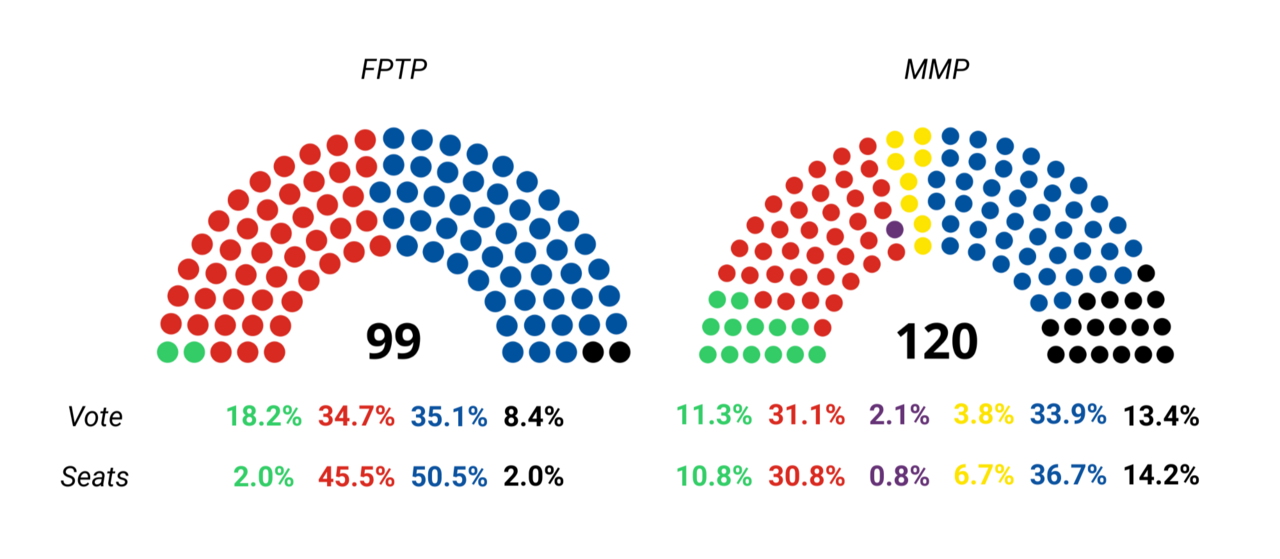
The relationship is the central argument in every debate about electoral reform. Supporters of proportional representation cite it to argue that majoritarian systems suppress genuine political diversity and waste large numbers of votes. Supporters of first-past-the-post cite the same relationship in reverse, arguing that it produces decisive single-party government and a clear line of accountability, and avoids the coalition bargaining in which small parties can extract concessions out of proportion to their support. Both are reading the same finding and valuing different things.