The quantum of the electromagnetic field, the smallest possible amount of light at a given frequency. It has no mass, always travels at the speed of light, and its recognition forced the abandonment of the purely wave account of light.
Max Planck introduced quantisation in 1900 to solve the problem of thermal radiation, proposing that energy is exchanged in discrete amounts proportional to frequency. He regarded it as a mathematical device rather than a physical claim.
Einstein took it literally in 1905, arguing that light itself consists of discrete quanta, and used the proposal to explain the photoelectric effect.
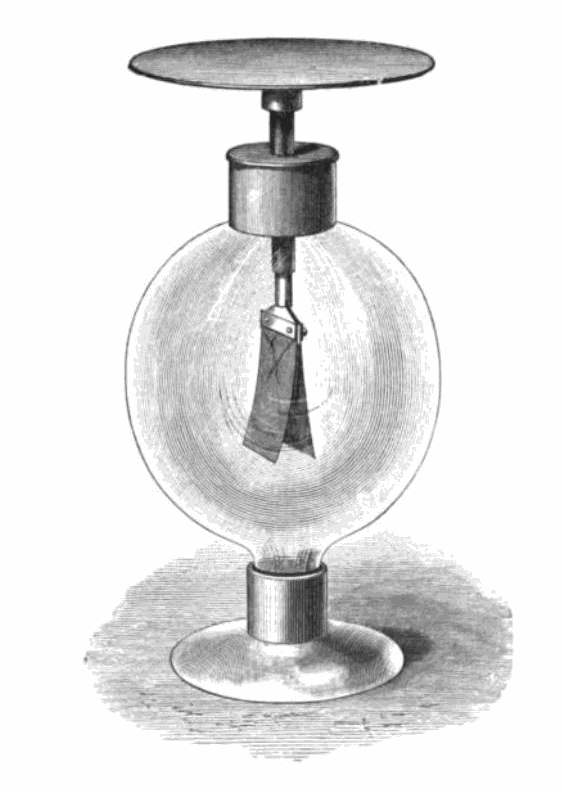
The photoelectric effect is the release of electrons from a metal struck by light, and its details contradict the wave account directly. Whether electrons are emitted depends on the frequency of the light and not its intensity: below a threshold frequency, no electrons are released however bright the light and however long one waits.
A wave delivering energy continuously should allow any frequency to work given sufficient intensity or time. A stream of quanta, each carrying energy proportional to frequency, produces exactly the observed behaviour, since a single quantum below the threshold energy cannot free an electron regardless of how many arrive.
Einstein received the Nobel Prize for this work rather than for relativity. Robert Millikan spent a decade attempting to disprove the prediction and confirmed it precisely instead, and received a Nobel Prize partly for that measurement.
The name photon was coined by Gilbert Lewis in 1926, two decades after the concept.
A photon carries energy proportional to frequency, so blue light delivers more energy per photon than red, which is why ultraviolet damages tissue and infrared does not at comparable intensity.
It carries momentum despite having no mass, which is why radiation pressure exists and why solar sails work.
It has no rest mass, and this is required rather than incidental: anything travelling at the speed of light must be massless.
It has spin one, making it a boson, so any number can occupy the same state, which is what makes lasers possible as the quantum spin capsule describes.
It is its own antiparticle.
It mediates the electromagnetic force. In quantum field theory, the interaction between charged particles is described as an exchange of photons, so the photon is not only light but the carrier of one of the fundamental forces.
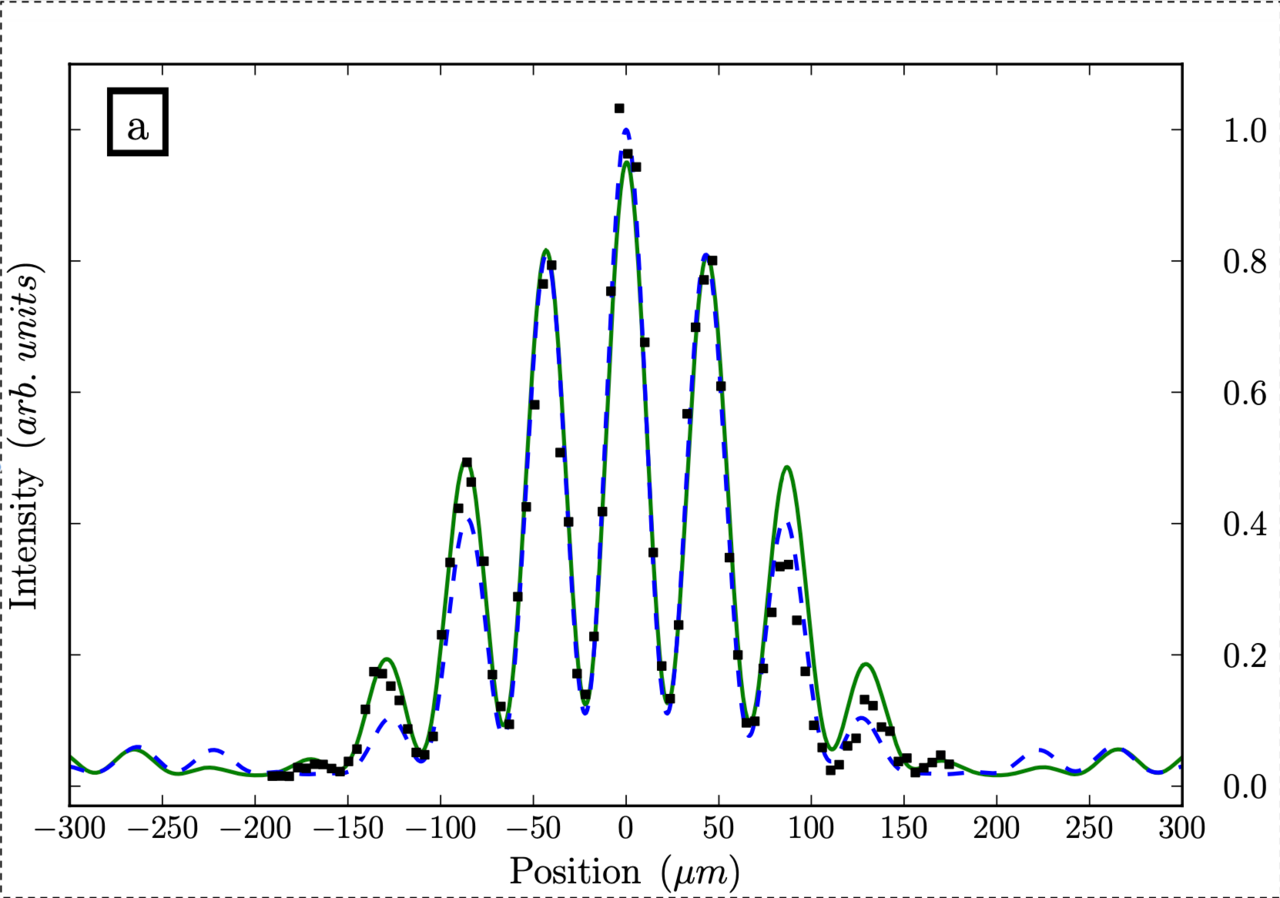
The photon does not restore a simple particle picture of light. Light still produces interference and diffraction, which require wave behaviour, and the double slit experiment produces an interference pattern even when photons arrive one at a time.
The correct statement is that light is neither a classical wave nor a classical particle, and the wave-particle duality capsule treats the general case.
A photon is not a small bullet. It has no definite position until detected, its behaviour is described by a wavefunction, and the particle aspect appears in how energy is exchanged rather than in the light travelling as a localised object.
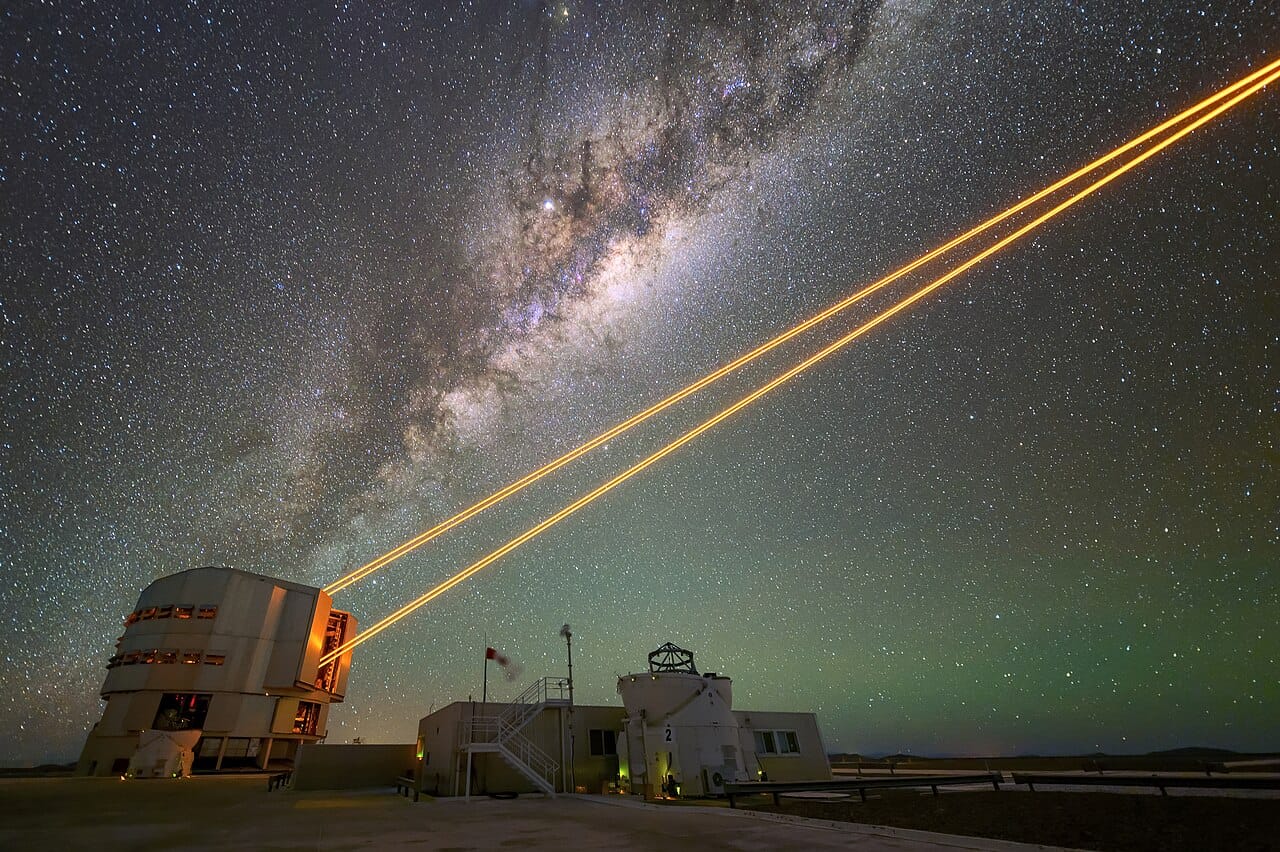
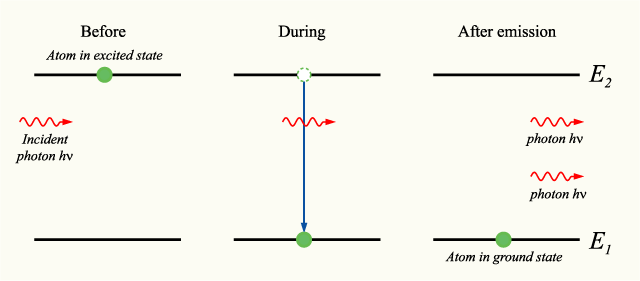
Lasers depend on stimulated emission, predicted by Einstein in 1917: an incoming photon causes an excited atom to emit a second photon identical in frequency, phase and direction. Amplifying this produces coherent light, and the applications run from surgery and manufacturing to communication and measurement.
Solar cells work by the photoelectric effect in a semiconductor, converting photons directly into electrical current.
Digital imaging sensors count photons, and astronomical detectors approach counting individual ones.
Optical fibre transmits information as pulses of light, and carries essentially all long-distance data traffic, as the computer networks capsule describes.
Quantum cryptography uses individual photons, exploiting the fact that measuring a quantum state disturbs it, so eavesdropping is detectable in principle rather than merely difficult.
Photodynamic therapy, spectroscopy and photosynthesis research all depend on the quantised character of light absorption.
The photon is where quantum mechanics began. Explaining the photoelectric effect required accepting that energy is exchanged in discrete amounts, and the resulting theory replaced classical physics at the atomic scale.
It also unifies two descriptions that had appeared separate. Light as electromagnetic wave and light as carrier of the electromagnetic force are the same object described at different levels, which is among the more satisfying consolidations in physics.