The result that certain pairs of physical properties cannot both have precisely defined values at the same time. It is a statement about what quantum systems are, not about the limitations of instruments.
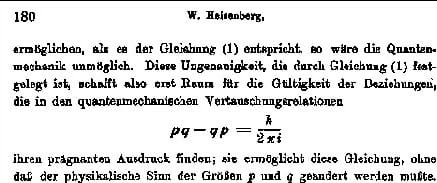
Werner Heisenberg formulated it in 1927. For position and momentum, the product of the uncertainties in the two cannot be smaller than a fixed quantity set by Planck's constant.
Knowing position more precisely necessarily means knowing momentum less precisely, and the reverse.
A similar relation holds for energy and time, and for other pairs of quantities described as conjugate.
The limit is extremely small in ordinary terms, which is why it has no consequence for objects of everyday size. It becomes dominant at the scale of atoms and particles.
Two misreadings are common and both matter.
It is not a statement that measurement disturbs the system. Heisenberg's own first explanation used exactly that argument, describing a microscope in which observing an electron requires bouncing a photon off it and thereby changing its momentum. The illustration is intuitive and it is not the content of the principle.
The principle follows from the mathematical structure of quantum mechanics, in which position and momentum are represented by operators that do not commute. It applies to the system itself, and it holds for an ensemble of identically prepared systems that are never disturbed at all, which is how it is tested.
A particle does not have a precise position and momentum that are merely unknown. On the standard interpretation it does not have both, and treating the uncertainty as ignorance about hidden values is the position ruled out by Bell test experiments, discussed in the quantum interpretations capsule.
It is also not a statement about human knowledge, consciousness or observation in any everyday sense, and the extension of the principle into general claims about the impossibility of objectivity has no basis in the physics.
The relation is a general property of waves, which is what makes it less mysterious than it is usually presented.
Any wave that is sharply localised in space must be built from a wide range of wavelengths, and any wave with a single well-defined wavelength must extend indefinitely. This is a mathematical fact about wave superposition, familiar in signal processing as the relationship between the duration of a pulse and the width of its frequency spectrum.
Since a quantum particle is described by a wavefunction, and momentum corresponds to wavelength, the trade between localisation and wavelength becomes the trade between position and momentum. The wave-particle duality capsule sets out the underlying behaviour.
Atoms are stable because of it. In classical physics an orbiting electron radiates energy and spirals into the nucleus. Confining an electron to a smaller region increases its momentum uncertainty and therefore its kinetic energy, and the balance between electrostatic attraction and that cost sets the size of the atom.
Zero-point energy follows. A system cannot be entirely at rest, since perfectly defined position and momentum are excluded, so residual motion persists even at absolute zero. Helium remains liquid at atmospheric pressure down to absolute zero for this reason.
Quantum tunnelling, treated separately, depends on the same indefiniteness and is what allows fusion to proceed in stars at temperatures classical physics says are too low.
The energy-time relation permits short-lived fluctuations, which is the basis of virtual particles in quantum field theory and of the Casimir effect.
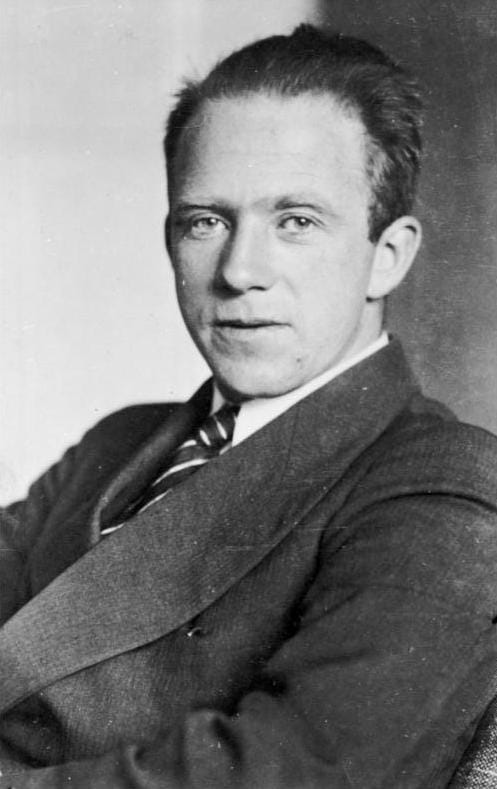
Heisenberg derived the relation while working with Niels Bohr in Copenhagen, and the two disagreed sharply about how to present it.
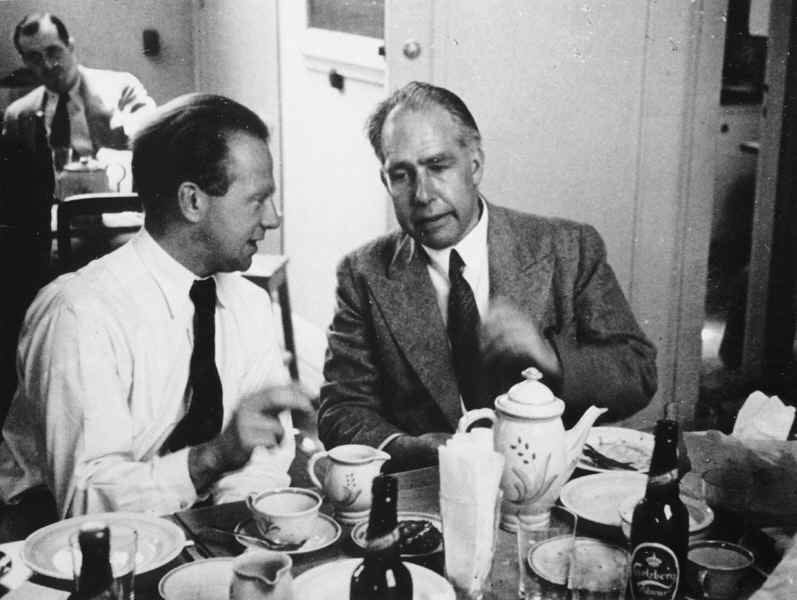
Bohr held that the principle should be presented as an instance of complementarity, in which wave and particle descriptions are both necessary and mutually exclusive. Heisenberg initially preferred the disturbance account. Bohr's framing prevailed and became part of what is now called the Copenhagen interpretation.
Einstein resisted the implications for years, and his exchanges with Bohr produced a series of thought experiments intended to defeat the relation, each of which Bohr answered. Einstein's objection was never that the mathematics was wrong but that a theory of this kind could not be the complete description of nature.
The uncertainty principle marks the point at which physics stopped describing systems as having definite properties awaiting measurement, which is a change in what a physical theory claims to be about rather than a refinement of precision.
It is also the most misappropriated result in physics, routinely cited to support claims about observation, subjectivity and knowledge in general. The actual statement is narrow, quantitative, and concerns conjugate variables in quantum systems.