The finding that light and matter both display wave behaviour in some experiments and particle behaviour in others, and that no single classical picture accounts for both. It is the central strangeness of quantum mechanics and it is experimentally settled.
Light was argued about for two centuries. Newton favoured a particle account; Huygens argued for waves.
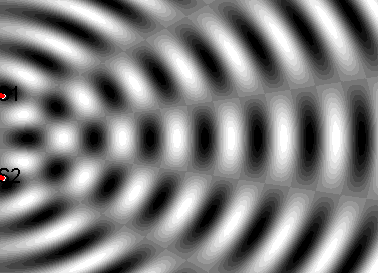
Thomas Young's double-slit experiment, presented from 1801, appeared to settle it. Light passing through two slits produces alternating bright and dark bands, which is what waves do when they overlap and cannot be produced by particles travelling in straight lines. Maxwell's identification of light as an electromagnetic wave in the 1860s appeared to close the question permanently.
The photoelectric effect reopened it. Light striking a metal ejects electrons, and the details do not fit a wave account. Whether electrons are ejected at all depends on the frequency of the light and not its brightness: dim blue light works where intense red light does not. A wave delivering energy continuously should allow any frequency to work given enough time and intensity.
Einstein explained it in 1905 by proposing that light is absorbed in discrete quanta whose energy depends on frequency. Below a threshold frequency no single quantum carries enough energy, regardless of how many arrive. This is the work for which he received the Nobel Prize, and it required light to be particulate in exactly the circumstances where the wave account had succeeded.
Louis de Broglie proposed in 1924 that the symmetry runs both ways: if waves can behave as particles, particles should behave as waves, with a wavelength related to momentum.
The prediction was confirmed within three years. Clinton Davisson and Lester Germer scattered electrons from a nickel crystal and obtained a diffraction pattern of the kind X-rays produce, which requires wave behaviour. George Paget Thomson obtained the same result independently.
The result has a notable feature: J. J. Thomson received a Nobel Prize for showing the electron is a particle, and his son received one for showing it behaves as a wave. Both were correct.
The wavelength is inversely related to momentum, which is why the effect is invisible for ordinary objects. A moving person has a wavelength so small that no possible experiment could detect it, which is why classical physics works at everyday scales.
Diffraction has since been demonstrated for neutrons, atoms, and molecules containing hundreds of atoms, with the practical limit set by the difficulty of isolating larger objects from their surroundings rather than by any known cut-off.
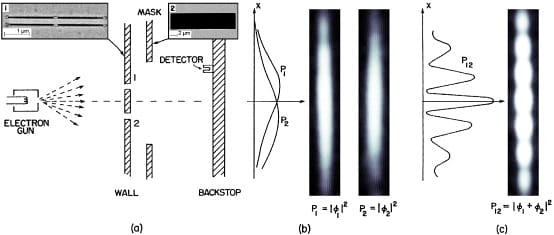
The decisive experiment sends particles through two slits one at a time.
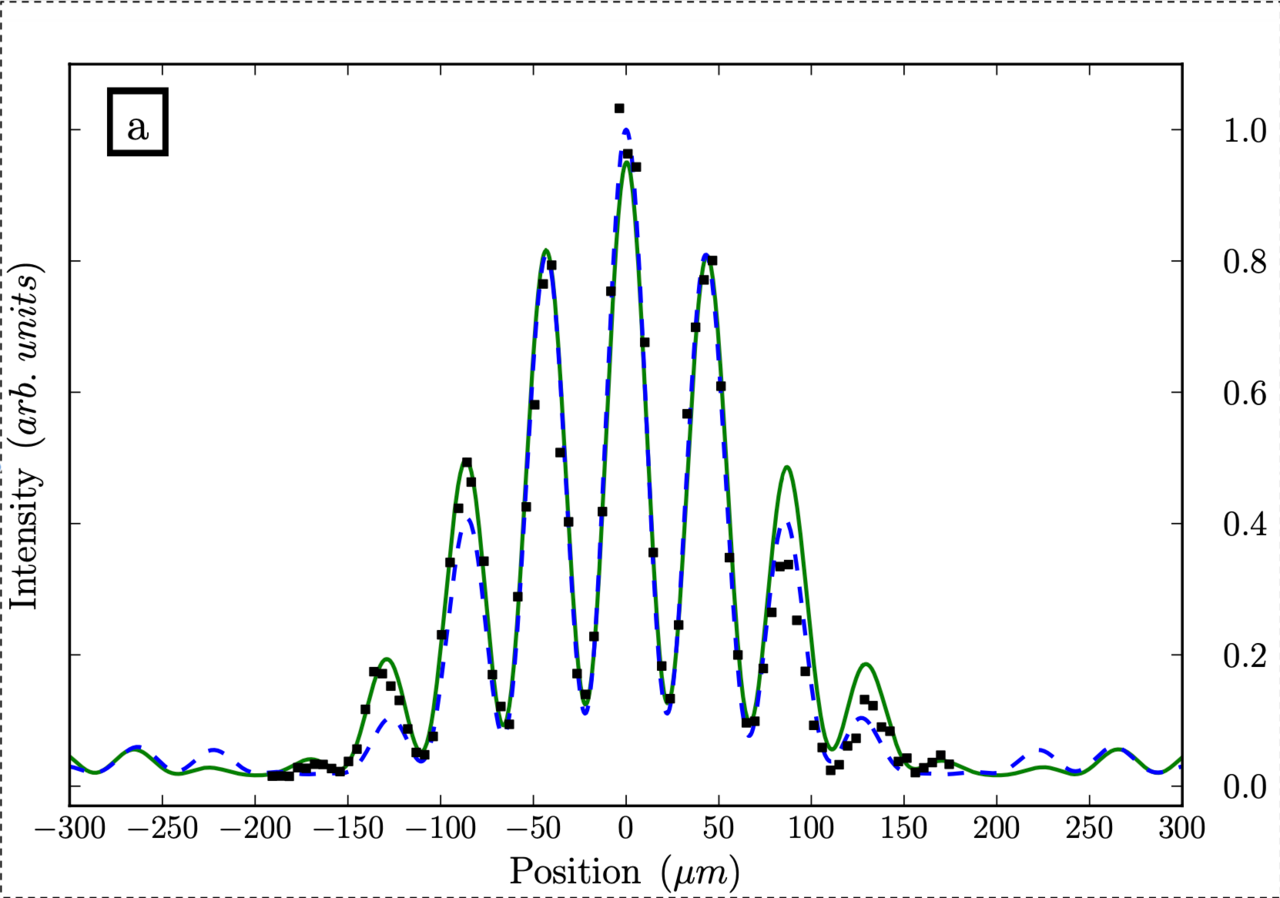
Each particle arrives at a single point on the detector, as a particle would. But as detections accumulate, they build up the interference pattern characteristic of waves.
This rules out the obvious explanation that the pattern comes from particles interacting with each other, since only one is present at a time. Whatever produces the pattern involves each particle individually and both slits.
The result is sharpened by attempting to detect which slit each particle passes through. When that information is available, the interference pattern disappears and two simple bands appear instead. Removing the possibility of that knowledge restores the pattern.
This is complementarity, stated by Niels Bohr: wave and particle behaviours are both real and cannot be observed in the same experimental arrangement. Which behaviour appears depends on what the apparatus is set up to detect.
Duality is frequently misdescribed, and two corrections are worth making.
It does not mean an electron is sometimes a wave and sometimes a particle, switching between them. The modern description is that it is neither, being a quantum object whose behaviour is described by a wavefunction, and that wave and particle are classical concepts that each capture part of that behaviour.
It does not mean that consciousness affects the outcome. What destroys interference is interaction with the environment sufficient to record which path was taken, and this occurs with or without any observer, which is decoherence. The role of observation in quantum mechanics is genuinely disputed, and this particular version of the claim is not supported.
What the wavefunction represents remains the substance of the interpretation debate, treated in the quantum interpretations capsule. The experimental results are not in dispute.
Wave-particle duality is where classical physics failed in a way no adjustment could repair, and it forced the construction of quantum mechanics.
Its practical consequences are large. The wave behaviour of electrons is why electron microscopes resolve far finer detail than light microscopes, and the same behaviour underlies semiconductors and therefore all modern electronics. A phenomenon that appears to be a philosophical curiosity is what the devices reading this sentence depend on.