A particle can pass through a barrier it does not have enough energy to climb. This has no classical analogue, it is measured routinely, and it is the reason the Sun shines and flash memory works.
In quantum mechanics a particle is described by a wave whose amplitude gives the probability of finding it in a given place. At a barrier the wave does not stop; it decays exponentially inside and, if the barrier is thin enough, emerges with a small amplitude on the far side. A non-zero amplitude beyond the barrier means a non-zero chance of the particle being detected there.
The probability falls off sharply with barrier width and with the particle's mass, which is why tunnelling dominates for electrons across a few nanometres and is undetectable for anything the size of a person.
George Gamow, and independently Ronald Gurney and Edward Condon, explained alpha decay by tunnelling in 1928. An alpha particle inside a nucleus is held by a barrier it plainly lacks the energy to cross, yet it escapes. Tunnelling accounts for this and, more impressively, explains why decay half-lives span more than twenty orders of magnitude across different isotopes: the exponential sensitivity to barrier height turns a small difference in nuclear structure into an enormous difference in lifetime.
Fusion in the Sun's core requires two positively charged nuclei to touch, against their mutual repulsion. The core's temperature is roughly fifteen million kelvin, which is about a thousand times too low to push them over that barrier. They tunnel through it instead. Without tunnelling the Sun would not shine.
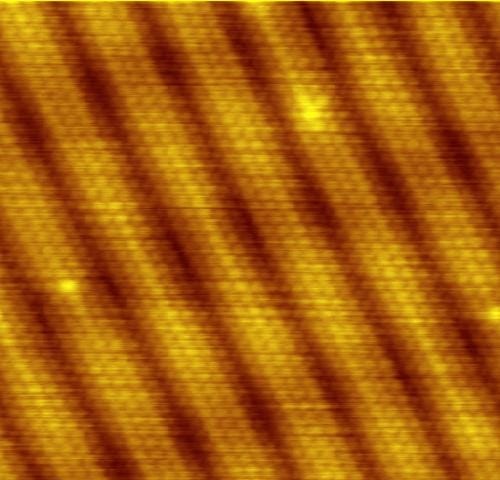
The scanning tunnelling microscope, built by Gerd Binnig and Heinrich Rohrer in 1981, holds a sharp conducting tip a fraction of a nanometre above a surface. Electrons tunnel across the gap, and the current is so sensitive to distance that moving the tip by the width of one atom changes it several times over. Scanning the tip and holding the current constant maps the surface atom by atom. Binnig and Rohrer shared the 1986 Nobel Prize in Physics.
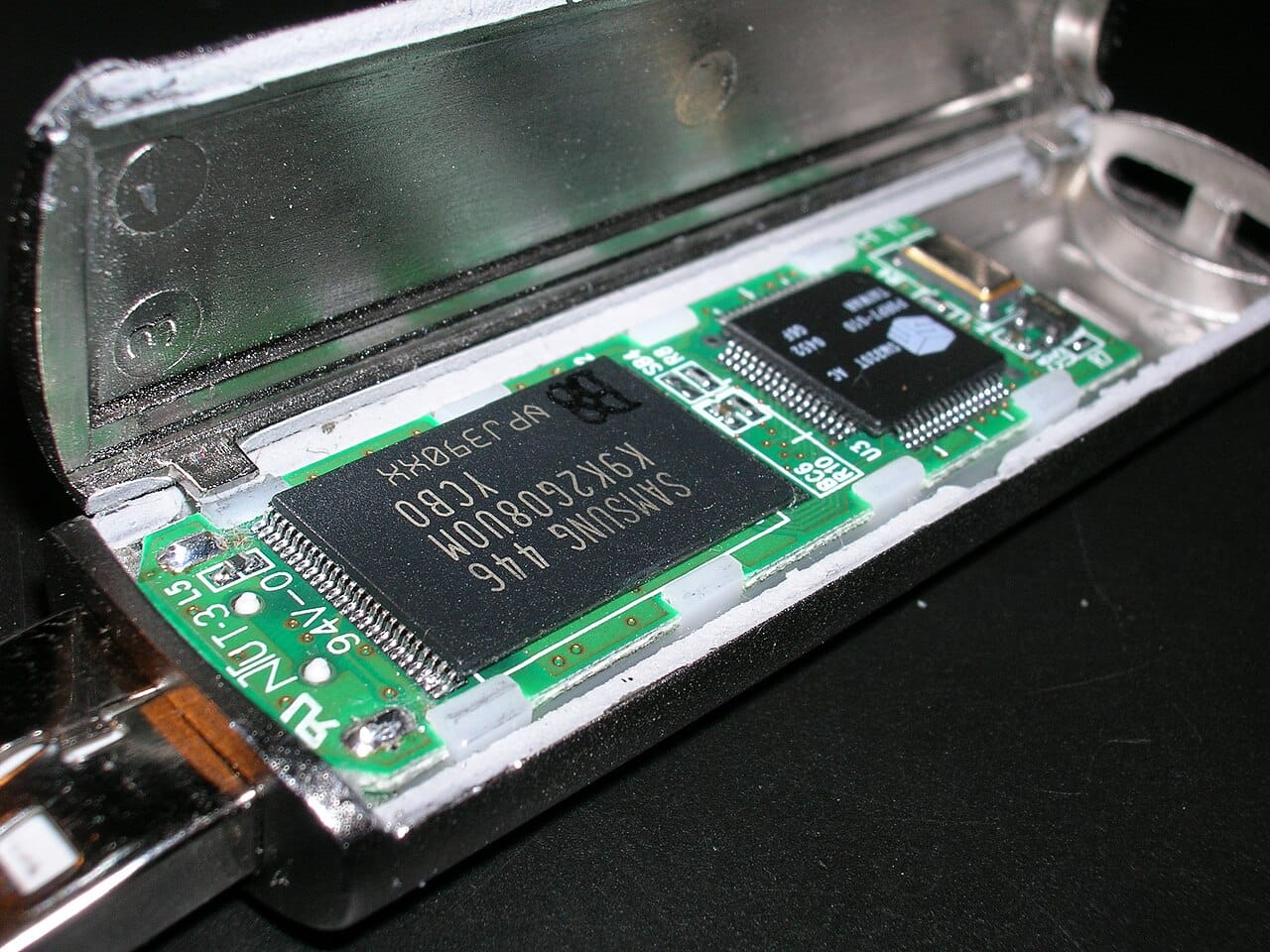
Flash memory stores a bit by trapping charge on a gate insulated from the rest of the circuit. Writing and erasing push electrons through that insulator by tunnelling, which is why the memory holds its contents with no power and why it wears out: each cycle damages the insulating layer.
The same effect sets a floor under transistor size. As gates shrink below a few nanometres, electrons tunnel across them when the transistor is supposed to be off, and the resulting leakage current wastes power and generates heat. This is one of the physical limits behind the slowing of transistor scaling.
Whether it is meaningful to assign a duration to the passage through the barrier has been argued since the 1930s, with several competing definitions. Some analyses give times implying speeds greater than light. Experiments since 2019 using ultracold atoms and attosecond measurements have produced finite numbers, and most physicists hold that no signal outruns light because the transmitted wave is a reshaped part of the original rather than something that raced ahead. The measurement is agreed; its interpretation is not.