An extended work of prose fiction. It is among the youngest major literary forms, it became the dominant one within roughly two centuries, and its rise is closely tied to printing, literacy and the emergence of a reading public.
Length, prose and fiction are the usual criteria, and each is imprecise at the edges.
More useful is what the form does. A novel typically follows individual characters over time, gives access to interior experience, and is set in a world resembling the reader's own rather than in myth or legend. It is generally read privately and silently rather than performed or recited.
That combination separates it from the epic, which is verse, public and concerned with heroes and gods, and from the romance, which is episodic and set in a deliberately remote world.
Extended prose fiction is much older than the European novel.
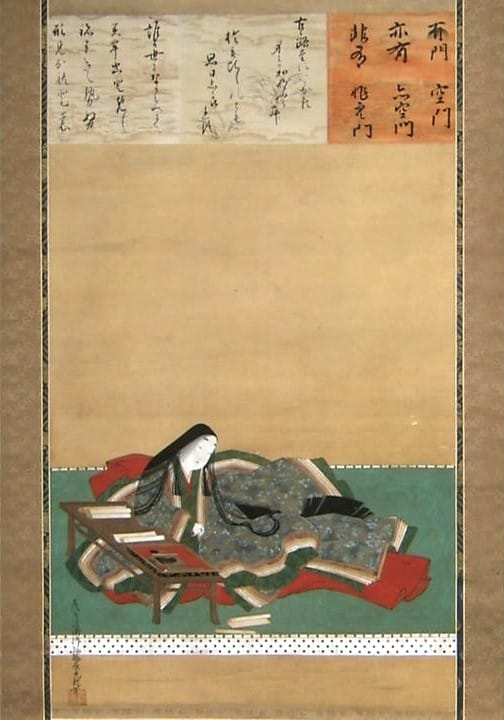
The Tale of Genji, written by Murasaki Shikibu, a lady of the Japanese imperial court, and completed by around 1010, follows a large cast across generations with sustained psychological attention. It is frequently called the world's first novel, and the claim is defensible on any definition that does not simply build in European features.
Greek and Roman prose fictions, including the Satyricon and the Golden Ass, survive from antiquity. Arabic and Persian traditions produced long narrative prose. Chinese vernacular fiction produced major works from the fourteenth century onward, including Journey to the West and Dream of the Red Chamber.
Don Quixote, published in two parts in 1605 and 1615, is the work most often identified as the first modern European novel, largely because it is about a reader whose expectations have been formed by earlier romances and who is comically unequipped for the actual world.
The form as now recognised consolidated in eighteenth century England, and the reasons are material as much as literary.
Printing had become cheap, literacy was rising, and a commercial middle class had leisure and money for books. Circulating libraries made novels accessible to people who could not buy them.
Daniel Defoe's Robinson Crusoe of 1719 and Samuel Richardson's Pamela of 1740 are conventional markers. Richardson's use of letters to convey a character's thoughts as events unfold was influential out of proportion to the book's current readership.
Serial publication in the nineteenth century changed the form again. Novels issued in monthly parts had to end each instalment with a reason to buy the next, which shaped plotting, and the author could adjust to reader response mid-composition. Dickens is the standard case.
The novel was also the form in which women writers first achieved sustained commercial and critical standing in Europe, and a substantial share of eighteenth and nineteenth century novels were written by women, often anonymously or under male names.
Realism in the nineteenth century aimed at detailed, unromanticised representation of ordinary social life, in Balzac, Eliot, Tolstoy and Flaubert.
Modernism in the early twentieth century turned attention inward, using stream of consciousness and fragmented chronology to represent thought rather than events, in Joyce, Woolf and Proust.
Later movements continued to reject the preceding conventions, and the form has proved unusually accommodating: it has absorbed the detective story, science fiction, the graphic novel and autofiction without ceasing to be recognisable.
The novel is the principal form through which literate cultures have examined individual interior life, and its rise coincides with a broader shift toward regarding the individual person as the natural unit of interest.
It is also the most commercially successful literary form ever devised, which is not incidental to its development. Much of what the novel became was determined by the economics of publishing, by what libraries would stock and by what readers would pay for in instalments.