A device storing energy chemically and releasing it as electric current. It made electricity portable, and its energy density is the constraint governing electric vehicles, grid storage and every device that is not plugged in.
A battery contains two electrodes in an electrolyte. At one electrode a chemical reaction releases electrons; at the other, a reaction consumes them.

The electrons cannot cross the electrolyte, so they travel through the external circuit instead, and that flow is the current. Ions move through the electrolyte to complete the circuit internally.
The voltage is set by the difference in chemical tendency between the two reactions, which depends on the materials chosen. Capacity depends on how much reactant is present.
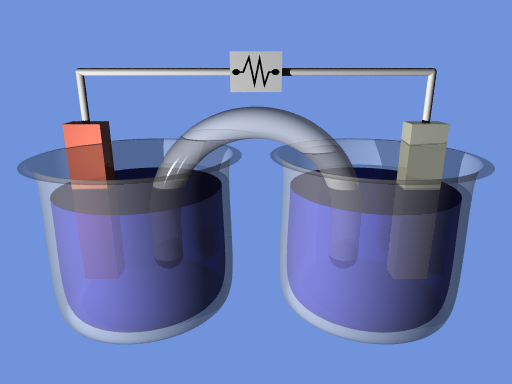
The distinction between a cell and a battery is that a battery is strictly several cells connected, though the word is now used for both.
Primary cells are not rechargeable, because the reaction is not readily reversed. Secondary cells are rechargeable, since applying current in reverse drives the reaction backwards and restores the original materials.
Rechargeability degrades. Each cycle produces small irreversible changes, and capacity falls over hundreds to thousands of cycles depending on chemistry and use.
Luigi Galvani observed in the 1780s that a frog's leg twitched when touched with two different metals, and concluded that animal tissue contained a form of electricity.
Alessandro Volta disagreed, arguing that the electricity came from the contact between dissimilar metals and that the tissue was merely detecting it.
Volta settled the dispute in 1800 by building a stack of alternating zinc and copper discs separated by brine-soaked cloth, which produced current with no animal tissue involved. The voltaic pile was the first source of continuous electric current, and its unit is named after him.
The consequences were immediate. Previous sources produced only brief static discharges; a continuous current allowed electrolysis, which within months was used to decompose water and shortly afterwards to isolate several elements, as the electrolysis capsule describes.
Galvani was not simply wrong. Bioelectricity is real and is central to nerve and muscle function, as the neuron capsule describes, and both men had identified something genuine.
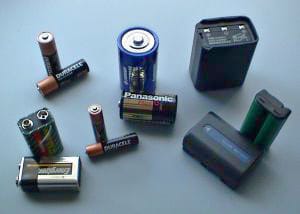
Lead-acid, invented in 1859, is heavy and cheap, tolerates high current, and remains standard for vehicle starting and for backup power.
Alkaline cells replaced earlier zinc-carbon cells for consumer use and are not rechargeable in ordinary form.
Nickel-cadmium and then nickel-metal hydride provided rechargeable consumer power before lithium.
Lithium-ion, commercialised in 1991, is the current standard for portable devices and vehicles. Lithium is the lightest metal and gives high energy per unit mass, and the cells work by moving lithium ions between electrodes rather than by dissolving and depositing metal, which makes them durable across many cycles. The Nobel Prize in Chemistry was awarded for its development in 2019.
Flow batteries store energy in liquid electrolytes held in tanks, so capacity and power can be sized independently, which suits grid storage rather than vehicles.
Sodium-ion cells use a far more abundant element at lower energy density, and are being commercialised where weight matters less than cost.
Energy density is the fundamental constraint. Lithium-ion cells store roughly one fiftieth of the energy per kilogram that liquid hydrocarbon fuel does, which is why battery-electric aviation is limited to short flights, as the aviation capsule notes.
The gap is not closing quickly. Improvement in commercial energy density has been steady and incremental, in the region of a few per cent per year, rather than following anything like the trajectory of semiconductors.
Charging rate is limited by heat and by degradation, since forcing ions in quickly damages the electrodes.
Temperature affects performance substantially, with capacity falling in cold and degradation accelerating in heat.
Safety is a genuine issue. Lithium cells store a great deal of energy in a small volume with a flammable electrolyte, and internal short circuits can produce thermal runaway, which is why transport of cells is regulated.
Materials supply is a constraint on scale. Lithium, cobalt and nickel are geographically concentrated, cobalt mining raises documented labour concerns, and recycling rates remain low relative to the volumes now being deployed.
The battery is what made electricity portable, and every device that operates away from a socket depends on it, from hearing aids to spacecraft.
It is now also the constraint on two much larger transitions. Whether road transport electrifies and whether variable renewable generation can be balanced both depend on how cheaply energy can be stored, which makes an incremental chemistry problem one of the most consequential technical questions of the period.