A prohibition so strong that violating it provokes disgust or horror rather than merely disapproval. Taboos are found in every society, they are enforced without formal machinery, and what they cover varies enormously while the mechanism does not.
The word entered English from Tongan and related Polynesian languages, where it denotes something set apart or forbidden, and it was recorded by James Cook in the 1770s.
A taboo differs from an ordinary rule in the character of the reaction. Breaking a rule invites correction; breaking a taboo invites revulsion, and the response is frequently visceral rather than reasoned.
People often cannot say why a taboo exists. Asked to justify a prohibition, they may offer a reason that does not withstand examination and continue to hold the prohibition regardless, which psychologists have described as moral dumbfounding.
Taboos are usually enforced socially rather than legally, though several have legal counterparts.
Food prohibitions are among the most widespread. Pork is prohibited in Judaism and Islam, beef in Hinduism, and various animals are avoided in traditions worldwide. Which animals are forbidden varies without obvious pattern, and the prohibitions are strongly held.

Purity and pollution rules govern contact with bodily substances, corpses, menstruation and childbirth, and generally specify ritual remedies for contamination.
Sexual prohibitions include the incest taboo, discussed below, and rules governing who may marry whom.
Death and the dead attract prohibitions in most societies, including rules about handling remains, naming the deceased and mourning conduct.
Naming taboos forbid speaking certain names, including those of the dead, of rulers, or of dangerous animals, and have measurably affected languages by driving words out of use.
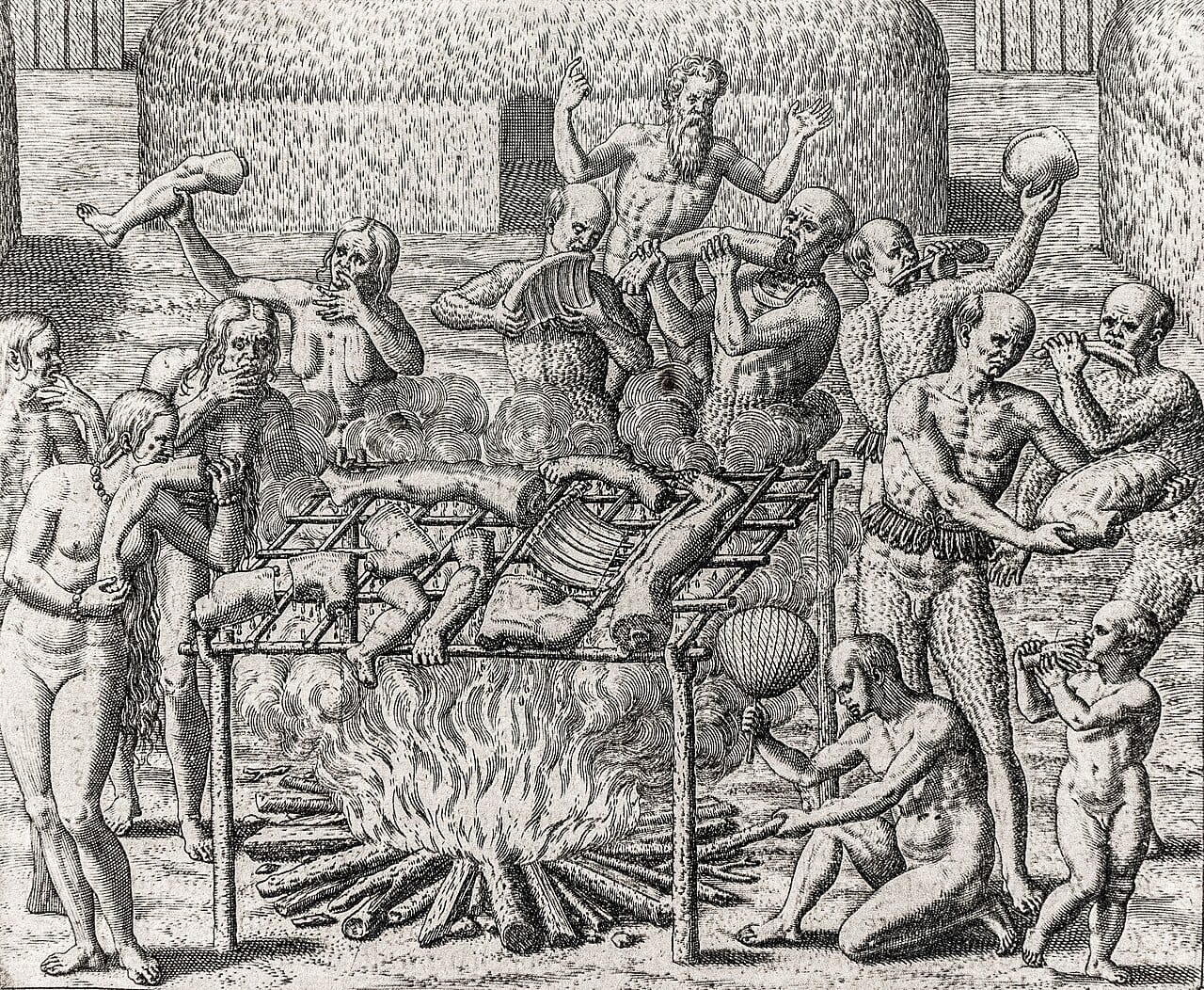
Cannibalism is among the most widely prohibited practices, and European depictions of it were extensively used to characterise colonised peoples as savage, which makes the historical sources on it unreliable and politically loaded.
Several accounts have been proposed, and none explains all cases.
Functional explanations hold that taboos encode practical knowledge. The best known example, that the prohibition on pork prevented trichinosis, is not well supported: the parasite was unknown when the prohibition arose, other meats carry comparable risks and are permitted, and neighbouring peoples ate pork without apparent consequence.
Structural explanations, associated with Mary Douglas, hold that taboos concern classification. In her account things are treated as polluting when they fall between categories a culture uses to order the world, and she analysed the dietary rules of Leviticus as prohibiting animals that do not fit cleanly into the categories the text establishes. The account is influential and has been criticised for fitting some cases better than others.
Social explanations hold that the primary function is marking group boundaries. A prohibition that is costly and arbitrary identifies members reliably, precisely because an outsider would not observe it, and this account explains why the content varies while the practice does not.
Psychological explanations point to disgust as an evolved response to contamination that has been extended to social and moral domains, which explains the visceral character of the reaction.
Prohibition of sexual relations between close relatives is close to universal, though the boundary of who counts as too close varies substantially between societies.
Two explanations are prominent and are not exclusive.
The biological account points to inbreeding depression: offspring of close relatives have elevated rates of harmful recessive conditions, which is well established.
The Westermarck effect proposes a psychological mechanism: individuals raised together in early childhood develop sexual aversion to one another regardless of biological relatedness. Evidence includes studies of Israeli kibbutzim, where children raised communally rarely married one another, and of Taiwanese minor marriages, where girls raised in their future husband's household from infancy had marriages with lower fertility and higher dissolution rates.
Freud argued the opposite, that a prohibition would be unnecessary if the desire did not exist, and the evidence has generally favoured Westermarck.
Anthropological accounts add that exogamy, marrying outside the group, creates alliances between groups, which is advantageous independently of biology.
Industrial societies retain taboos while frequently denying they have any.
Contemporary examples include prohibitions around bodily waste, certain words, incest, cannibalism, and conduct toward the dead.
Some subjects are treated as taboo in the weaker sense of being unspeakable in particular contexts, which is a matter of social convention rather than the visceral response that characterises the stronger form.
Taboos also shift. Prohibitions surrounding illegitimacy, divorce, mental illness and homosexuality weakened substantially within living memory in many countries, which demonstrates that they are not fixed.
Taboos regulate behaviour with no enforcement apparatus, relying on internalised revulsion rather than on penalty, which makes them among the most efficient mechanisms of social control available.
They also demonstrate that a large part of moral response is not the product of reasoning. People hold prohibitions they cannot justify and continue to hold them when the justification fails, which is a fact about moral psychology rather than a criticism of any particular taboo.