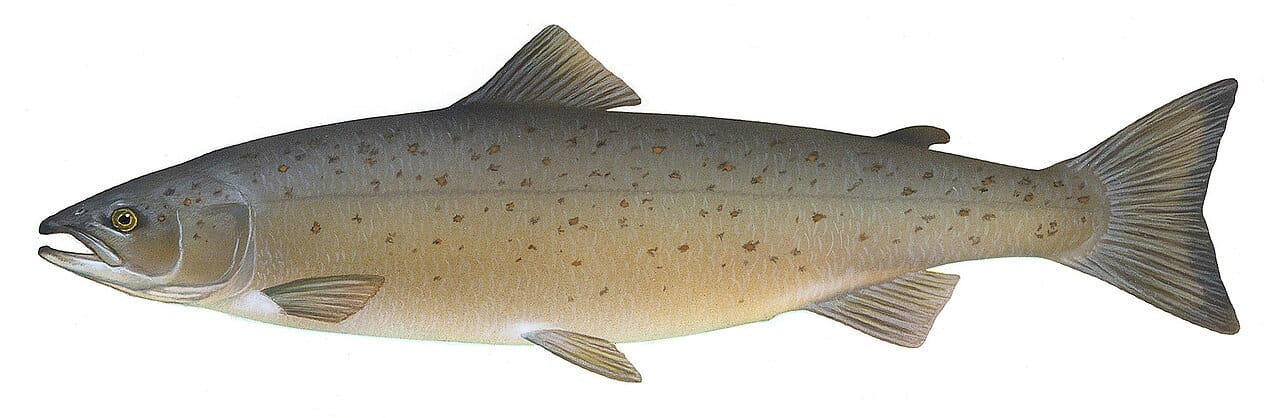
Salmon are anadromous fish of the family Salmonidae: born in fresh water, grown at sea, and returning to fresh water to spawn, in most cases to the precise stream where they hatched. They carry nutrients from the ocean into the interiors of continents, they support some of the largest fisheries in the world, and the Atlantic species was moved onto the IUCN's threatened categories for the first time in 2023.
Two groups matter. Salmo salar is the Atlantic salmon, a single species across the North Atlantic. The genus Oncorhynchus holds the Pacific salmon, of which the principal species are chinook, coho, sockeye, chum and pink, along with the trouts that were reassigned to the genus once their relationships were understood.
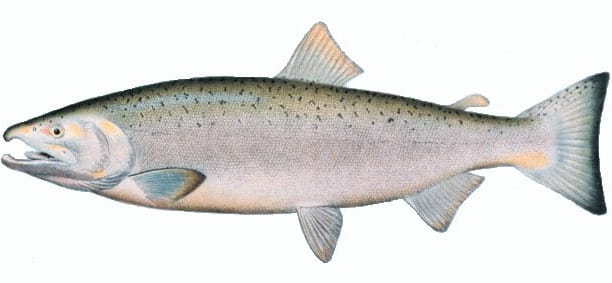
The great behavioural difference between the two groups is what happens after spawning. Pacific salmon are semelparous: they spawn once and die, and the physiological changes leading up to spawning are effectively a programmed decline. Atlantic salmon are iteroparous and can survive to spawn again, though in practice most do not.
Eggs are laid in gravel in a depression the female digs with her tail, called a redd, and buried. Alevins hatch with the yolk sac attached and remain in the gravel; fry emerge and feed; parr grow in the stream, marked with dark vertical bars, for months to years depending on species and latitude.
Then comes smoltification, which is the most remarkable part. The parr reorganises itself for salt water: the body silvers, the shape changes, behaviour switches from territorial to schooling, and the gills and kidneys rebuild their ion-handling machinery to excrete salt rather than retain it. The fish that goes downstream is physiologically a different animal from the one that grew there.
At sea salmon grow rapidly, spending one to five years in ocean feeding grounds, in some cases thousands of kilometres from their natal river. Then they return.
Returning salmon find their natal stream with high precision, and the mechanism has two stages.
Ocean navigation appears to be magnetic. Salmon imprint on the magnetic signature of the river mouth as smolts and use the geomagnetic field to return to that region, and the strongest evidence is that shifts in the field over decades predict shifts in the routes returning fish take.
The final approach is olfactory. Arthur Hasler's work from the 1950s established that salmon imprint on the specific chemical odour of their home stream as juveniles and follow it upstream against the gradient. Fish with blocked olfactory function fail to select the correct tributary; fish imprinted artificially on a synthetic compound will return to water dosed with it.
Straying is real and important: a small percentage of fish return to the wrong stream, which is what allows salmon to colonise new rivers after glaciers retreat or dams are removed.
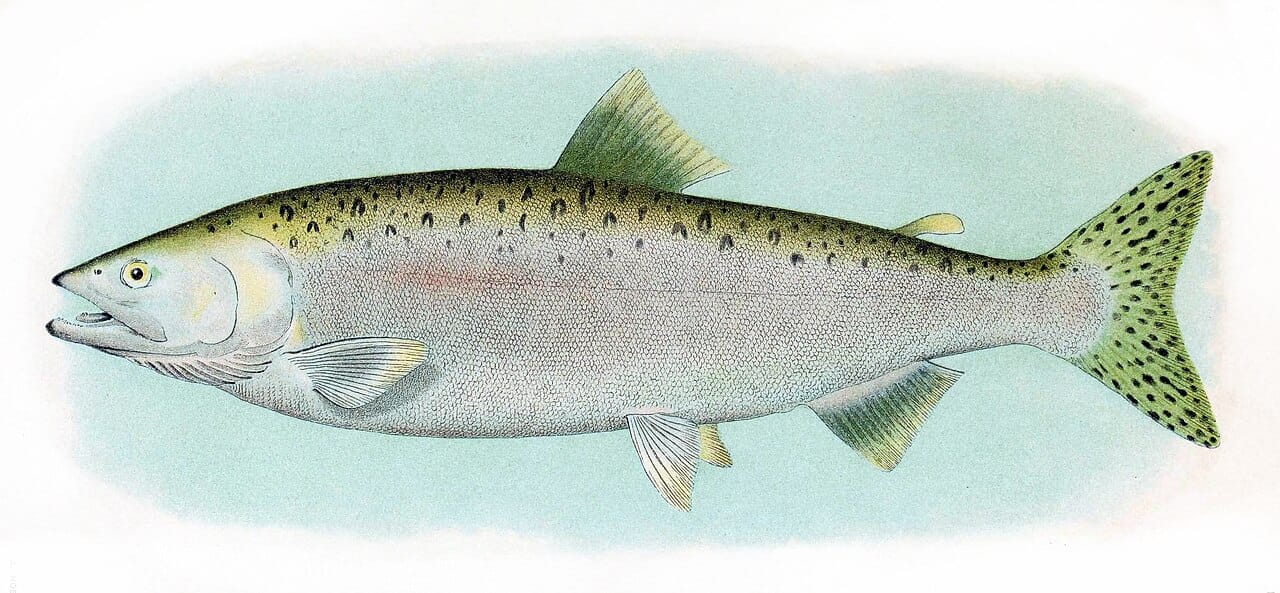
The change in a Pacific salmon between the ocean and the spawning ground is one of the most extreme in any vertebrate. The fish stops feeding entirely. Its digestive tract atrophies. It changes colour, often to deep red or green. Males develop a hooked jaw, the kype, and in pink salmon a pronounced dorsal hump.
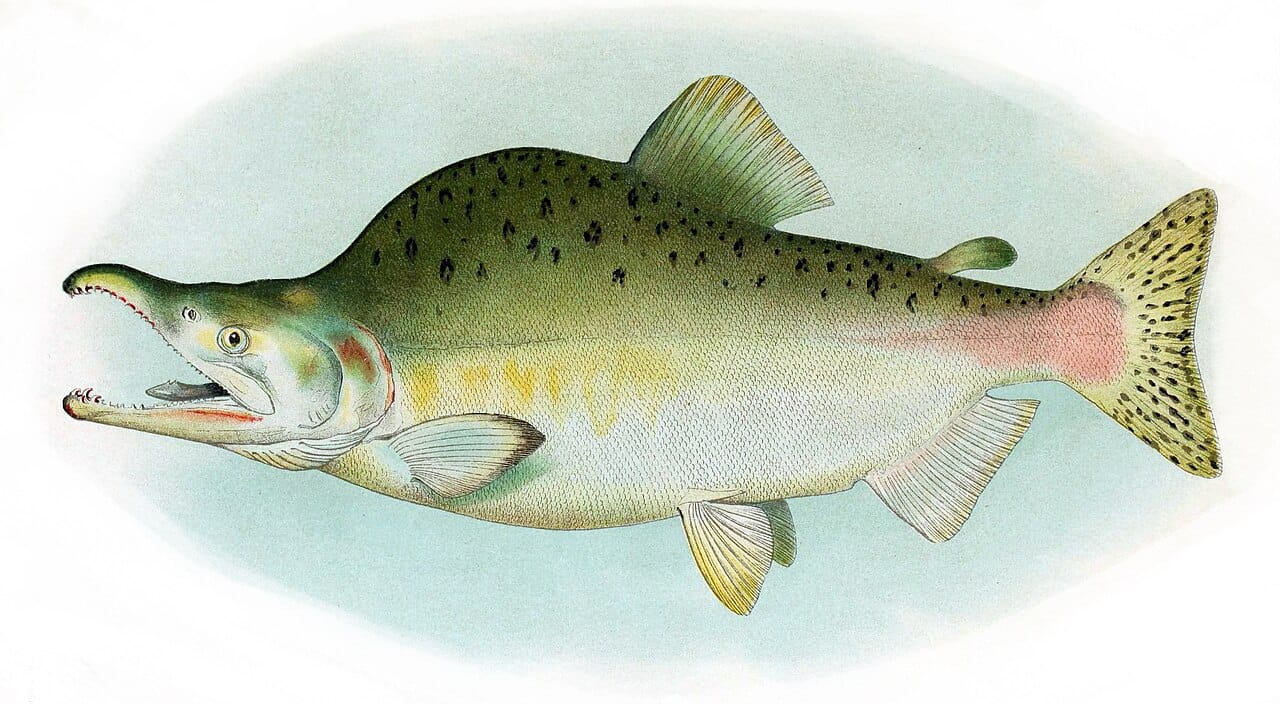
All of this is funded by tissue already present, and the fish dies within days or weeks of spawning. It is not a failure of the body but a scheduled reallocation: an animal that will not reproduce again has no reason to conserve anything.
The carcasses matter enormously. Spawning salmon carry nitrogen, phosphorus and carbon accumulated in the ocean hundreds of kilometres inland, and when they die that material enters the stream, the soil and the forest.
Stable isotope work traces marine-derived nitrogen into streamside trees, insects, birds and bears, and in some Pacific Northwest watersheds a substantial fraction of the nitrogen in riparian vegetation is of oceanic origin, delivered by fish. Bears and eagles move carcasses into the forest, which distributes it further.
This is one of the clearest cases of an animal functioning as a nutrient pump against a gradient, and it means that removing salmon from a river removes something from the forest beside it.
Salmon support very large commercial fisheries, particularly in Alaska and Russia, and Pacific salmon management in Alaska is often cited as among the better-run wild fisheries anywhere, built on escapement targets that require a set number of fish to reach the spawning grounds before harvest is permitted.
Farmed salmon, almost all of it Atlantic salmon, now greatly exceeds the wild catch of that species and is produced principally in Norway, Chile, Scotland and Canada. The industry has three persistent problems, all of which affect wild fish: sea lice amplified in net pens and transmitted to wild smolts passing them; escapes of farmed fish that interbreed with wild populations and dilute locally adapted genetics; and the fishmeal demand of a carnivorous farmed species, though the ratio of wild fish input to farmed output has improved substantially.
Atlantic salmon was reassessed in December 2023 and moved from Least Concern to Near Threatened globally, on evidence of a 23 per cent decline between 2006 and 2020. It was the first global reassessment since 1996. Great Britain's populations were separately assessed as Endangered.
Pacific salmon are in very different conditions depending on where. Alaskan runs remain large. Many populations in the Columbia and Snake river systems and in California are listed as threatened or endangered, and dozens of runs are extinct.
The dominant causes are dams blocking access to spawning habitat, warming water that is lethal to eggs and stressful to adults, logging and agriculture that silt the gravel, and hatchery fish that compete with and genetically swamp wild ones. Dam removal on the Elwha and Klamath rivers has produced rapid recolonisation, which is unusually direct evidence that the barrier, rather than some more diffuse decline, was the binding constraint.
Salmon are the reason a forest two hundred kilometres inland can contain nitrogen from the Pacific. They are also, because they must pass through a specific river at a specific time, uniquely easy to count, block and destroy. Almost every pressure on freshwater systems shows up in a salmon run before it shows up anywhere else.