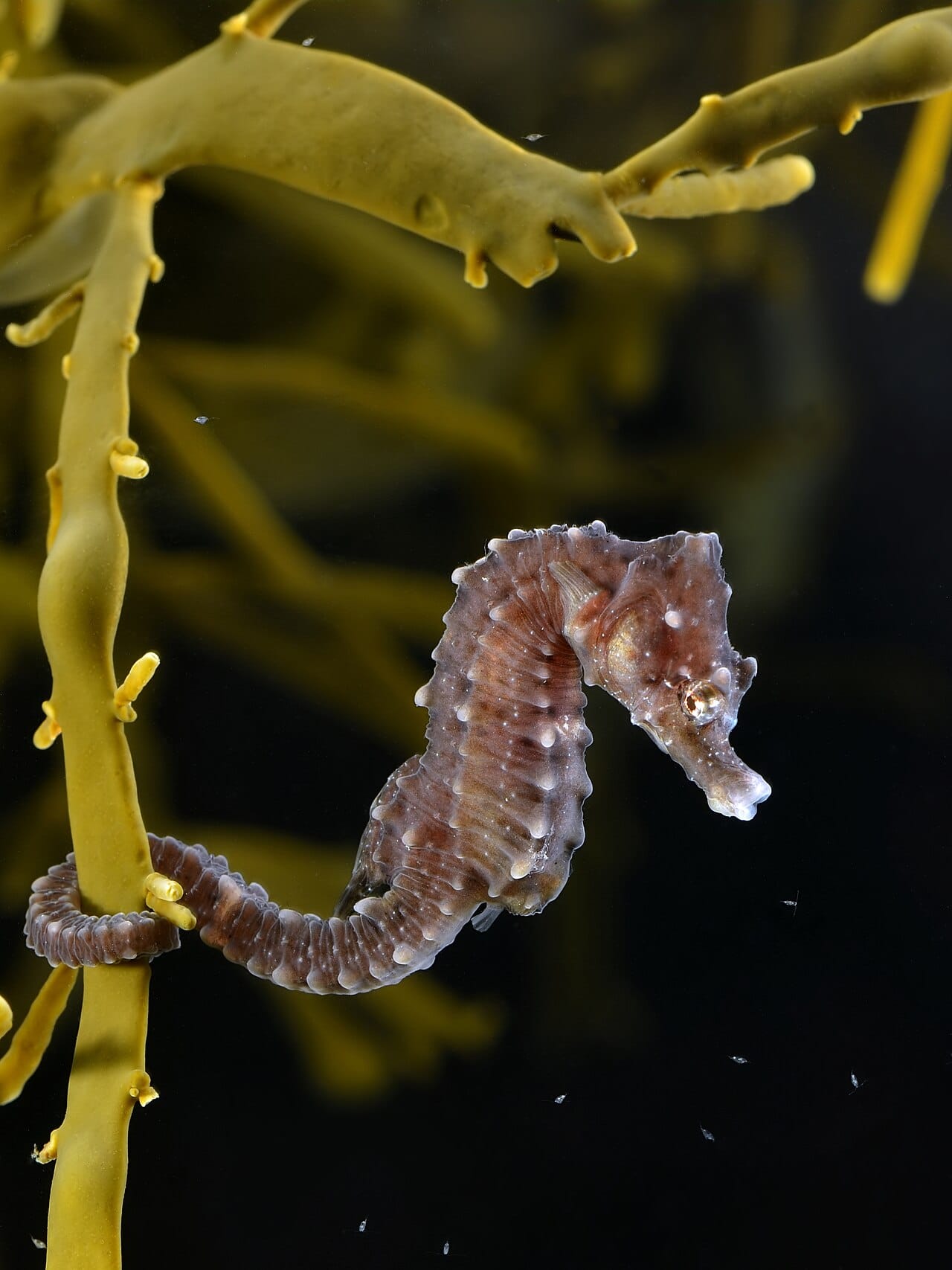
Seahorses are small marine fish of the genus Hippocampus, around fifty species, distinguished by an upright posture, a prehensile tail, a tubular snout, and a reproductive arrangement in which the male becomes pregnant. They are poor swimmers, they are extremely well camouflaged, and they are traded in very large numbers.
Seahorses are fish, in the family Syngnathidae with the pipefishes and seadragons. They have no scales; the body is encased in a series of bony plates fused into rings, which is why a dried seahorse holds its shape.
They swim upright, propelled almost entirely by a rapidly beating dorsal fin, with small pectoral fins for steering. There is no caudal fin at all, because the tail has been repurposed for grasping. This makes them among the slowest fish in the sea, and the dwarf seahorse is often cited as the slowest, moving at a matter of metres per hour.
The eyes move independently, in the manner of a chameleon, allowing one to track prey while the other watches for threats.
A seahorse has no stomach and no teeth. Food passes through a short digestive tract quickly and incompletely, which means they must eat almost continuously, taking dozens of small crustaceans an hour.
The feeding strike is called pivot feeding and it is very fast. The head is held on a flexible neck; the seahorse rotates it upward and expands the buccal cavity, generating suction that draws prey in. The whole action takes a few thousandths of a second.
The snout's shape is the reason it works. Modelling and flow visualisation have shown the narrow head shape minimises the bow wave in front of the approaching snout, so a copepod, which detects and escapes water disturbance with extremely fast reflexes, does not sense the strike arriving. Capture success rates are reported around ninety per cent, unusually high for a predator on copepods.
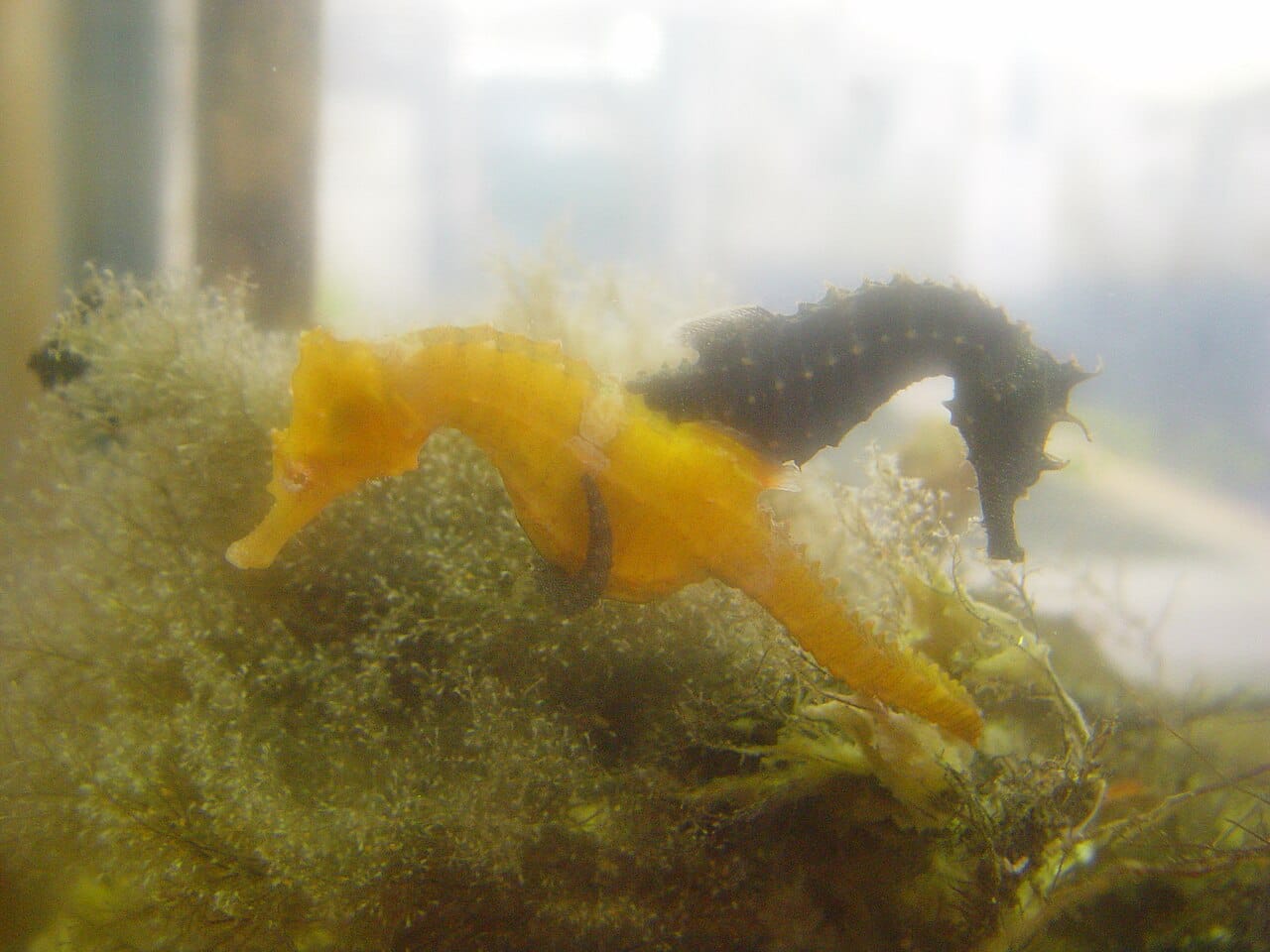
Male pregnancy in seahorses is not a loose analogy. The male has a brood pouch on the ventral surface into which the female deposits eggs with an ovipositor. The male fertilises them inside the pouch, and the pouch then does considerably more than hold them.
The pouch tissue becomes vascularised, regulates the salinity of the internal fluid, supplies oxygen, removes waste, and provides nutrients beyond the yolk. There is an immunological accommodation of the embryos, comparable in function to what mammalian pregnancy requires. Gestation runs roughly two to four weeks depending on species and temperature, and ends with muscular contractions that expel from tens to well over a thousand young.
Once released, the young get no further care and mortality is very high.
The evolutionary interest is in what this does to sexual selection. In most species the sex with the higher reproductive investment is choosier and the other competes. In seahorses the male carries the pregnancy, but because the female must produce eggs on her own schedule the rates do not simply reverse, and the outcome differs between species. In some pipefish relatives the classical roles are fully reversed, with larger ornamented females competing for males; in most seahorses the pairing is monogamous within a breeding cycle and the roles are closer to conventional.
Monogamy in seahorses is often overstated in popular accounts. Several species do form pairs that persist across cycles and greet each other daily, and several others do not.
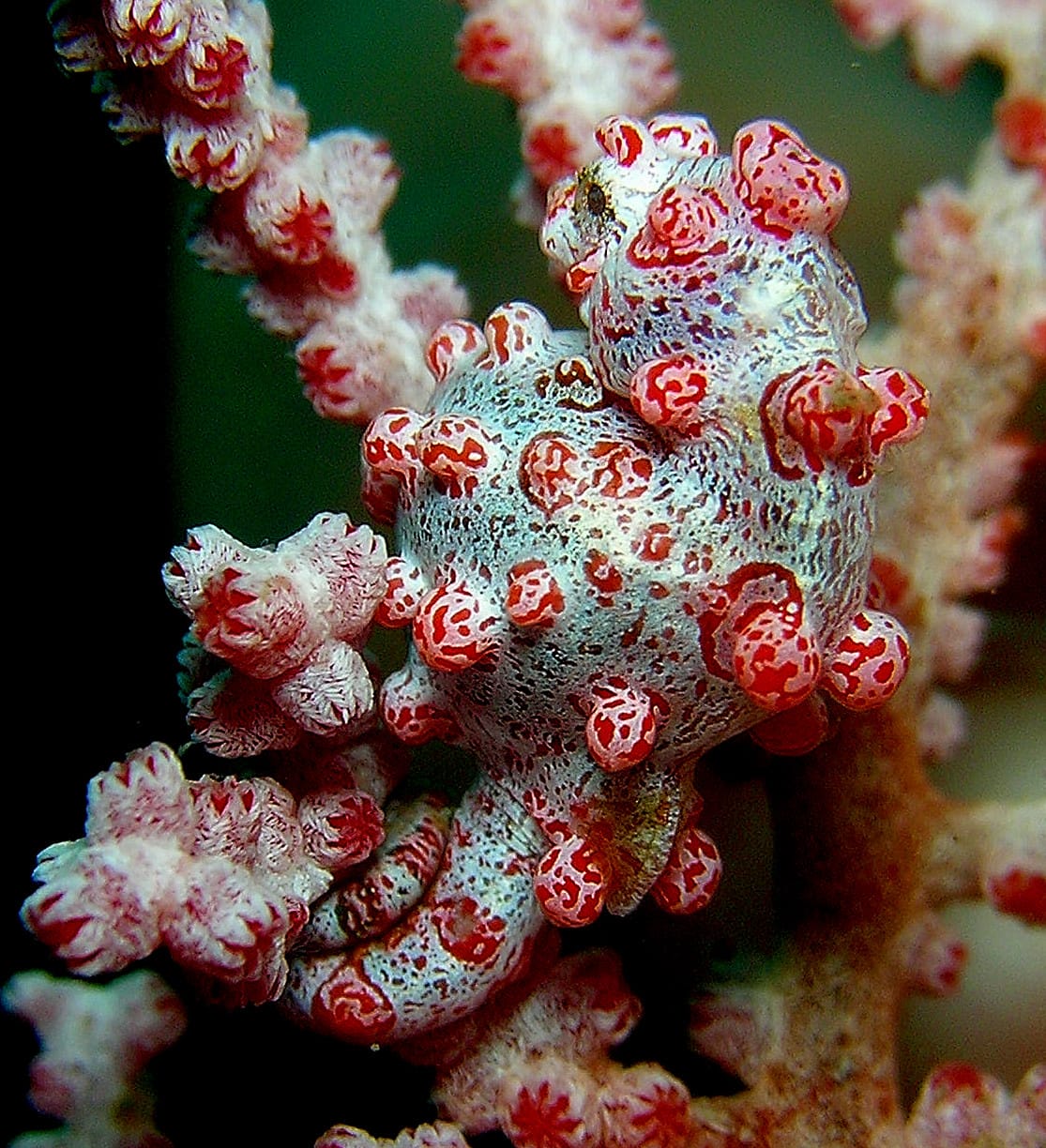
Seahorses are ambush predators that cannot chase anything, so concealment does all the work. They anchor by the tail to seagrass, coral or sponge and match it, with skin filaments and tubercles that break the outline, and with colour change over hours to days.
The pygmy seahorses are the extreme case. Hippocampus bargibanti lives only on gorgonian sea fans of two genera, is under two centimetres long, and carries tubercles that match the polyps of its host so precisely that the species was discovered in 1969 only when a collected sea fan was examined in a laboratory.
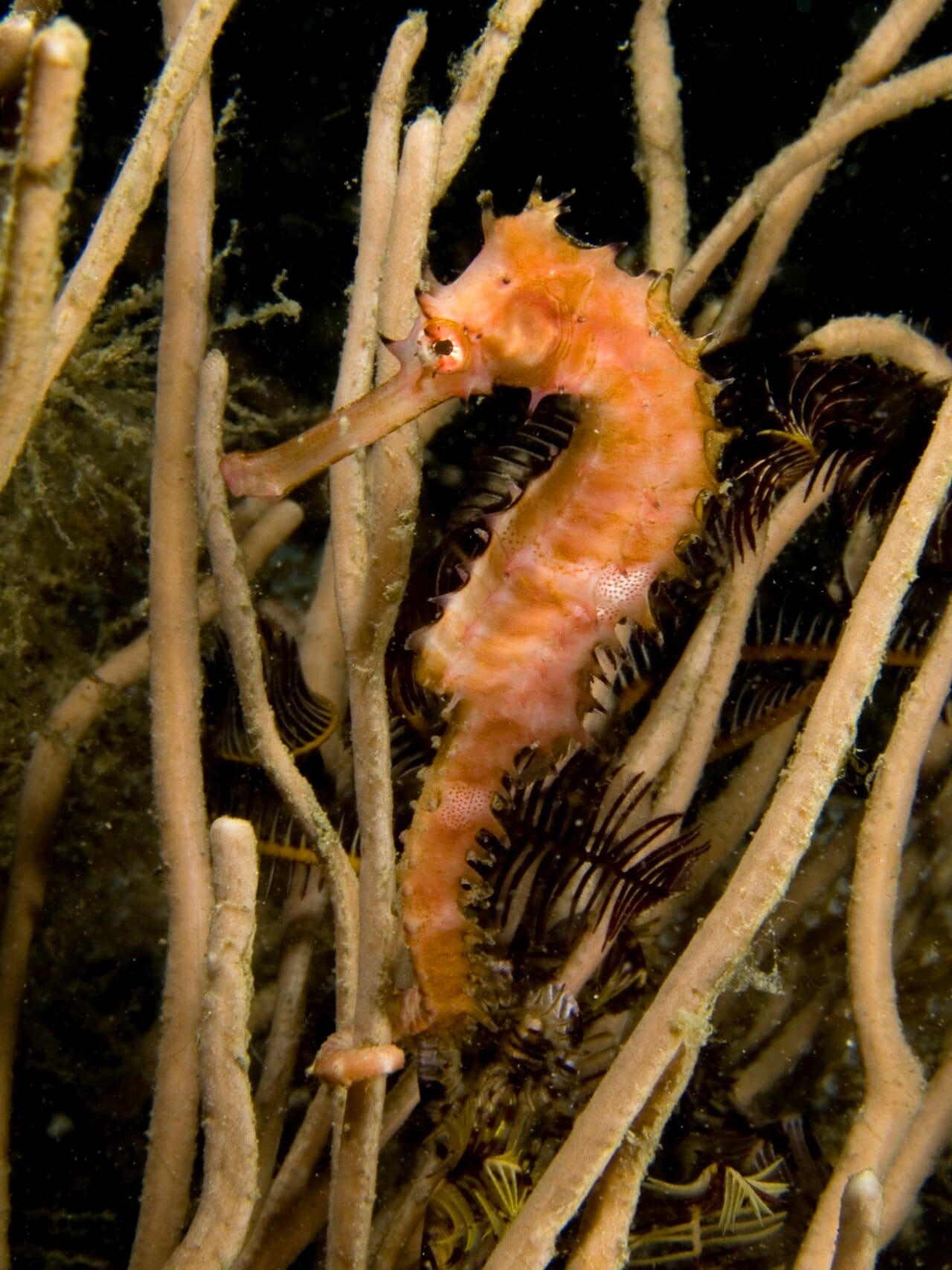
Seahorses occur in shallow tropical and temperate waters worldwide, in seagrass meadows, mangroves, coral reefs and estuaries. They are strongly associated with structured habitat, since an animal that anchors by its tail and hides needs something to anchor to and hide in.
That association is the core of their vulnerability, because seagrass, mangrove and reef are among the most rapidly degraded coastal habitats.
Seahorses are traded in very large quantities, principally dried for traditional Chinese medicine, with smaller volumes for the curio trade and the aquarium trade. Estimates of the dried trade have run to tens of millions of individuals a year.
The whole genus was listed on CITES Appendix II in 2002, effective 2004, which requires that exports be shown not to be detrimental to wild populations. Enforcement is difficult: most seahorses enter trade as bycatch from trawling rather than as targeted catch, which means the pressure does not respond to seahorse-specific rules.
Assessment is hampered by a shortage of data, and a large share of species are listed as Data Deficient, with a number of others Vulnerable or Endangered.
The seahorse is the standard illustration for the idea that reproductive roles are not fixed by being male or female but follow from who invests what. It is also a case in which the popular version, that seahorses are monogamous fish where the father gives birth, is both roughly true and misleading in most of its details.