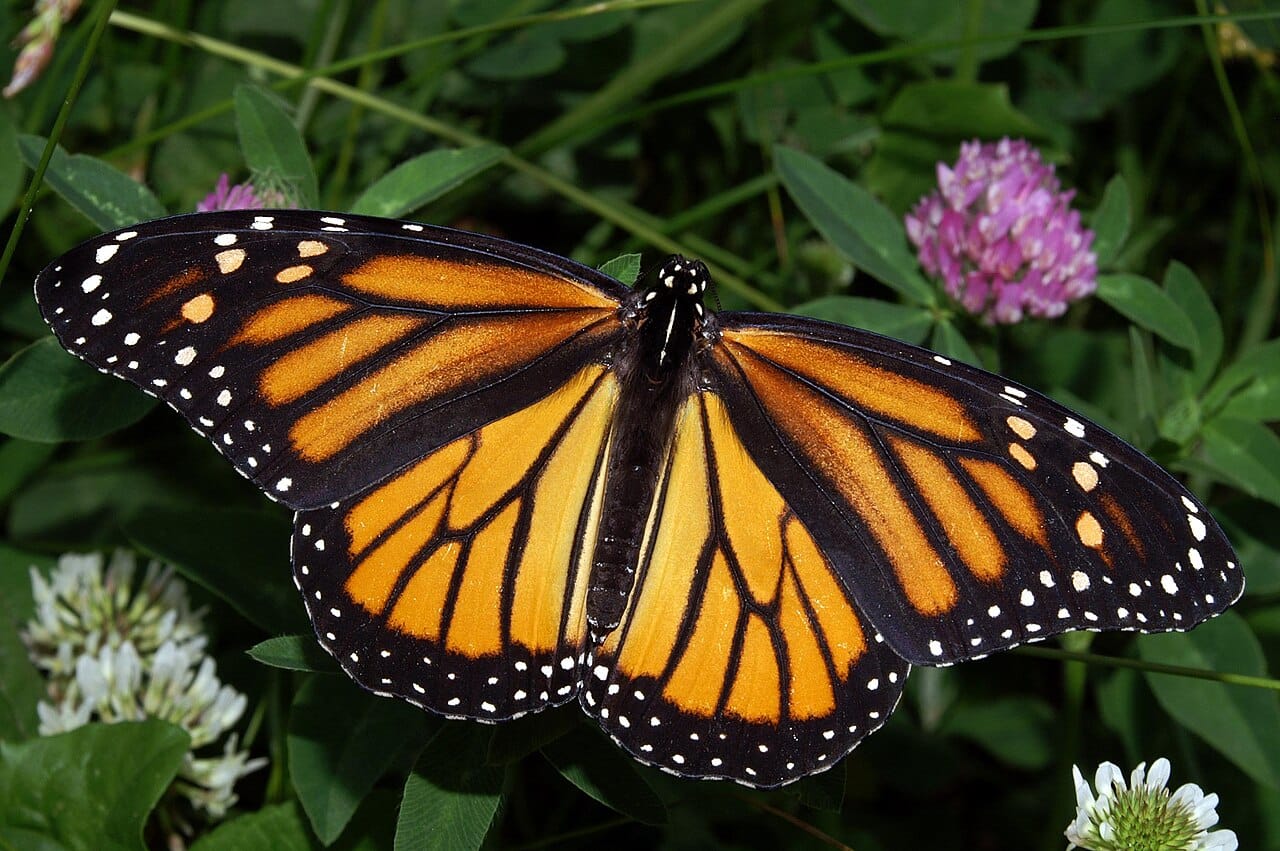
The monarch, Danaus plexippus, is a large orange and black butterfly of the Americas, and the migratory population of eastern North America performs a journey no individual completes twice. It is chemically defended by poisons taken from its food plant, its numbers have fallen steeply, and both its conservation status and the cause of its decline are actively disputed.
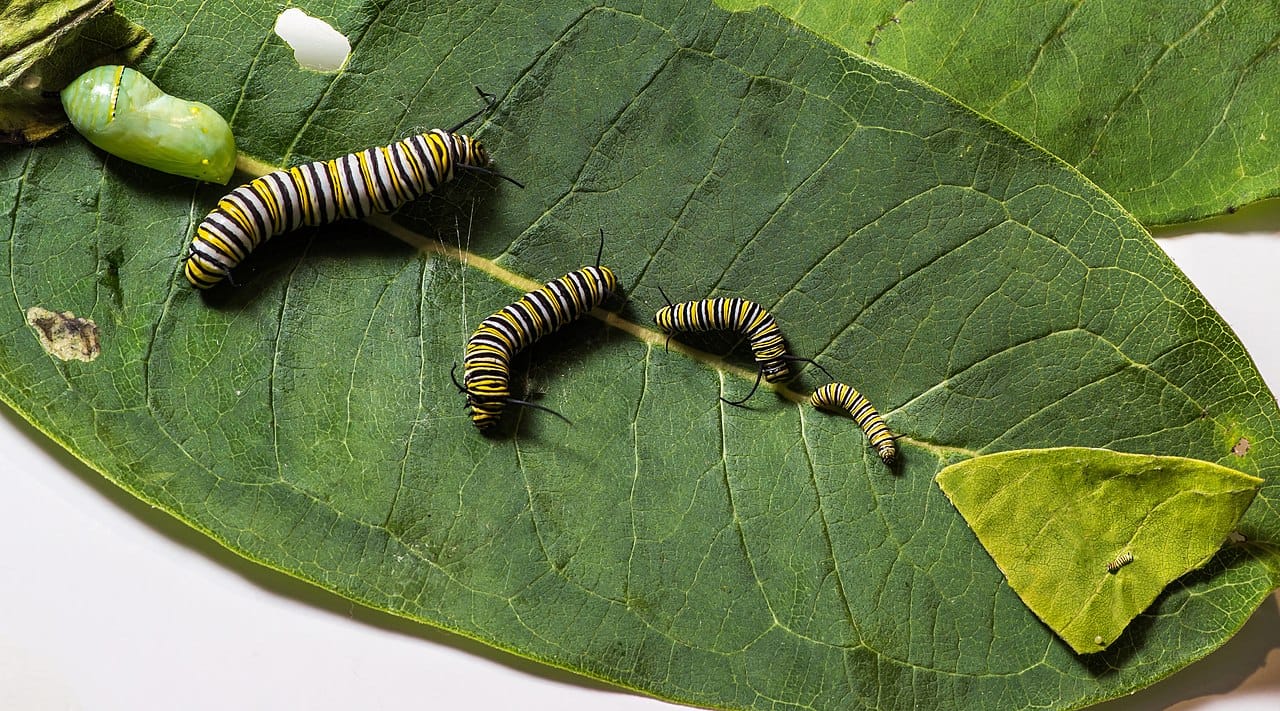
A female lays eggs singly on milkweed, and milkweed only. The caterpillar hatches, eats the eggshell, and then feeds on the plant through five instars, growing by a factor of roughly two thousand in about two weeks.
It then forms a chrysalis, jade green with a band of metallic gold spots, in which the larval body is substantially dismantled and rebuilt. Around ten days later the case goes transparent, the wing pattern shows through, and the adult emerges.
Adults of the summer generations live two to six weeks. The generation that emerges in late summer does not.
The last generation of the season in eastern North America emerges in reproductive diapause. It does not mature its gonads, it lives up to eight or nine months rather than a few weeks, and it flies south, up to 4,000 kilometres, to a few dozen sites in the oyamel fir forests of the mountains of Michoacán and the State of Mexico.
It has never been there. Its parents have not been there. Three to five generations have passed since the butterflies that left those mountains the previous spring, and the returning individuals nonetheless converge on the same small groves.
Navigation uses a time-compensated sun compass: the butterfly reads the sun's azimuth and corrects for time of day using circadian clocks located in the antennae, which was shown by painting antennae to block light and observing the orientation error. A magnetic inclination compass appears to supply backup under overcast conditions.
At the overwintering sites the butterflies cluster on tree trunks and branches in densities of thousands per tree, in a state of near-dormancy at the cool, humid, stable conditions the oyamel forest provides. The Mexican sites were not known to science until 1975, when Fred Urquhart's decades-long tagging programme located them with the help of Kenneth Brugger and Catalina Aguado.
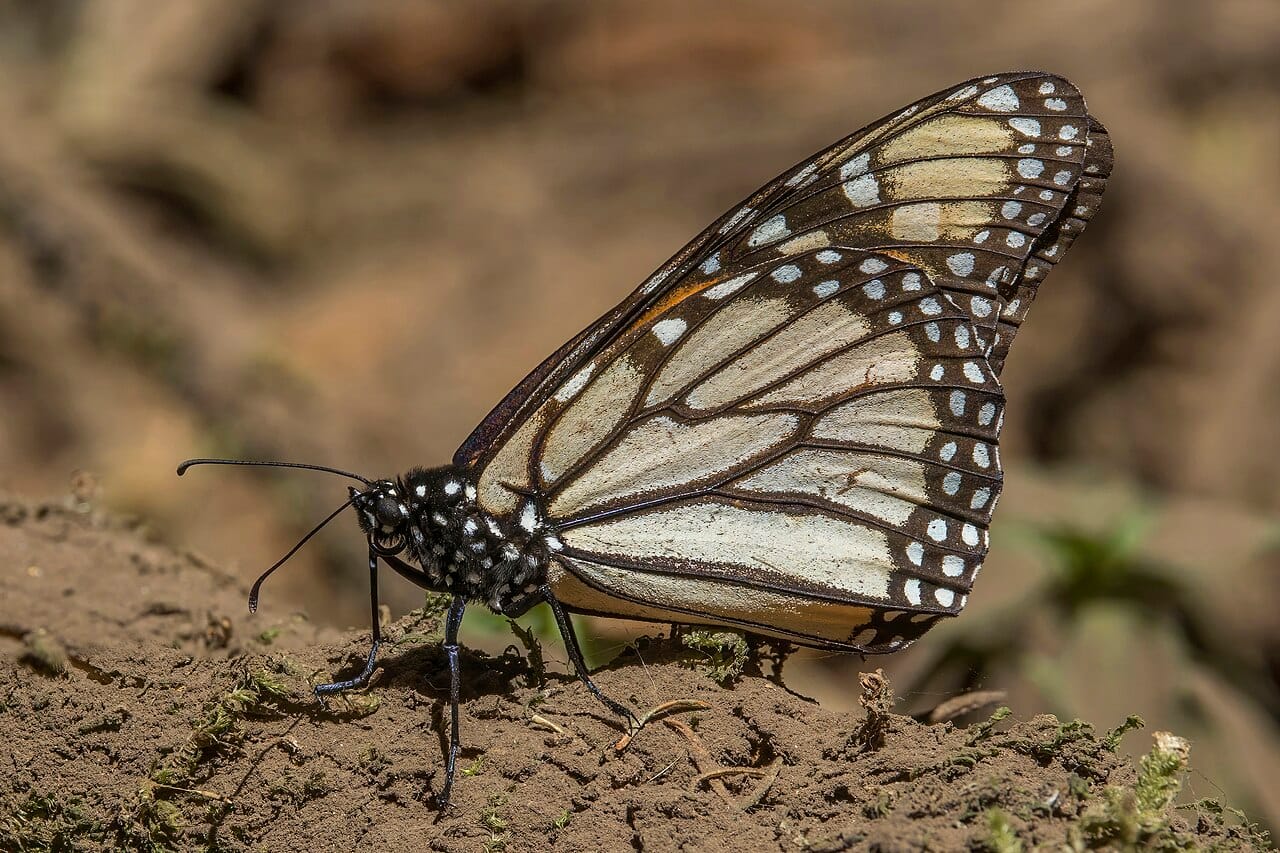
In spring the same individuals fly north, mate, lay on the first milkweed they reach, and die. Their offspring continue north, and it takes several generations to repopulate the continent.
Milkweed contains cardenolides, cardiac glycosides that inhibit the sodium-potassium pump and are toxic to vertebrates. Monarch caterpillars sequester them, and the adults retain them, so a bird that eats a monarch vomits and does not do it again.
The monarch's own pump carries amino acid substitutions that confer resistance, a case of convergent molecular evolution that has occurred independently in several insect lineages feeding on the same plants, in some cases at exactly the same positions. In 2019 the resistance substitutions were engineered into fruit flies, which became cardenolide-tolerant, confirming the mechanism directly.
The warning colouration is the standard textbook example of aposematism, and the viceroy butterfly's resemblance to it was for a century the standard example of Batesian mimicry, in which a palatable species imitates a defended one. That was overturned in 1991: the viceroy is itself unpalatable, so the pair is Müllerian mimicry, two defended species converging on a shared warning signal. The correction has been slow to reach textbooks.
Overwintering colonies are measured as hectares of occupied forest. The eastern population occupied over 18 hectares in the mid 1990s and has fluctuated at a small fraction of that in recent years. The western population, which overwinters on the Californian coast, fell by well over ninety per cent from its 1980s level and dropped below 2,000 individuals in 2020 before partially recovering.
The decline is not in dispute. Its cause is.
The standard account is loss of milkweed in the North American breeding range, driven by herbicide-tolerant crops that allowed comprehensive weed control in the corn and soybean belt from the late 1990s, compounded by loss of overwintering forest to illegal logging and by climate effects on the migration.
A competing account, argued most persistently by Andy Davis, holds that summer breeding numbers across North America have not declined in step with the overwintering counts, and that the problem therefore lies in mortality during the autumn migration rather than in a shortage of milkweed. If that is right, the very large investment in milkweed planting is aimed at the wrong stage.
The dispute has had direct consequences. The IUCN listed the migratory monarch as Endangered in July 2022; following a challenge from Davis the assessment was revised to Vulnerable in 2023. The US Fish and Wildlife Service proposed listing the monarch as Threatened under the Endangered Species Act in December 2024, and as of the middle of 2026 that rule has not been finalised, having been reclassified as a long-term action.
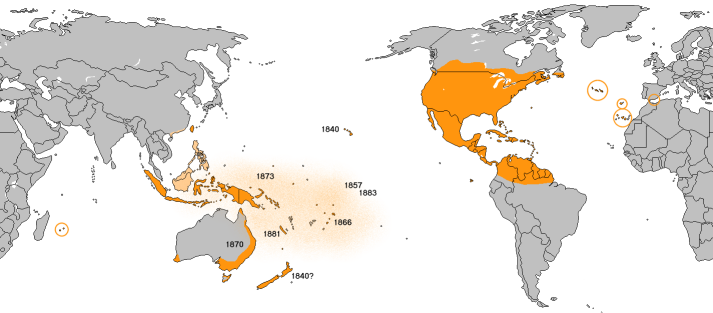
Not all monarchs migrate. Non-migratory populations are established in Florida, the Caribbean, Central and South America, Hawaii, Australia, New Zealand and parts of Iberia, most of them founded in the nineteenth century as milkweed spread with human movement.
Resident populations in the southern United States, sustained by planted tropical milkweed that does not die back in winter, are a live concern: they carry high loads of the protozoan parasite Ophryocystis elektroscirrha, and there is evidence that year-round milkweed interrupts migration and raises infection rates.
The monarch migration is a behaviour rather than a species, and it can be lost while the butterfly persists. That distinction is what the conservation argument is actually about, and it is why the IUCN assessed the migratory population separately from the species as a whole.