Prepared routes for travel over land. Roads are the oldest large-scale infrastructure, the engineering problem they solve is drainage rather than surface, and their construction has repeatedly reshaped the settlements they connect.
A road fails when its foundation becomes saturated. Wet soil loses bearing strength, traffic pushes the surface into it, and the road breaks up.
Every durable road design is therefore a drainage design. The surface is cambered so water runs off, ditches carry it away, and the foundation is built of material that drains rather than holds water.
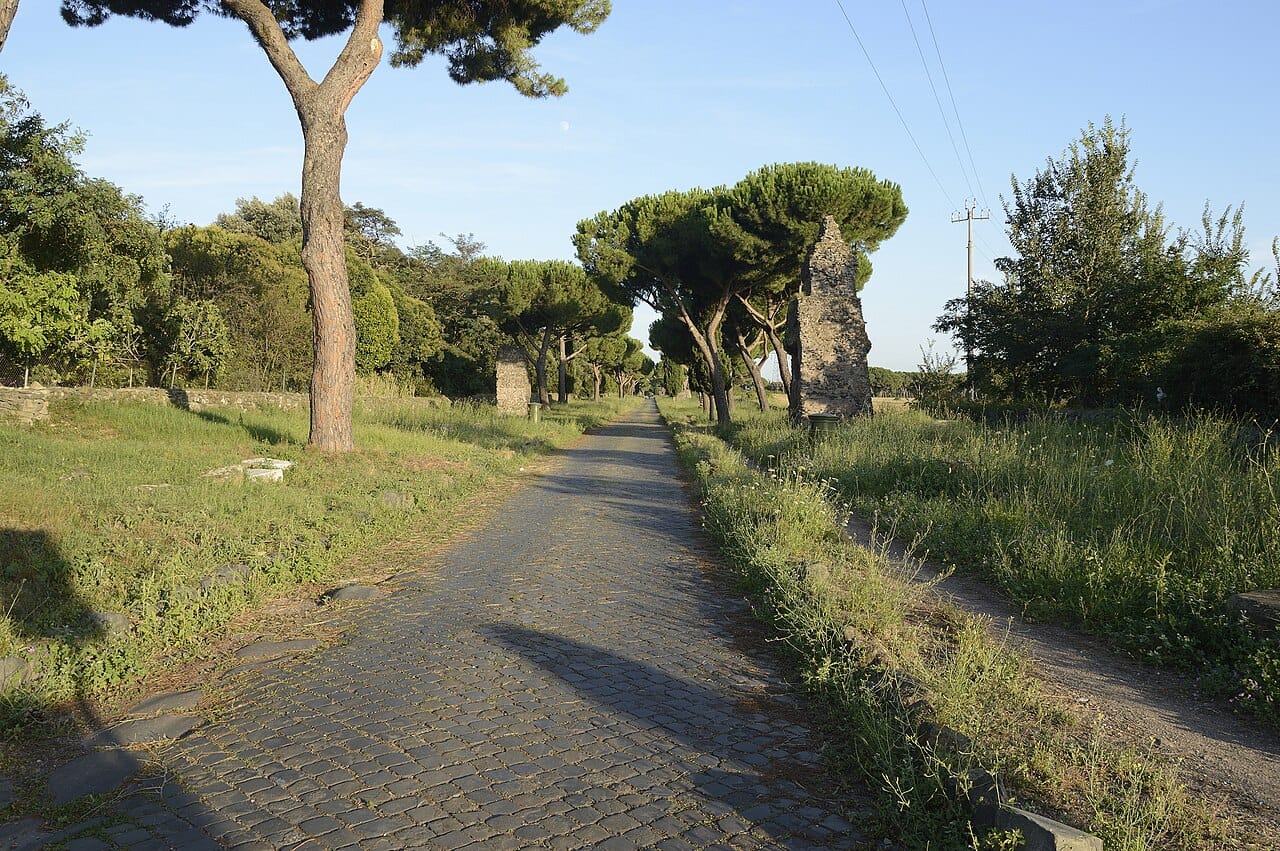
Roman roads followed this exactly. They were built in layers on an excavated foundation, cambered, and flanked by ditches, and the surviving examples survive because the drainage still works.
The load itself is spread rather than borne. Layers of decreasing coarseness distribute a wheel's concentrated load over a wide area of subsoil, which is the same principle a modern pavement uses with different materials.
Frost is the other destroyer. Water in the structure expands on freezing and lifts the surface, then leaves voids when it thaws, which is why potholes appear in spring rather than in midwinter.
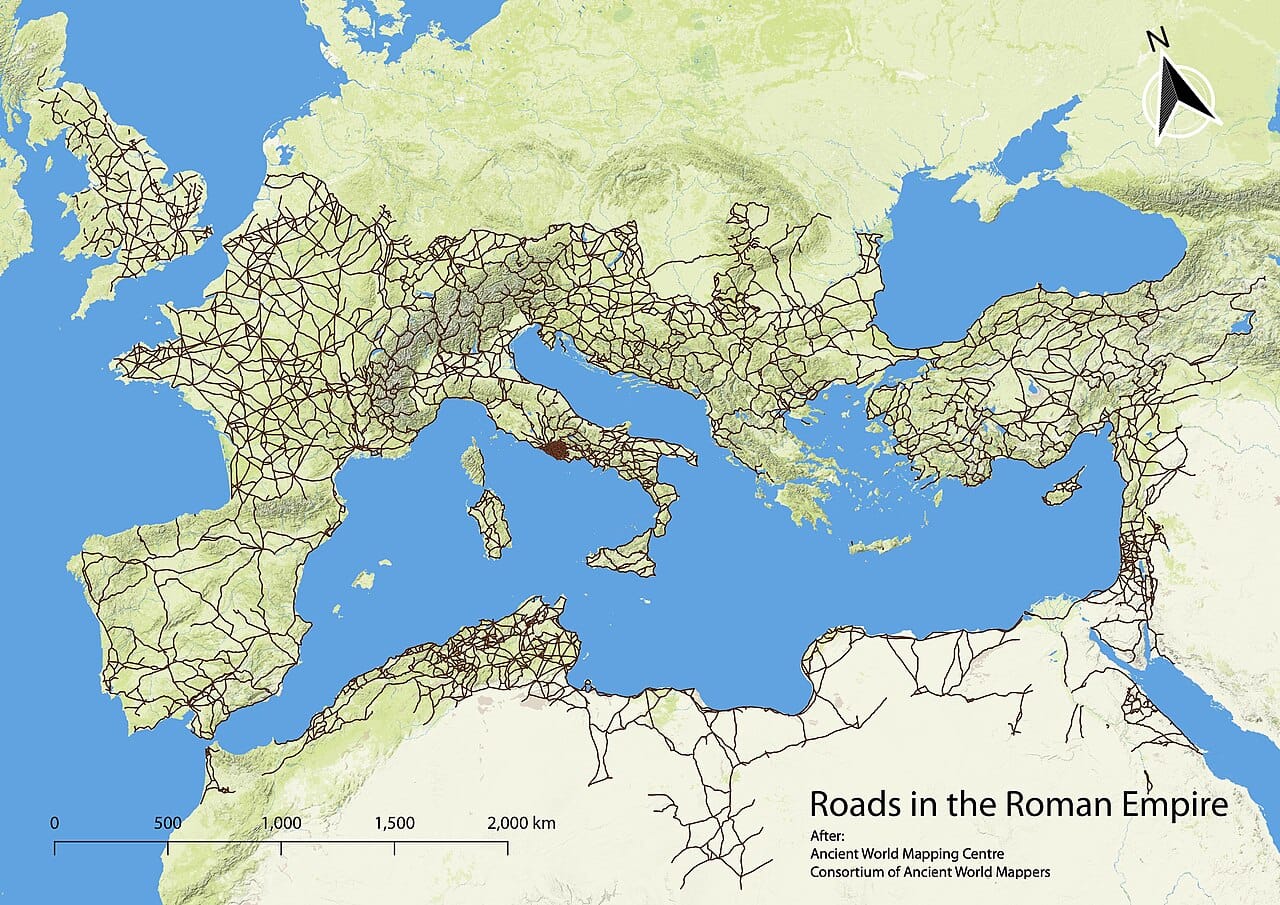
Military and administrative movement is the historical driver. The Roman network existed to move legions and officials, the Persian Royal Road carried royal messengers, and the Inca road system, built without wheeled vehicles or draught animals, held an empire together across extreme terrain by relay runners.
Trade used them and rarely paid for them. Long-distance commerce generally followed routes built for the state, which is a pattern that recurs into the modern period.
Pilgrimage and religious travel sustained routes in several regions, and the infrastructure of inns and hospices along them was substantial.
The interstate system in the United States was authorised in 1956 with explicit defence justification in its name, and its actual effect was on freight, suburbanisation and the decline of rail passenger travel.
Roman methods were not surpassed in Europe for well over a millennium, and road quality in the medieval and early modern periods was generally poor, with maintenance a parish obligation that was frequently neglected.
Turnpike trusts from the seventeenth century onward funded roads by tolls, which improved main routes and introduced the argument about charging for access that is still live.
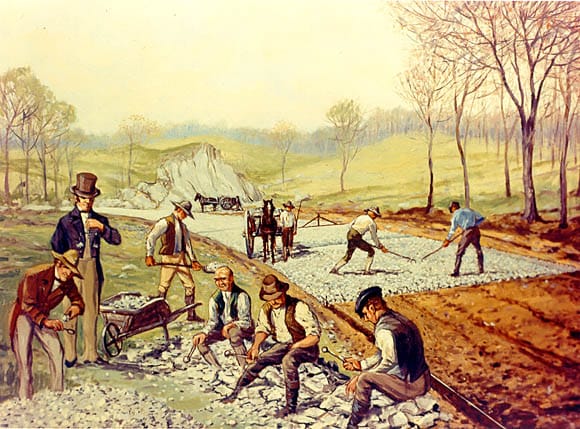
John Loudon McAdam's method, from the early nineteenth century, was the decisive advance and was as much economic as technical. He argued that heavy stone foundations were unnecessary if the subsoil was drained, and that a compacted layer of small angular stones would lock together under traffic and shed water. It was far cheaper than earlier methods and it worked.
Tar was added to macadam surfaces from the early twentieth century to bind dust raised by motor vehicles, producing tarmacadam.
Modern pavements are either flexible, using layers of asphalt concrete that deform slightly under load, or rigid, using concrete slabs that spread load by bending. Flexible pavements are cheaper to build and repair; rigid ones last longer under heavy traffic.
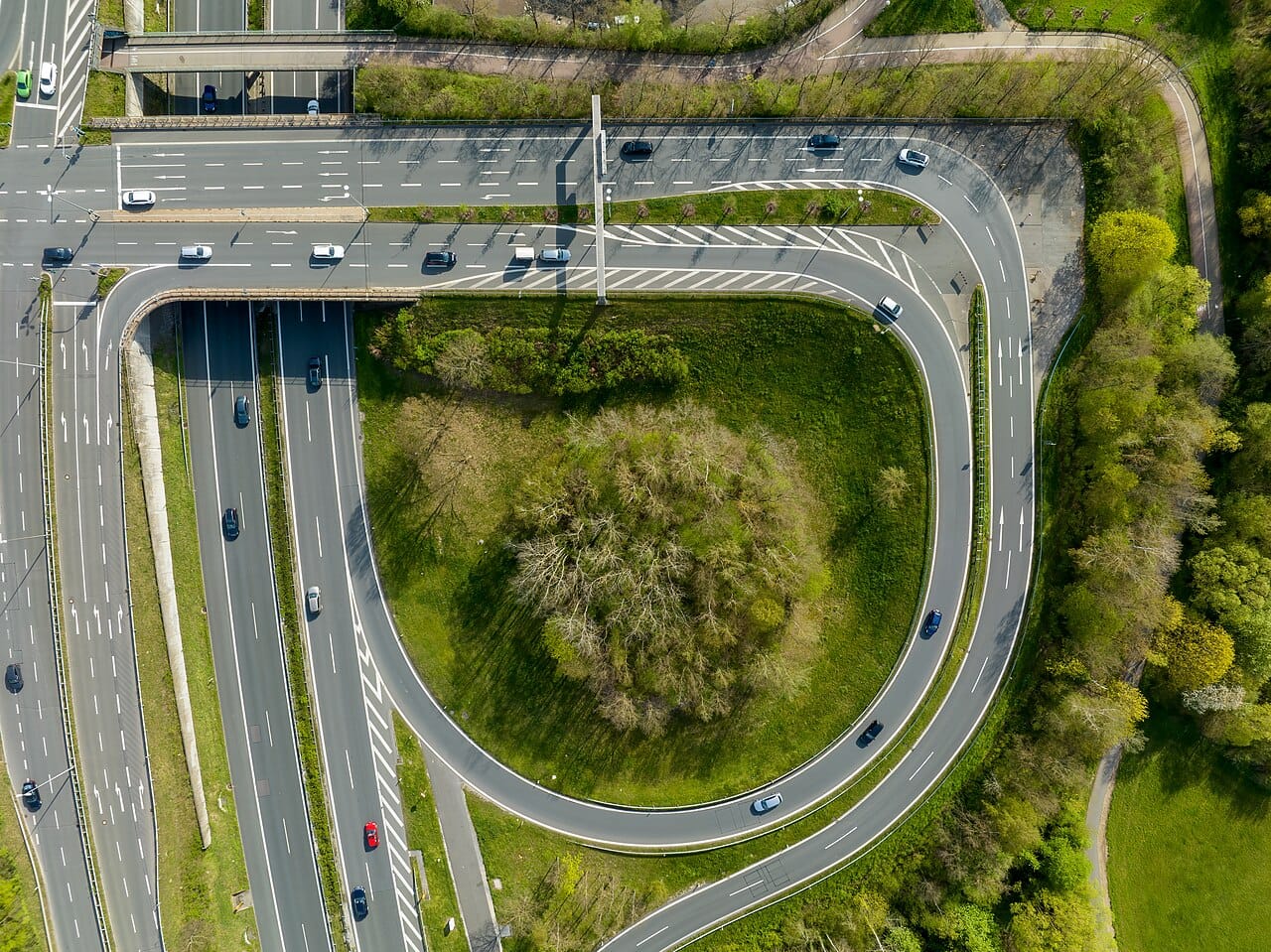
Induced demand is the best-established and least intuitive finding. Adding road capacity in a congested area generates additional traffic that fills it, because the reduced travel cost changes how far and how often people travel and where they choose to live and work. The relationship is strong enough that studies have found roughly proportional increases in traffic to increases in lane capacity over a period of years.
The implication is that building out of congestion does not work in growing areas, and this is contested less among transport researchers than in public debate.
Severance is the effect of a road on the places it passes through. Urban motorway construction in the mid twentieth century divided neighbourhoods, and the routes chosen ran disproportionately through poorer and minority districts in several countries, which is documented rather than alleged.
Road deaths are the largest direct cost. Around one and a quarter million people die on roads annually worldwide, and it is the leading cause of death for young people in many countries. The systematic approaches that reduced aviation deaths, described in that capsule, have been applied to roads under the name Vision Zero, with the central premise that the system should be designed so that human error does not kill.
Removing roads has repeatedly produced less congestion than predicted rather than more, which is the same effect as induced demand operating in reverse.
Roads are the infrastructure almost everything else uses. Freight, emergency services, and access to work, schooling and healthcare all depend on them, and their absence is one of the sharper practical measures of poverty.
They are also the clearest case of infrastructure creating the demand it was built to meet, which makes road planning unusually prone to a mistake that looks like common sense: adding capacity to relieve congestion generally does not.