Two particles can be prepared in a joint state where neither has a definite property of its own, and measuring one immediately fixes the corresponding property of the other, however far apart they are. Einstein thought this proved quantum mechanics incomplete. Fifty years of experiments have shown he was wrong about that.
An entangled pair is described by a single joint state that cannot be written as one state for each particle. A pair of photons can be prepared so that their polarisations are guaranteed opposite, while neither photon has a polarisation until measured. The correlation is definite; the individual values are not.
Nothing is transmitted. Each measurement on its own produces a random result, and the pattern only appears when both sets of results are brought together and compared, which requires an ordinary signal. This is why entanglement cannot carry a message faster than light.
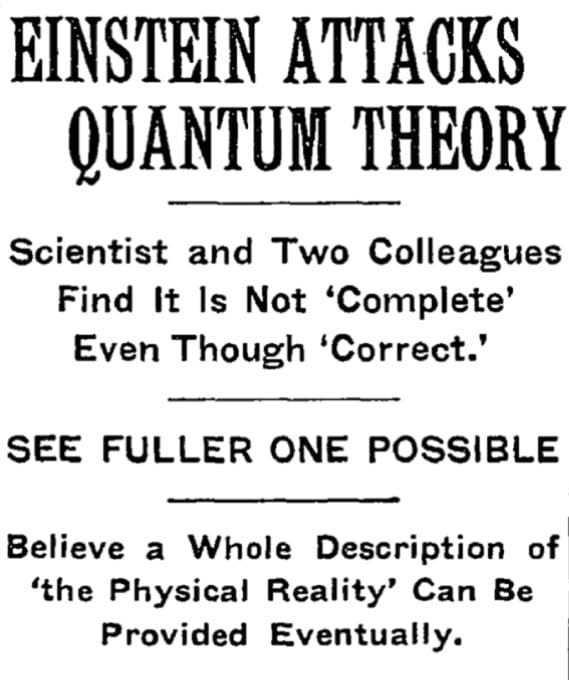
Einstein, Podolsky and Rosen argued in 1935 that if measuring one particle reveals the state of a distant one without disturbing it, that state must have been real all along. Since quantum mechanics does not include it, quantum mechanics must be an incomplete description. Einstein called the alternative spooky action at a distance.
For nearly thirty years this was regarded as philosophy, because both views predicted the same experimental results.
John Stewart Bell showed in 1964 that the two positions differ measurably. Any theory in which particles carry predetermined values, and in which no influence travels faster than light, obeys a mathematical limit on how strongly the measurements of separated particles can be correlated. Quantum mechanics predicts correlations that exceed the limit.
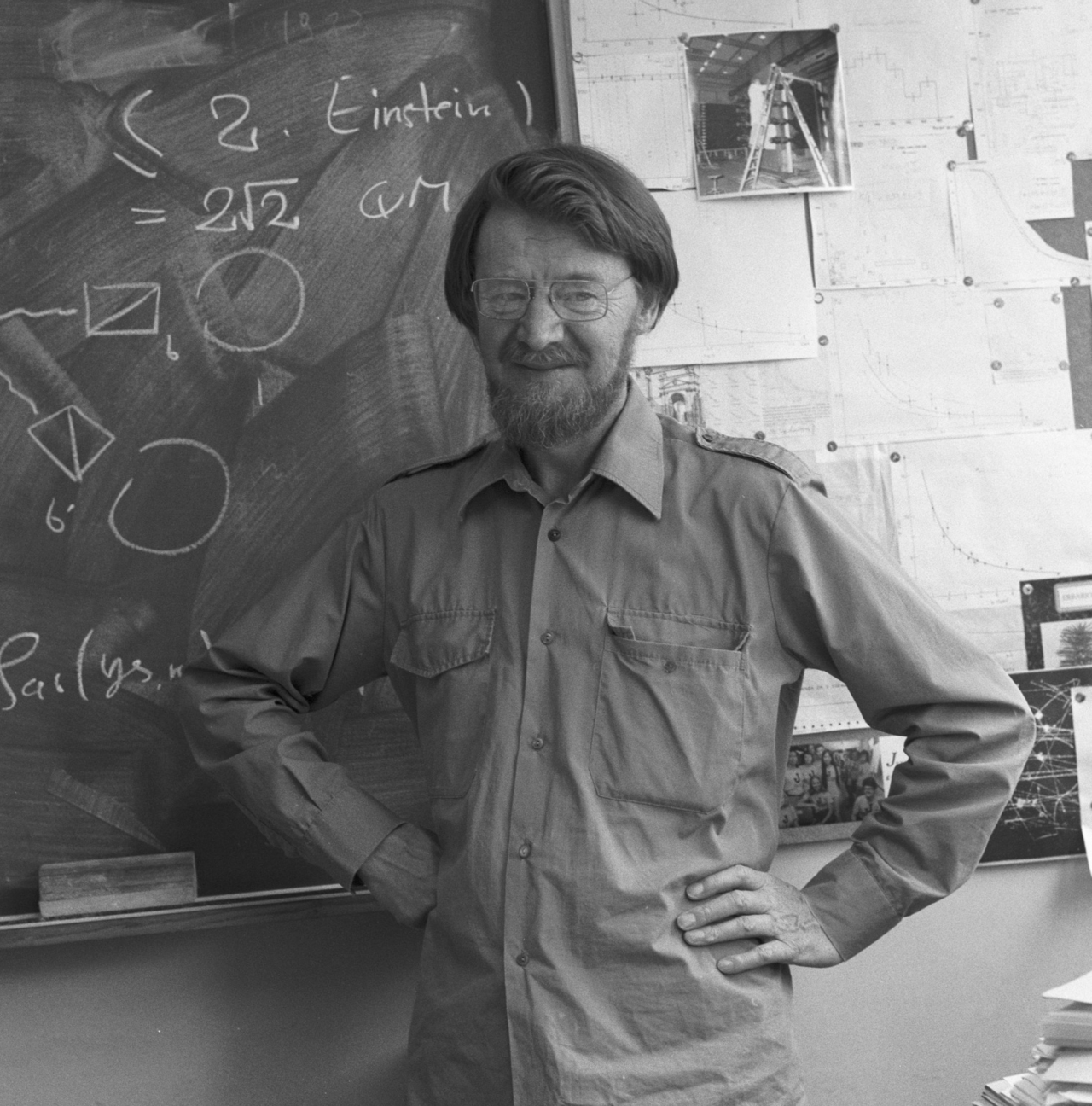
This converted a debate about interpretation into a question an apparatus could settle.
John Clauser performed the first practical test in 1972. Alain Aspect's experiments in the early 1980s changed the measurement settings while the photons were in flight, closing the possibility that the detectors had communicated their settings in advance.
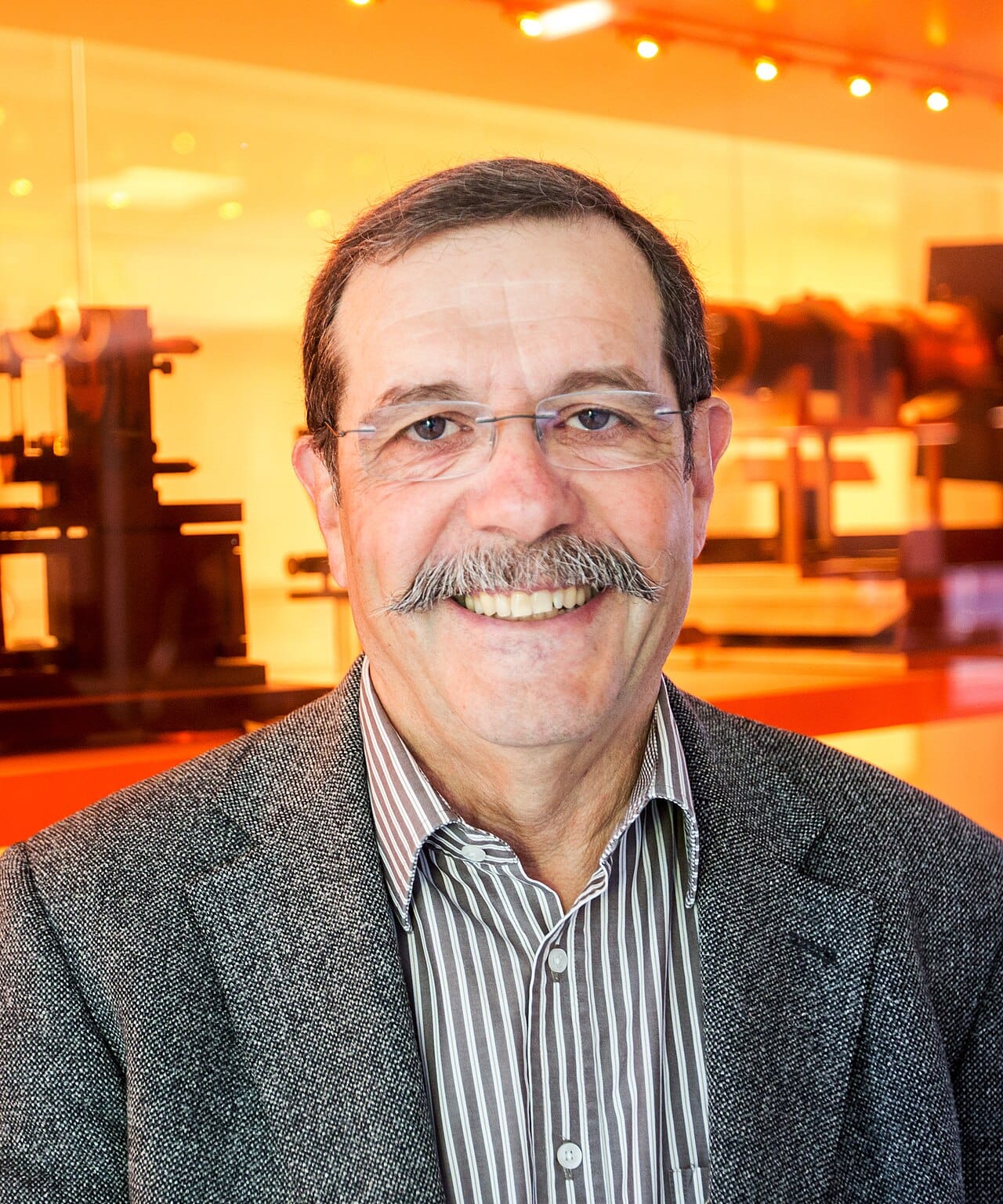
Two loopholes remained: detectors might sample an unrepresentative subset of pairs, and the choice of settings might not be genuinely independent. Experiments in 2015 in Delft, Vienna and Boulder closed both at once. Clauser, Aspect and Anton Zeilinger shared the 2022 Nobel Prize in Physics.
Entanglement is a resource rather than a curiosity. Quantum key distribution uses it to detect eavesdropping, since any measurement of the pair disturbs the correlation. Quantum computing uses entangled qubits to hold states that no set of independent bits can represent. Quantum teleportation transfers a state from one location to another using an entangled pair plus an ordinary classical message, and the classical message is why the procedure respects relativity.
The experimental facts are settled. What they say about reality is not. Abandoning predetermined values leads to one family of interpretations, abandoning locality to another, and abandoning the assumption that measurements have single outcomes to a third. The choice is treated in the capsule on quantum interpretations; no experiment yet distinguishes them.