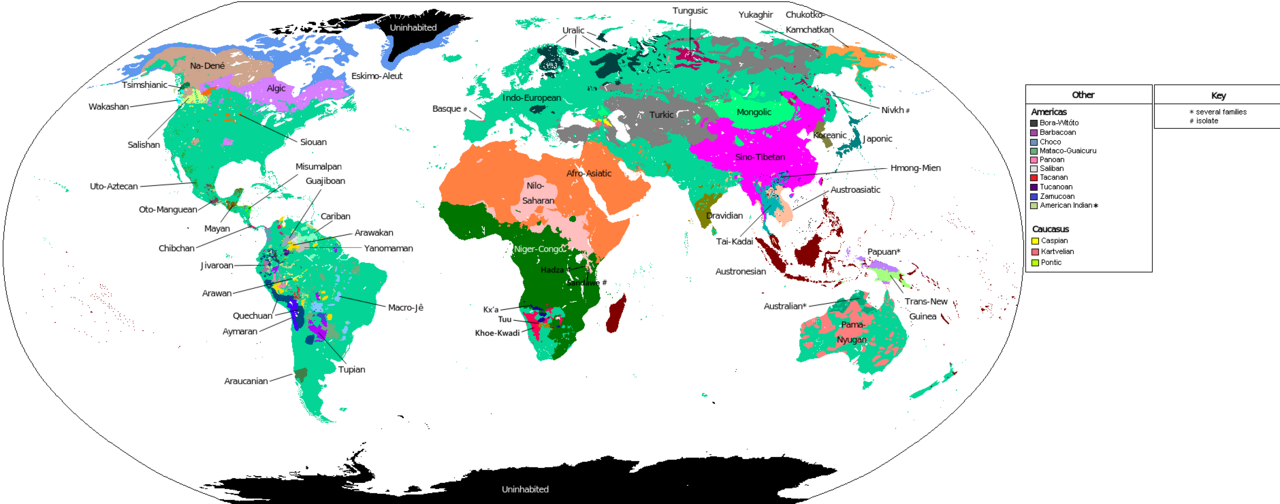
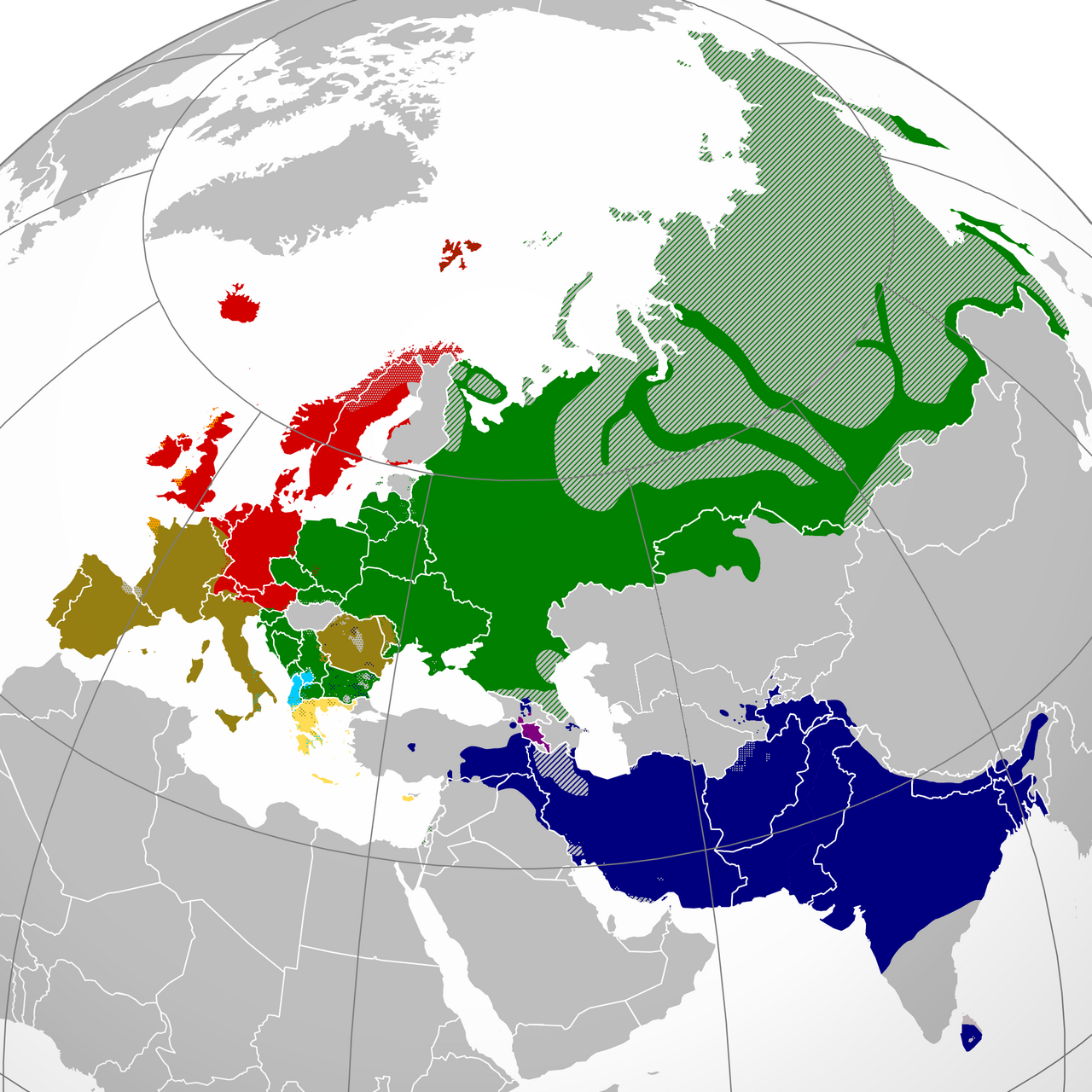
Proto-Indo-European is a language nobody has ever heard, that left no written record, and whose vocabulary and grammar have nonetheless been reconstructed in considerable detail. It is the common ancestor of a family that includes English, Spanish, Russian, Greek, Persian, Hindi, and roughly four hundred other languages, spoken today by close to half the world's population.
In 1786 Sir William Jones, a judge in Bengal, observed that Sanskrit bore to Greek and Latin a resemblance in verb roots and grammar too strong to be accidental, and proposed that all three had sprung from a common source which no longer exists. He was not the first to notice similarities, but he framed the conclusion that founded the field.
The evidence is systematic correspondence rather than casual resemblance. English father, Latin pater, Sanskrit pitar, and Greek pater are not similar by chance, and the pattern repeats across core vocabulary: kinship terms, numbers, body parts, and basic verbs.
Nineteenth-century scholars found that sound change is regular. Grimm's law describes how certain consonants shifted systematically in the Germanic branch, which is why Latin pater corresponds to English father with p becoming f, and the same correspondence holds across the vocabulary rather than in isolated words.
Regularity makes the process reversible. Comparing daughter languages and running the known sound laws backwards yields reconstructed forms, conventionally marked with an asterisk, such as pehter for father. A striking confirmation came in the twentieth century: Ferdinand de Saussure had proposed on internal grounds that the parent language contained sounds preserved in none of its descendants. Decades later, Hittite was deciphered and found to preserve exactly such a sound where he had predicted it.
The linguistic reconstruction is far better established than the question of the speakers. The reconstructed vocabulary contains words for wheel, axle, yoke, horse, and wool, which places the language after the spread of wheeled transport, roughly the fourth millennium BC.
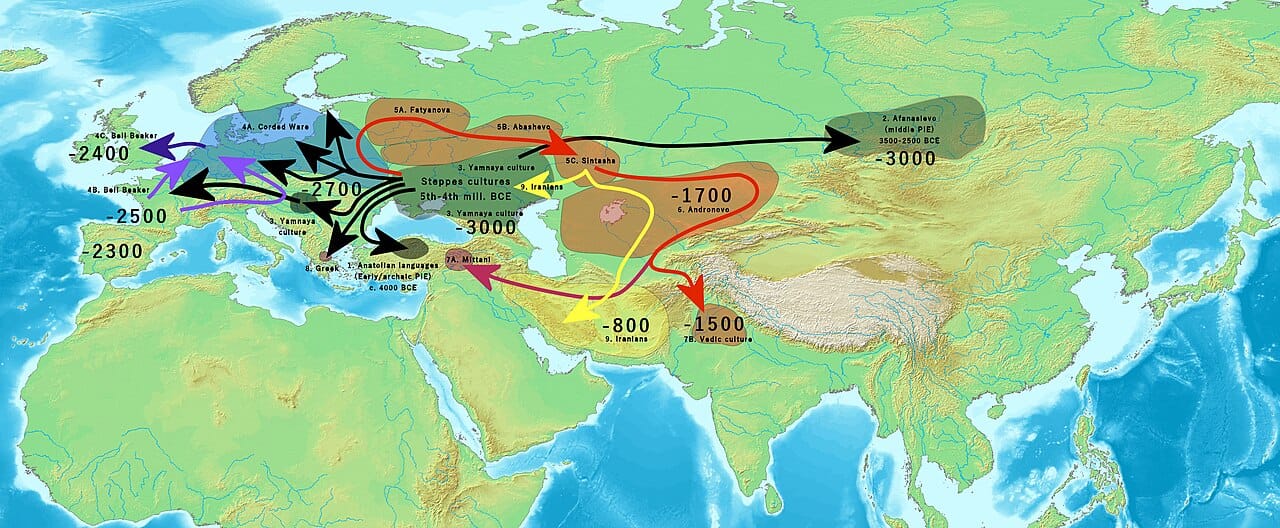
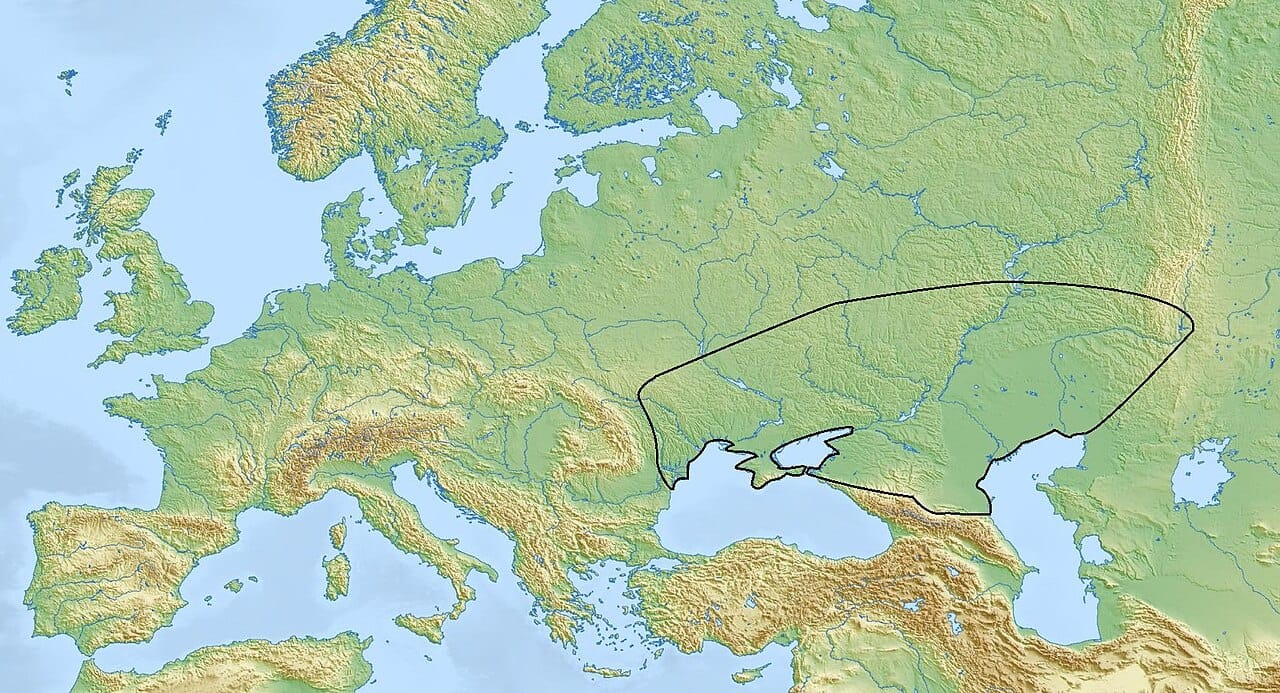
The dominant account is the steppe hypothesis, associated with Marija Gimbutas and developed by David Anthony, placing the homeland in the Pontic-Caspian grasslands north of the Black and Caspian seas, with the Yamnaya culture as the likely bearers, spreading through mobility on horseback and by wagon. The main rival, argued by Colin Renfrew, placed the origin in Anatolia and attributed the spread to farming several millennia earlier.
Ancient DNA studies since 2015 have shifted the balance substantially toward the steppe account, showing a large movement of people from that region into Europe in the third millennium BC. The question is not closed, and the relationship between the genetic, archaeological, and linguistic evidence continues to be argued, but the convergence is the strongest it has been.