The doctrine that an organism exists fully formed in miniature within the egg or the sperm, and that development is merely the enlargement of a structure already present. It dominated thinking about generation for roughly a century and was replaced by the recognition that form is built during development rather than unpacked.
The question was genuinely hard: how does a complex, highly organised animal arise from material that appears structureless?
The alternative on offer, epigenesis, held that structure emerges progressively from unorganised material. To seventeenth century thinkers that looked like asking for organisation to arise from nothing, which was both physically obscure and theologically awkward.
Preformation solved the problem by denying that it existed. If the organism is already there, development requires only growth, and no one has to explain how order appears.
Preformationists divided over which parent carried the miniature.
Ovists, including Marcello Malpighi, Jan Swammerdam and later Charles Bonnet, held that it resided in the egg. They had the better evidence, since eggs are large, visibly organised, and observably develop.
Spermists held that it resided in the sperm. Nicolaas Hartsoeker's drawing of a homunculus tucked inside a sperm head is the image most associated with the whole doctrine, and it is routinely misrepresented. Hartsoeker did not claim to have seen it. He presented it as what an observer would expect to find if the spermist account were true, which is a conditional illustration rather than a reported observation.
The doctrine carried a consequence its proponents accepted explicitly. If each miniature contains the miniatures of all its own descendants, then all future generations are nested inside the first, an idea known as encasement. Bonnet embraced it, and it implies that the number of possible generations is finite and was fixed at creation.
Several lines of evidence converged.
Hybrids were decisive in principle. Offspring reliably resemble both parents, which a single preformed miniature from one parent cannot explain. Joseph Kölreuter's plant hybridisation work in the 1760s made this quantitative and difficult to evade.
Regeneration was awkward for the doctrine. Abraham Trembley showed in the 1740s that a hydra cut into pieces regenerates complete animals from each fragment, which requires form to be generated rather than merely unfolded.
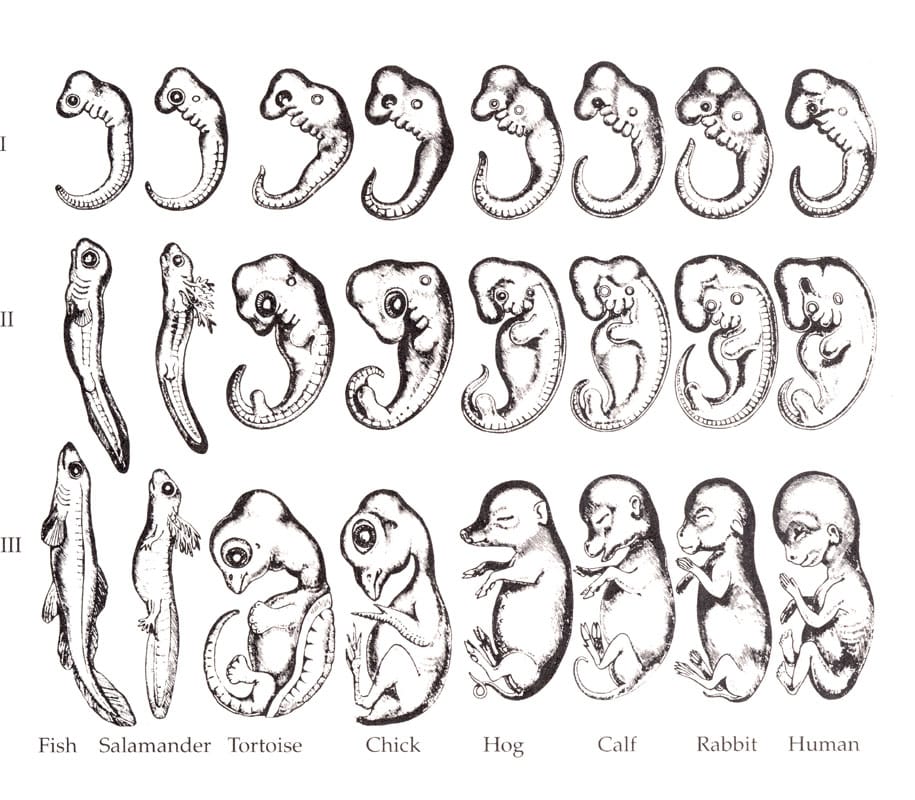
Direct observation settled it. Caspar Friedrich Wolff, in his 1759 dissertation, examined the chick embryo and reported that the intestine forms progressively from a flat sheet of tissue that folds into a tube, and that the heart and blood vessels likewise appear where nothing structured had been. Nothing preformed was there to enlarge.
Karl Ernst von Baer identified the mammalian egg in 1827, which removed the empirical basis for the more speculative versions of the debate, and cell theory supplied the framework within which development could be described as division and differentiation.
The encasement version also fails on scale. Successive nesting requires structures shrinking without limit, and the atomic constitution of matter forbids it.
There is a sense in which something is preformed, and it should be stated precisely because it is easy to overstate.
A fertilised egg does contain inherited information that specifies how development will proceed, and it contains organised maternal material, including localised molecules that establish the embryo's axes. In that respect the egg is not undifferentiated raw material.
What it does not contain is a miniature of the organism. Information specifying a process is not a small copy of the outcome, and the distinction is the entire content of the dispute. Development is the execution of that information in interaction with the environment, which is what epigenesis asserted and preformation denied.
Preformationism is a clear case of a theory adopted because it dissolved a difficulty rather than because evidence supported it. It made the emergence of order unnecessary to explain, at the cost of a claim about the world that observation eventually contradicted.
It also frames a question that remains live. The relationship between genetic information and physical form is not a simple readout, and how a linear sequence specifies a three-dimensional organism is still among the harder open problems in developmental biology.