Ernst Haeckel's claim that an embryo passes through the adult forms of its ancestors as it develops, summarised as the slogan that ontogeny recapitulates phylogeny. The general law is false, the drawings that popularised it were overstated, and the real relationship between development and ancestry is different and more interesting.
Haeckel proposed in 1866 that development is a rapid and compressed replay of evolutionary history. On this account a mammalian embryo is briefly a fish, then briefly an amphibian, then a reptile, before becoming a mammal, each stage corresponding to an adult ancestor.
He called it the biogenetic law and treated it as a means of reading evolutionary history directly off embryos, which promised a way to reconstruct ancestry without fossils.
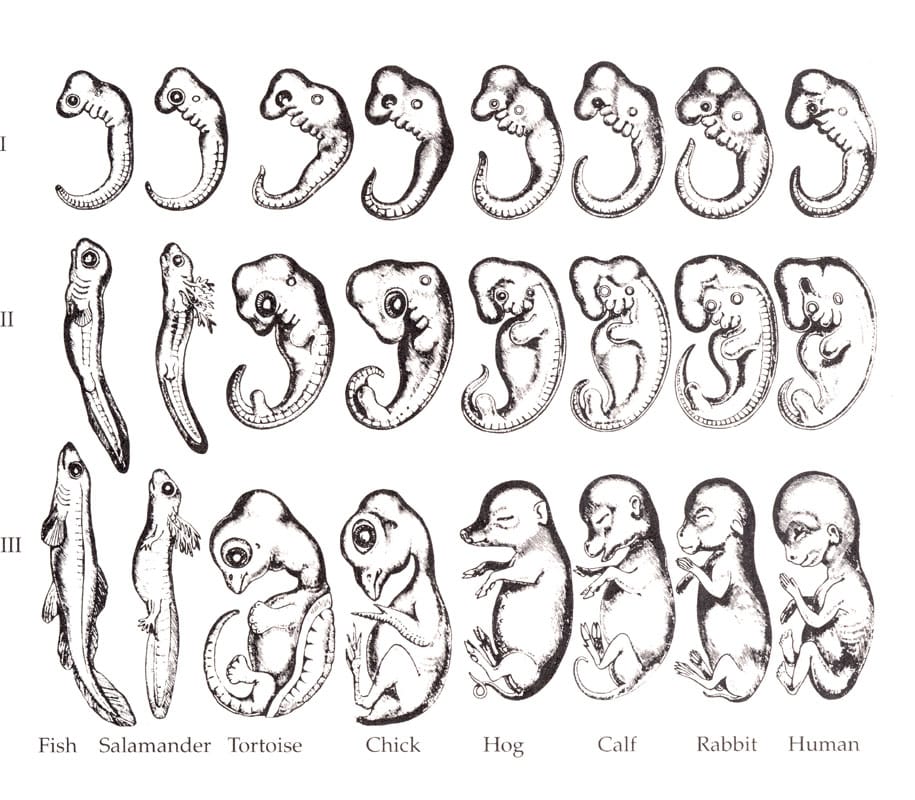
The famous illustrations arranged embryos of fish, salamander, tortoise, chick, pig, cow, rabbit and human in rows and columns, showing near identity at the earliest stage and progressive divergence.
The decisive objection is that embryos resemble the embryos of related species, not their adults. A human embryo has pharyngeal arches, structures that in a fish go on to form gills, but it never has gills, and it never passes through a stage that is a functioning fish.
This had already been stated before Haeckel wrote. Karl Ernst von Baer set out in 1828 that development proceeds from the general to the special: the features shared by a large group appear first, and the features distinguishing the particular species appear later. That describes the observations correctly, and it does not require an embryo to be an ancestor at any point.
Development can also add, delete and reorder stages. Evolution modifies development at every point, including the earliest, so there is no reason for the sequence to preserve a historical record, and often it does not. Mammalian embryos develop features their ancestors did not have, such as the placenta and its associated membranes, early rather than late.
Wilhelm His, an embryologist and contemporary of Haeckel, attacked both the law and the figures. He argued that developmental form arises from mechanical and physical processes in the growing embryo, and he accused Haeckel of drawing what the theory required rather than what the specimens showed.
The criticism of the figures has substance. Haeckel reused the same woodblock for embryos of different classes in an early edition, and his drawings exaggerate similarity at the earliest stage and understate real variation. Michael Richardson and colleagues published photographs of the actual embryos in 1997 and documented the differences.
Two cautions are needed here, because this episode is frequently misused. The drawings were misleading, and they are not evidence that embryology is fabricated or that common descent is unsupported. Embryonic similarity across vertebrates is real, is documented photographically and molecularly, and remains strong evidence for common ancestry. What is refuted is Haeckel's law about ancestral adults, not the comparative embryology it was built on.
The modern picture retains a genuine pattern that the biogenetic law distorted.
Vertebrate embryos are most similar to one another not at the very beginning but at an intermediate point, the phylotypic stage, and they diverge both before and after it. Plotting variation against developmental time gives a shape narrow in the middle and wide at both ends, which is why the idea is called the developmental hourglass.
The pattern is supported by comparative morphology and, more recently, by measurements of how strongly gene expression is conserved at each stage, which reach a minimum of divergence around the same point.
The explanation is about constraint rather than history. The mid-embryonic period is when body plan is laid down through highly interconnected signalling, so changes then disrupt many things at once and are strongly selected against. Early stages, which mostly handle egg type and cleavage, and late stages, which shape species-specific features, tolerate change more easily.
Recapitulation is a case where a memorable slogan outlived its refutation by a century, and where the correct account was available before the incorrect one became popular. Haeckel's figures continued to appear in textbooks long after specialists had abandoned the law, which is a failure of textbook practice rather than of research.
The theory also had consequences outside biology. Its logic was applied to human societies and to child development, supplying a scientific dressing for the claim that some human groups represented earlier stages of a single ladder of progress. That application was mistaken twice over, in the biology it borrowed and in the ranking it imposed, and it is part of why the episode is worth stating carefully.