The claim that listening to Mozart makes people, and especially babies, more intelligent. It came from one small study whose actual finding was far narrower, it did not replicate, and it nonetheless changed public policy in two American states.
Frances Rauscher, Gordon Shaw and Katherine Ky published a one-page report in Nature in 1993. Thirty-six college students performed a spatial reasoning task after ten minutes of a Mozart sonata, ten minutes of relaxation instructions, or ten minutes of silence. Scores after Mozart were higher, by the equivalent of eight or nine IQ points on that one task.

The authors were explicit about the limits. The effect was on one narrow spatial skill, it lasted around fifteen minutes, and there were no children in the study. They never claimed it raised intelligence, and Rauscher has spent thirty years saying so.
The finding was reported as proof that classical music makes children smarter. Don Campbell trademarked the phrase Mozart Effect and sold books and recordings on that basis.
In 1998 the governor of Georgia budgeted state funds to give a classical music recording to every newborn in the state. Florida required state-funded day care centres to play classical music daily. Neither measure had any evidence behind it, since no study had tested infants at all.
Attempts to reproduce the result were inconsistent from the start. A 1999 meta-analysis by Christopher Chabris covering sixteen studies found an effect on spatial task performance of about 1.4 IQ points, small enough to be explained without any special property of music. Kenneth Steele's group failed to replicate it in a large sample the same year.
The decisive work came from Jakob Pietschnig and colleagues in 2010, pooling around 3,000 participants across nearly forty studies. There was no Mozart-specific effect. Studies from laboratories affiliated with the original authors reported larger effects than independent ones, which is a signature of a result that is not there.
The explanation that survives is arousal and mood. Any stimulus that makes a person more alert improves performance on a task done immediately afterwards. Glenn Schellenberg's work showed the same boost from an upbeat Schubert piece, from a Stephen King audiobook for listeners who preferred it, and from anything else the participant enjoyed. Slow, sad music produced no benefit. Mozart is doing nothing that coffee or an interesting conversation does not.
Passive listening and musical training are different things, and conflating them is how the myth persists.
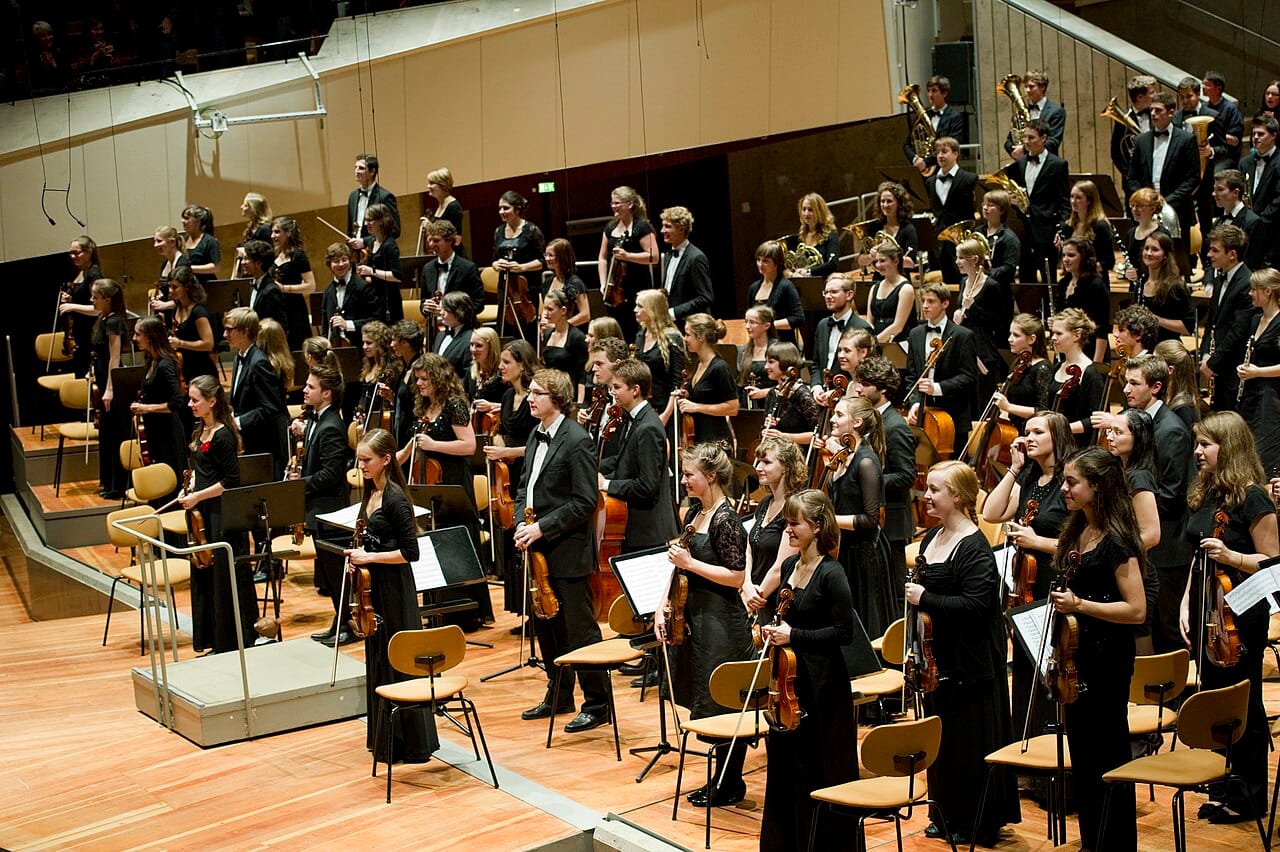
Schellenberg ran a randomised trial in 2004 assigning six-year-olds to keyboard lessons, voice lessons, drama or nothing for a year. The music groups gained about 2.7 IQ points more than the controls. Real, measured, and modest, and it required a year of lessons rather than ten minutes of listening. Later analyses suggest even this may partly reflect which families sustain music lessons.
The case for music education does not rest on IQ, and did not need to.