The practice of withdrawing from ordinary society to live under religious discipline, usually in community and usually under vows. It arose independently in several traditions and has had effects on agriculture, education and the transmission of texts far beyond religion.

Monastic traditions differ doctrinally and share a recognisable structure.
Withdrawal from ordinary life, whether to a remote place or to an enclosed community within a city.
Renunciation of property, family and personal autonomy, typically formalised as vows.
A rule governing daily life in detail, specifying hours of prayer, work, meals, silence and sleep.
Communal living under an elected or appointed superior, with an established process for admitting and training newcomers.
Manual or intellectual labour, which supports the community and is generally treated as part of the discipline rather than merely as necessity.
The recurrence of this pattern in traditions with no contact suggests it is a stable solution to the problem of sustaining an intensive religious life over a lifetime.
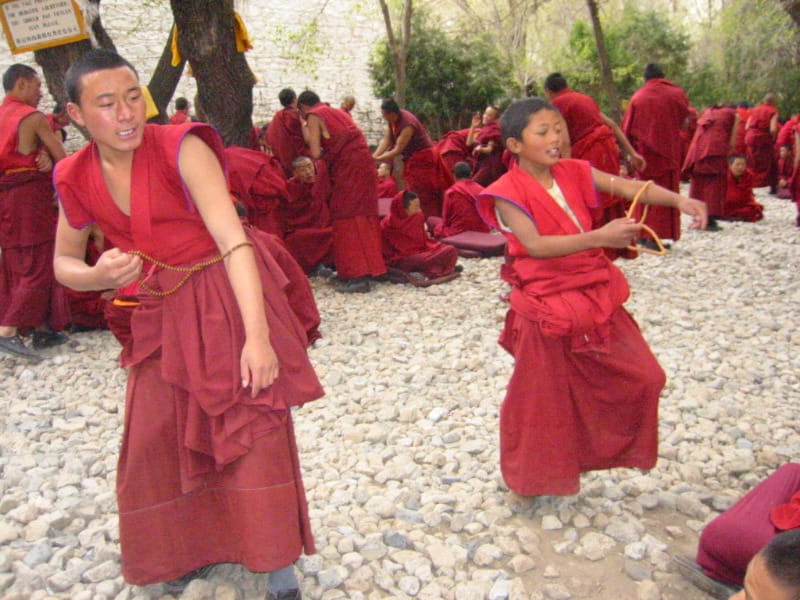
Buddhist monasticism is the oldest continuous tradition, with the sangha established during the Buddha's lifetime in the fifth century BCE. The Vinaya sets out several hundred rules governing conduct. Monks and nuns traditionally depend on lay donation for food, which creates a reciprocal relationship in which the laity gains merit by giving.
Christian monasticism began with hermits in the Egyptian desert in the third century, of whom Anthony is the best known. Pachomius organised communal life shortly afterwards, and Benedict's Rule, written around 530, became the standard in Western Europe, governing life with a balance of prayer, reading and work.
Later Christian orders differed by emphasis: Cistercians on austerity and agriculture, Carthusians on solitude, and the mendicant friars, Franciscans and Dominicans, on preaching and poverty in towns rather than enclosure.
Hindu traditions have sannyasa, the renunciate stage of life, and organised monastic orders established from the eighth century.
Jain monasticism is particularly demanding, with strict non-violence extending to precautions against harming insects.
Judaism and Islam have generally not developed institutional monasticism, though Sufi orders involve comparable discipline and community, and there are ascetic strands in both.
The historical effects extend well beyond religious practice, particularly in medieval Europe.
Textual transmission. Monastic scriptoria copied manuscripts, and a substantial part of surviving classical Latin literature exists because monks copied works they had no doctrinal interest in preserving. The survival of texts is disproportionately a function of whether a monastery held a copy.
Education. Monastic and cathedral schools were the principal educational institutions in Europe for centuries, and universities emerged partly from them.
Agriculture. Monastic estates were large and managed over long horizons, since the institution outlived any individual. Cistercians in particular cleared land, drained marsh and developed sheep farming, and monastic houses were significant agricultural innovators.
Technology. Monasteries adopted water power extensively for milling, and mechanical clocks appear to have developed partly from the need to regulate the hours of prayer.
Medicine and hospitality. Infirmaries treated the sick, and houses on travel routes provided lodging, which the pilgrimage capsule describes.
Brewing, viticulture and cheesemaking developed in monastic settings and several products still carry those origins.

A recurring cycle appears across traditions. A community founded on poverty attracts donations precisely because it is admired for renouncing wealth. The accumulated endowment makes the community wealthy and comfortable, which undermines the discipline that attracted the donations, prompting reform movements or new orders founded on stricter observance, which then repeat the cycle.
The Cluniac and Cistercian reforms in Europe follow this pattern, as does the founding of the mendicant orders.
Monastic wealth also made monasteries targets. The dissolution of the monasteries in England from 1536 transferred enormous property to the crown and its allies, and comparable suppressions occurred elsewhere in Europe, in Tibet, and under several twentieth century governments.
Monastic populations have declined substantially in Western Christianity over the past century, with many houses closing or amalgamating.
Buddhist monasticism remains large in Thailand, Myanmar, Sri Lanka and among Tibetan communities, and temporary ordination is a normal life stage for men in several Theravada countries rather than a lifetime commitment.
Contemplative practices derived from monastic traditions, including meditation and structured retreat, have been widely adopted outside religious contexts.
Monasticism is a form of social organisation that solved the problem of sustaining a demanding way of life across generations, and it did so well enough that some institutions have operated continuously for over a thousand years.
Its incidental effects are what a reader is most likely to encounter. Much of what survives of classical literature, a substantial part of the medieval agricultural and technological record, and the institutional ancestry of the university all run through communities founded for entirely different purposes.