The proposal that ice ages are paced by slow, predictable variations in Earth's orbit and axial orientation, which redistribute sunlight across latitudes and seasons. The pacing is confirmed. Why the response is as large as it is, and why it changed character, is not fully resolved.
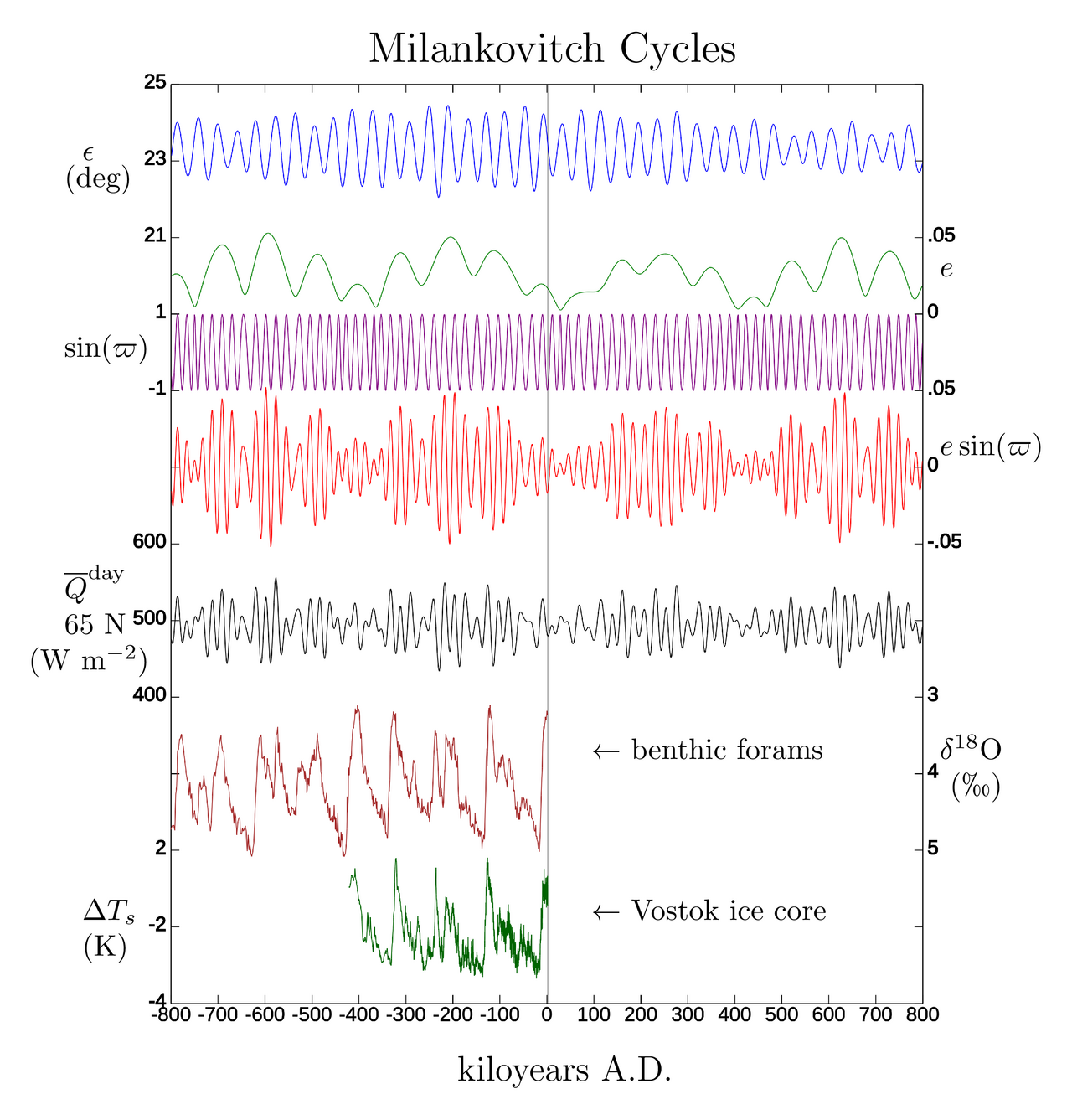
Eccentricity is the departure of Earth's orbit from a circle, varying over roughly one hundred thousand and four hundred and five thousand year periods. It alters the total annual sunlight received by only a fraction of a per cent, which is far too small to drive an ice age directly.
Obliquity is the tilt of the axis, varying between about 22.1 and 24.5 degrees over about forty one thousand years. Greater tilt means stronger seasons in both hemispheres and more sunlight delivered to high latitudes in summer.
Precession is the wobble of the axis, which changes the time of year at which Earth is closest to the Sun, with periods near nineteen and twenty three thousand years. It does not change annual totals at all; it moves sunlight between seasons.
These are computed from celestial mechanics, principally the gravitational influence of Jupiter, Saturn and the Moon, and they are known with precision for millions of years in both directions.
Milutin Milanković, working through the 1920s and completing the work in 1941, calculated insolation over time and identified what he considered the controlling quantity.
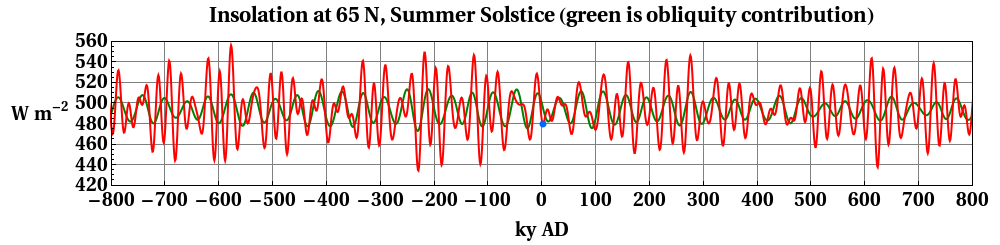
The key is not annual average sunlight but summer sunlight at high northern latitudes, around sixty five degrees north. The reasoning is that ice sheets grow when winter snow survives the summer. A cool summer that fails to melt the previous winter's snow allows accumulation, and accumulated snow raises the surface reflectivity, which reduces absorbed sunlight further.
The northern hemisphere matters disproportionately because that is where the large continental landmasses at the relevant latitudes are. The southern hemisphere at the same latitude is mostly ocean, which responds differently.
Earlier versions of the idea came from Joseph Adhémar and James Croll in the nineteenth century; Milanković supplied the quantitative calculation.
The theory was regarded as speculative for decades, because the terrestrial record was not resolved well enough to test it.
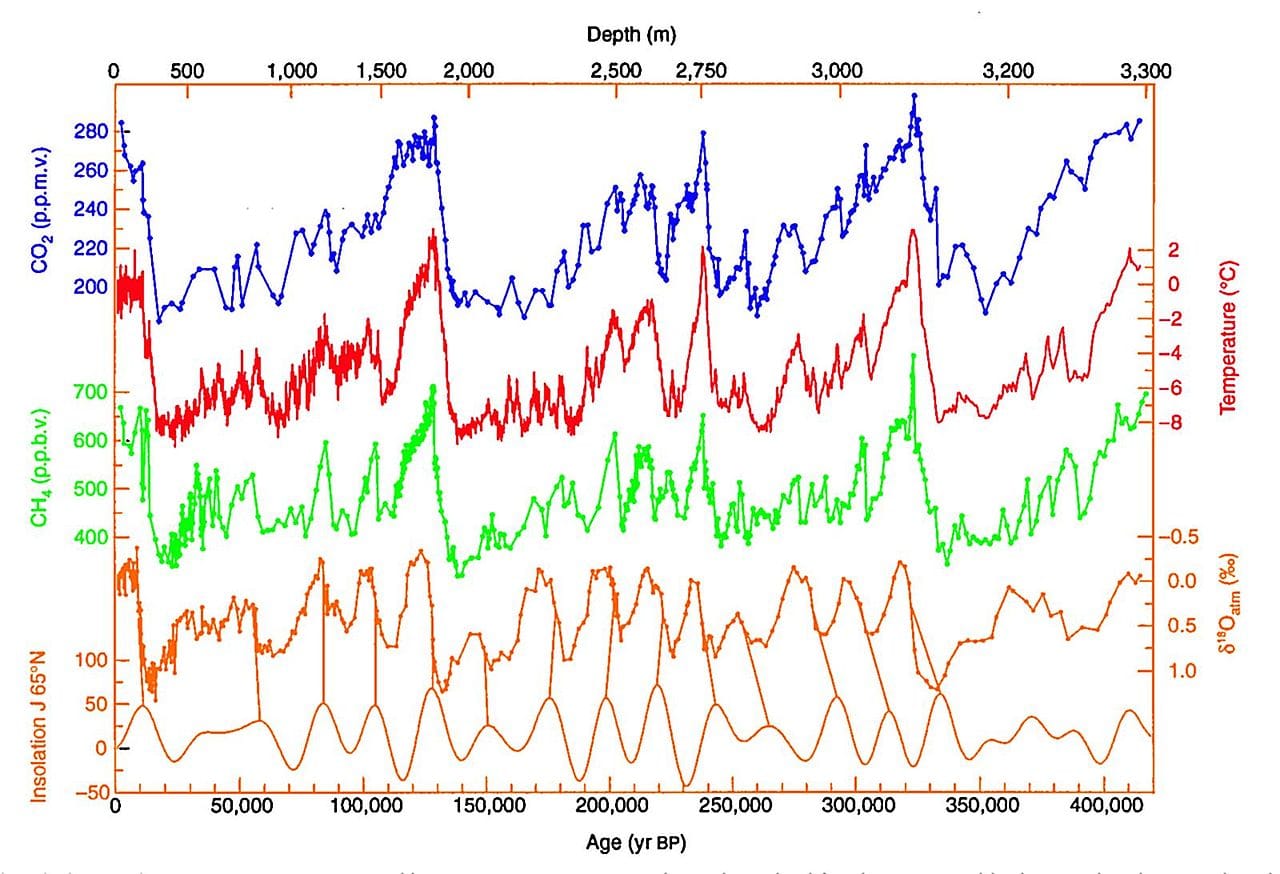
The decisive test came in 1976, when James Hays, John Imbrie and Nicholas Shackleton analysed deep-sea sediment cores under the title Variations in the Earth's Orbit: Pacemaker of the Ice Ages. Spectral analysis of oxygen isotope records revealed concentrated variance at periods close to twenty three thousand, forty one thousand and one hundred thousand years, matching the orbital frequencies.
Finding the predicted periods in an independent record, when they had been calculated from planetary motions with no reference to climate, is about as clean a confirmation as palaeoclimate offers. Subsequent ice cores, notably from Vostok and later from Dome C, reproduced the pattern over longer intervals.
Three difficulties are genuine and are actively worked on.
The hundred thousand year problem is the largest. For the last eight hundred thousand years the dominant cycle has been about one hundred thousand years, matching eccentricity, but eccentricity is by far the weakest of the three forcings in terms of energy delivered. The response is much larger than the forcing, which means internal amplification must be doing most of the work. Proposed amplifiers include ice sheet dynamics, carbon dioxide feedbacks and the physical state of the bed under ice sheets.
The mid-Pleistocene transition is the second. Before roughly one million years ago the cycles ran at forty one thousand years, matching obliquity, and afterwards at about one hundred thousand years. The orbital variations did not change at all across that boundary, so the change must be in how the Earth responds, and the cause is unresolved. Gradual decline in atmospheric carbon dioxide and progressive removal of subglacial sediment are leading candidates.
Causality and timing questions arise where climate changes appear to lead the orbital forcing rather than follow it in some records, though improvements in dating have reduced these discrepancies.
The orbital variations are established beyond dispute, being straightforward celestial mechanics. Their signatures are present in climate records at the predicted frequencies. The theory correctly identifies the pacemaker.
It does not by itself explain the amplitude of the response, and no one working in the field claims it does. The current understanding is that orbital forcing sets the timing and that internal feedbacks, particularly involving ice and carbon dioxide, supply most of the magnitude.
That amplification is directly relevant to current climate, since it demonstrates that the system responds strongly to small pushes, which is a statement about sensitivity rather than about orbits.
Milankovitch cycles establish that climate has a deterministic, calculable external driver operating on long timescales, which makes the ice ages predictable in timing rather than accidental.
They also settle one question that is sometimes raised about present-day warming. The orbital configuration is currently in a phase of slowly declining northern summer insolation, which on its own would favour very gradual cooling. The warming observed is in the opposite direction to the orbital forcing, and on a timescale thousands of times shorter than these cycles operate.