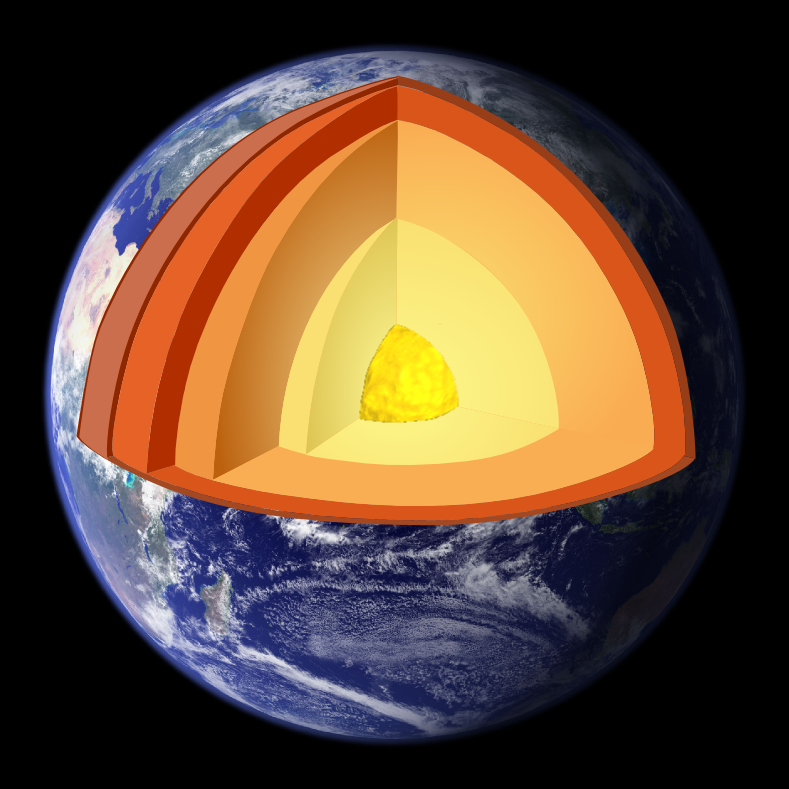
The layer of gas held around the Earth by gravity. It supplies the oxygen and carbon dioxide life requires, moderates temperature, blocks harmful radiation, and is thin enough relative to the planet that it is easily disturbed.
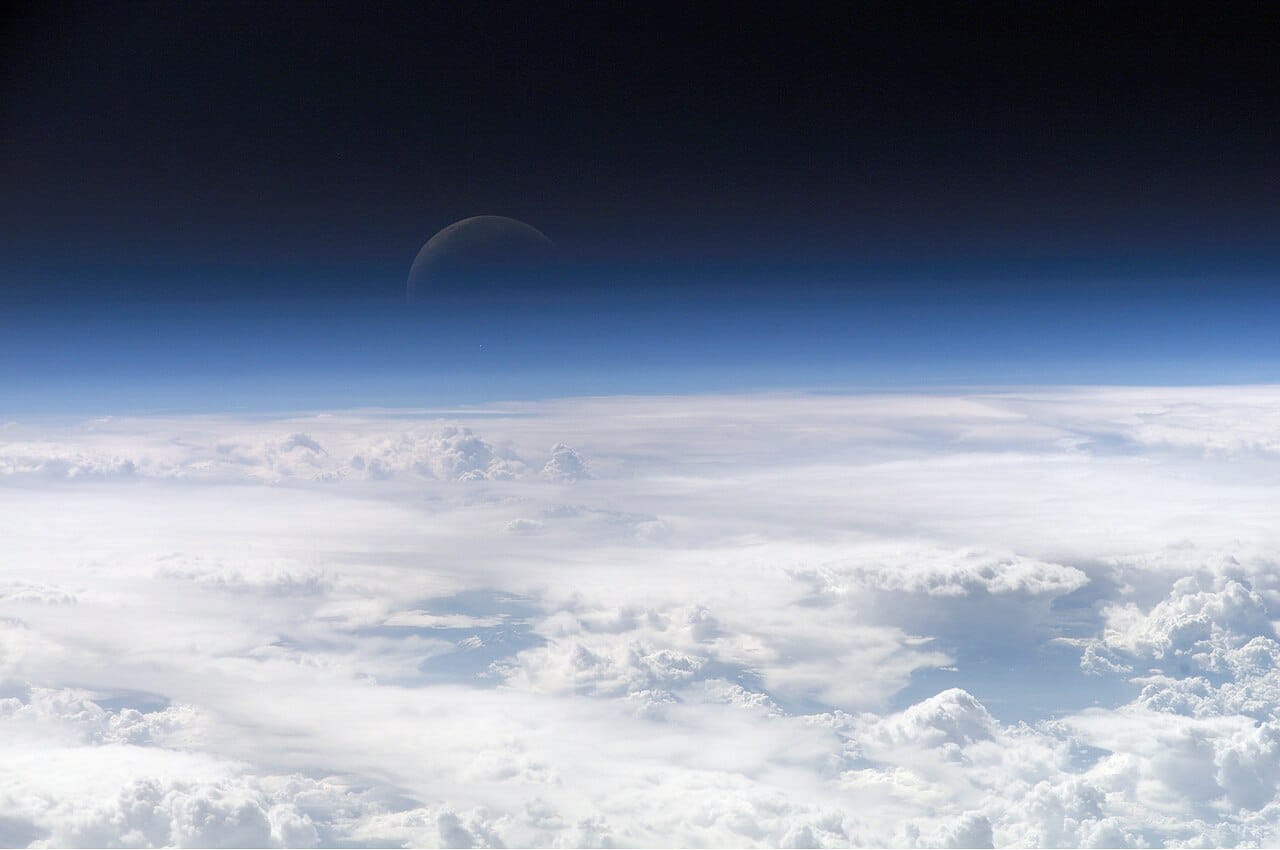
Dry air is about seventy eight per cent nitrogen and twenty one per cent oxygen, with argon at just under one per cent making up most of the remainder.
Carbon dioxide is a trace constituent, present at a few hundred parts per million, and its climatic importance is out of all proportion to its abundance because nitrogen and oxygen are transparent to infrared radiation while carbon dioxide is not.
Water vapour is highly variable, from almost nothing over deserts and at high altitude to several per cent in humid tropical air, and it is excluded from the standard figures for this reason.
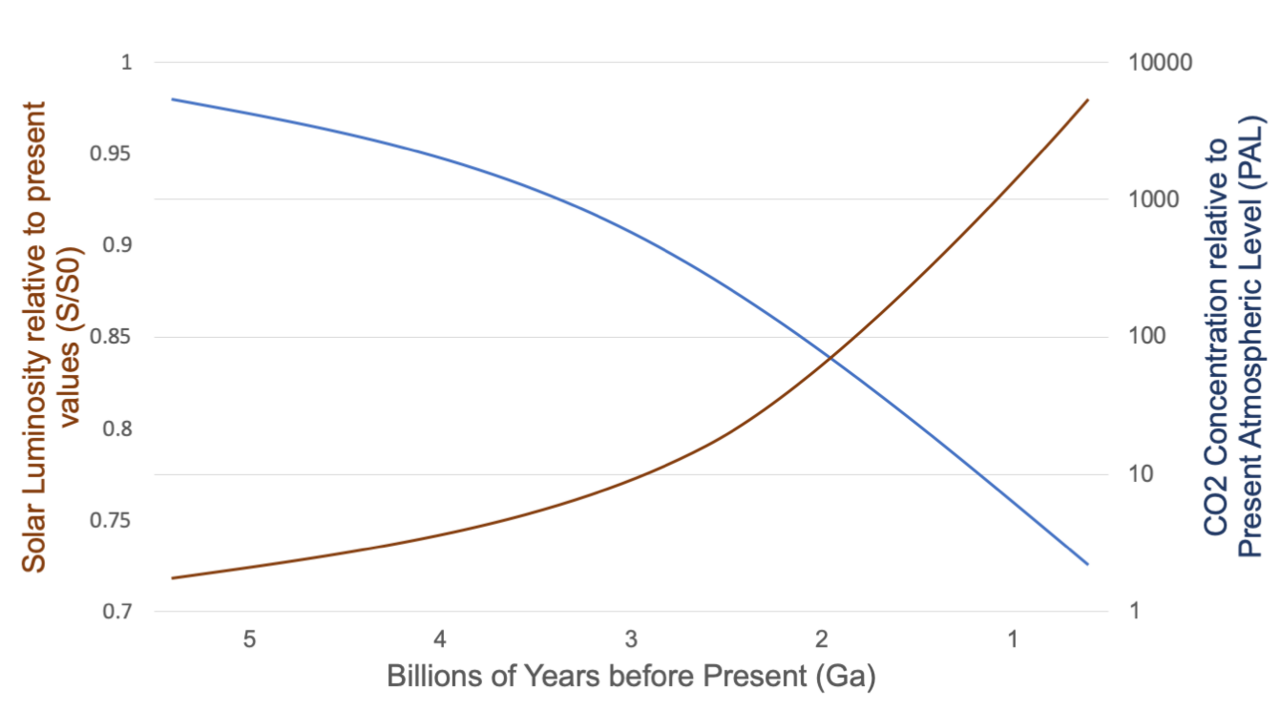
Oxygen is not primordial. The early atmosphere had almost none, and the present concentration is a product of photosynthesis, accumulated over billions of years. The atmosphere is therefore partly a biological construction.
The troposphere extends from the surface to about eight kilometres at the poles and sixteen at the equator. Temperature falls with height, which allows warm surface air to rise, and essentially all weather occurs here. It contains roughly three quarters of the atmosphere's mass.
The stratosphere extends to about fifty kilometres. Temperature rises with height because ozone absorbs ultraviolet radiation, and that inversion suppresses vertical mixing, which is why the stratosphere is stable and why airliners cruise at its base.
The mesosphere extends to about eighty five kilometres, temperature falls again, and most meteors burn up here.
The thermosphere extends several hundred kilometres. Individual molecules reach very high temperatures while the gas is so thin that it would not feel hot. The International Space Station orbits within it.
The exosphere is the outermost region, where molecules rarely collide and some escape entirely.
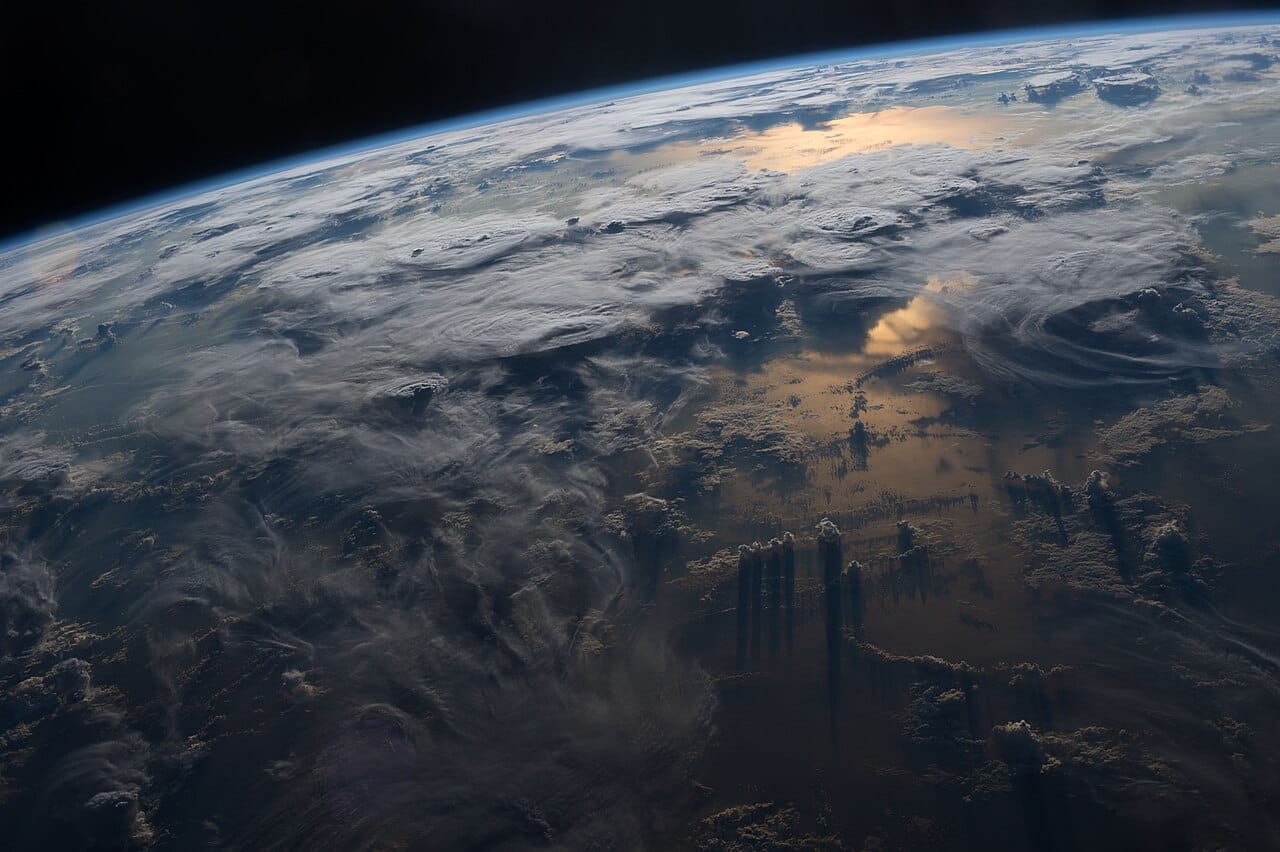
The atmosphere has no sharp upper boundary; it thins gradually. The Kármán line at one hundred kilometres is a convention for where space begins rather than a physical edge.
Half the mass lies below about five and a half kilometres, which is lower than several mountain ranges. Ninety nine per cent lies below about thirty two kilometres.
Relative to the planet, the layer is proportionally thinner than the skin of an apple. That ratio is why the atmosphere's composition can be altered measurably by surface activity, and it is the fact most often cited by people who have seen it from orbit.
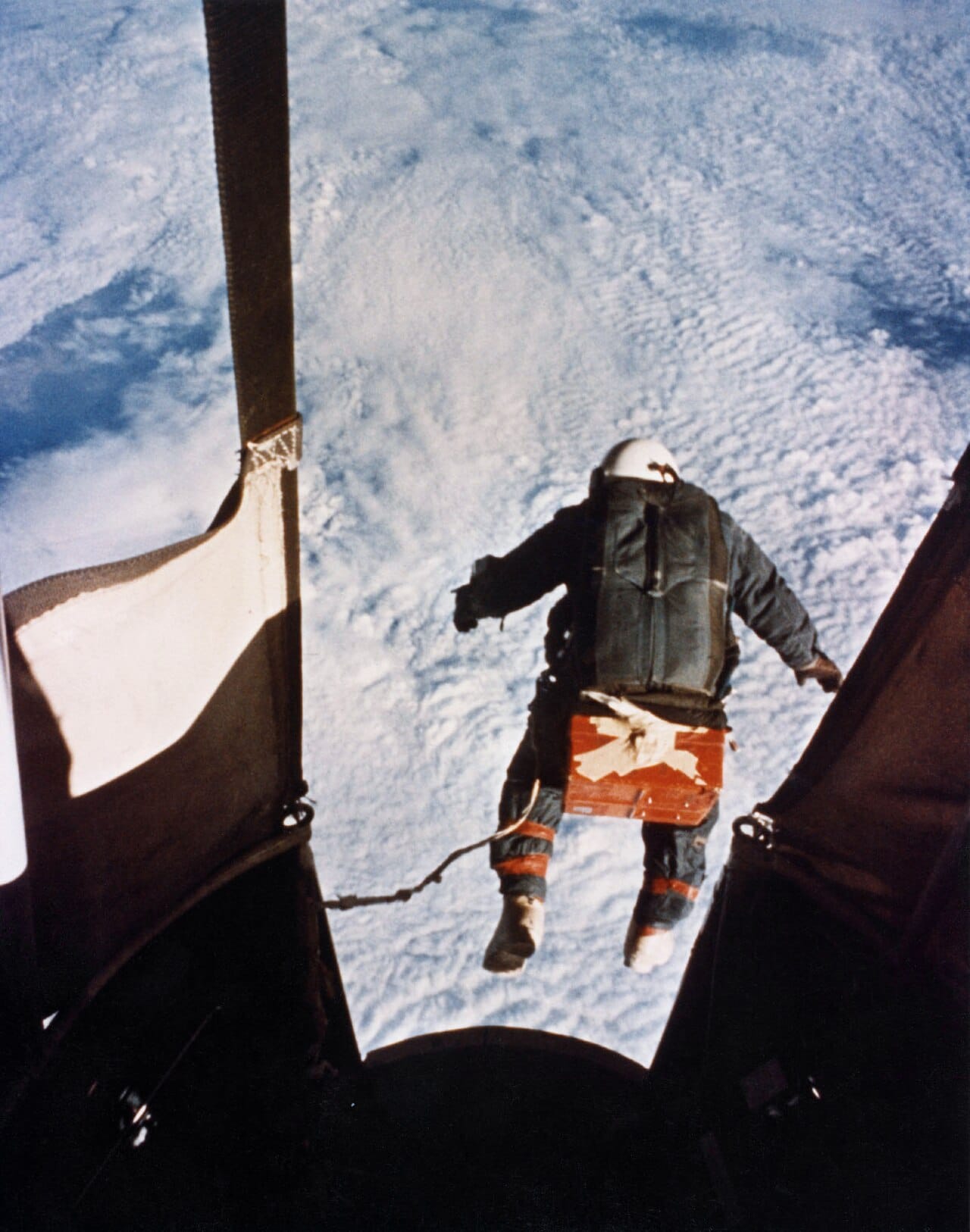
It supplies the gases metabolism requires and returns them through the carbon and oxygen cycles.
It moderates temperature. The greenhouse effect keeps the surface roughly thirty three degrees warmer than it would otherwise be, without which the planet would be frozen. It also limits the day to night swing, which on the airless Moon exceeds two hundred and fifty degrees.
It blocks radiation. The ozone layer absorbs most ultraviolet radiation in the range that damages DNA, and the atmosphere as a whole stops most incoming meteors.
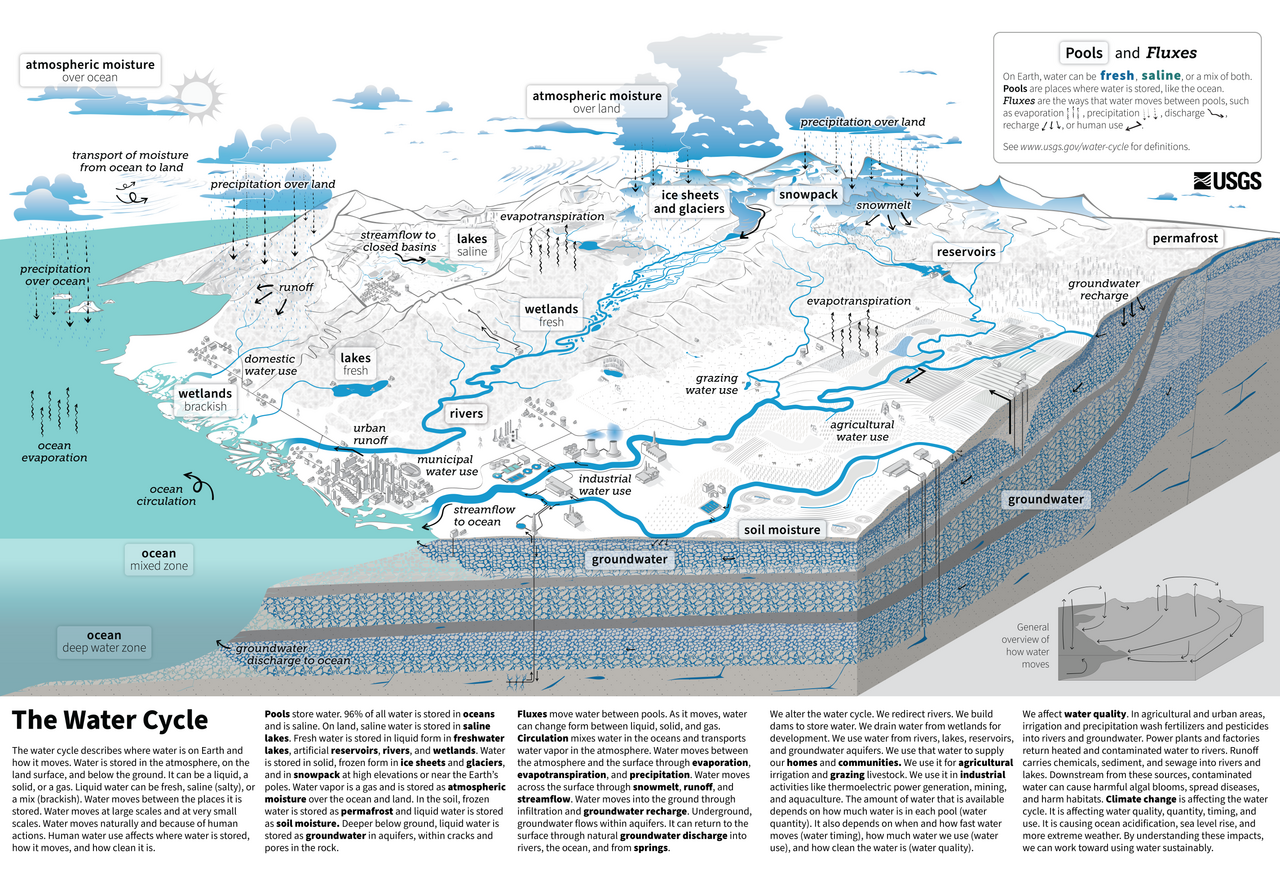
It distributes heat, carrying energy from the tropics toward the poles, and it moves water from ocean to land, which is the water cycle treated in its own capsule.
It transmits sound, which does not travel in vacuum.
Carbon dioxide concentration has risen from roughly 280 parts per million before industrialisation to over 420, measured continuously at Mauna Loa since 1958 and reconstructed further back from air trapped in ice cores. The isotopic composition of the added carbon identifies fossil fuel as its source.
The consequences are treated in the climate change capsules, and the atmospheric fact is straightforward: the composition of the layer has been altered measurably within a human lifetime.
The ozone layer supplies the counterexample. Chlorofluorocarbons were found in the 1970s and 1980s to destroy stratospheric ozone, and the Montreal Protocol of 1987 phased them out. The ozone layer is recovering, and it is the clearest case of an atmospheric problem identified, addressed and substantially reversed by international agreement.
The atmosphere performs several functions life depends on and does so in a layer that is, in proportion to the planet, extremely thin.
Its history is also a demonstration that a planetary environment is not a fixed backdrop. The oxygen in it was put there by organisms over billions of years, and its carbon dioxide content has been altered detectably by one species within about two centuries.