The continuous movement of water between ocean, atmosphere, land and living things. The quantity is fixed; what changes is where it is and in what state, and the whole system is driven by solar energy and gravity.
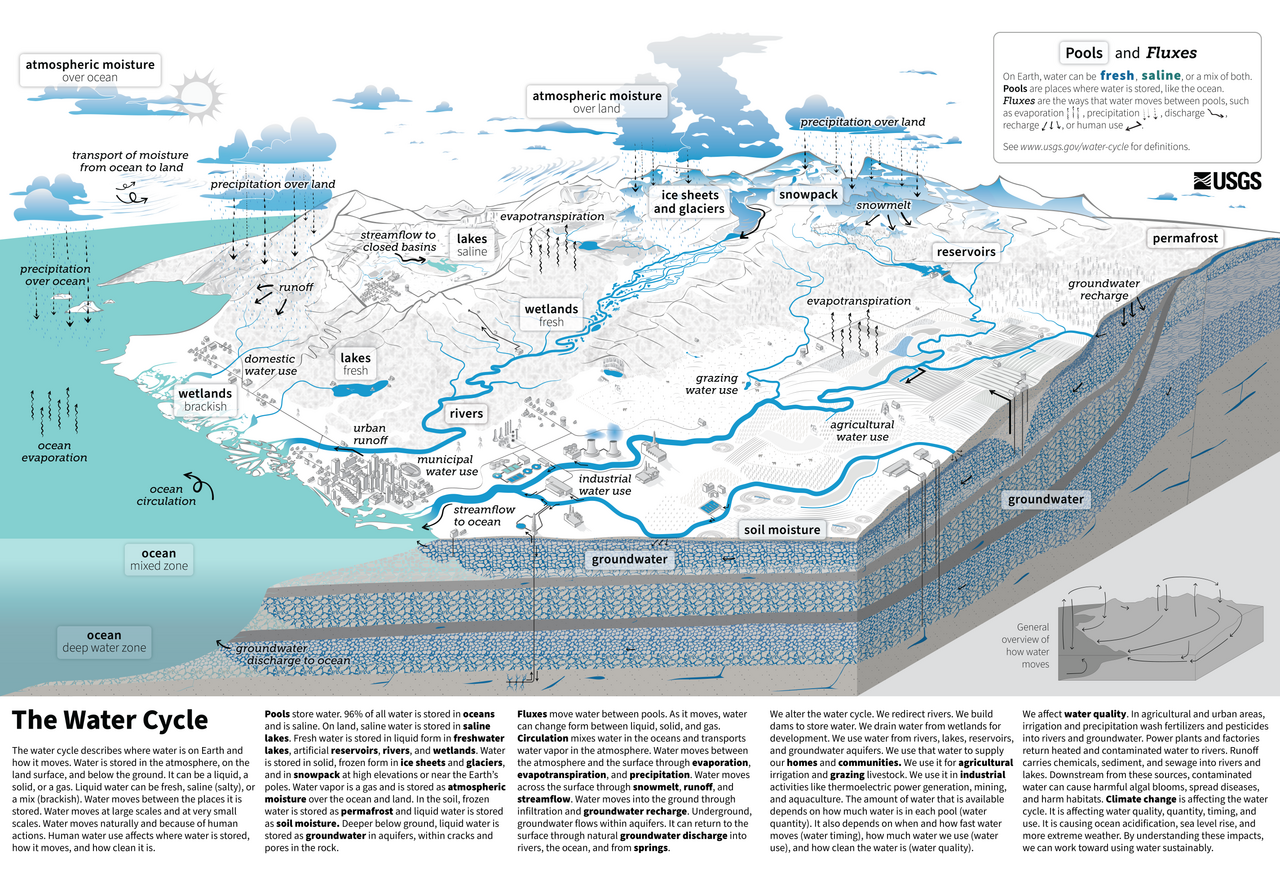
Evaporation converts liquid water to vapour, principally from the oceans, which supply the large majority of atmospheric moisture.
Transpiration is water released by plants through their leaves, drawn up from the soil. Combined with evaporation from soil and surfaces it is called evapotranspiration, and over vegetated land it is substantial: a large forest returns enormous quantities of water to the atmosphere.
Condensation forms clouds as rising air cools and vapour returns to liquid, requiring small particles to condense onto.
Precipitation returns water to the surface as rain, snow, sleet or hail.
Water then follows several routes. Some runs off into streams and rivers and returns to the ocean. Some infiltrates the soil and recharges groundwater. Some is stored as ice. Some is taken up by organisms.
Sublimation converts ice directly to vapour without melting, which is significant in cold dry regions.
The distribution is extremely uneven, and the proportions are worth stating because they are counterintuitive.
The oceans hold about ninety seven per cent of the world's water. Of the roughly three per cent that is fresh, most is locked in ice sheets and glaciers, and most of the remainder is groundwater.
Surface fresh water in lakes and rivers, which is what most human use draws on directly, is a very small fraction of one per cent of the total.
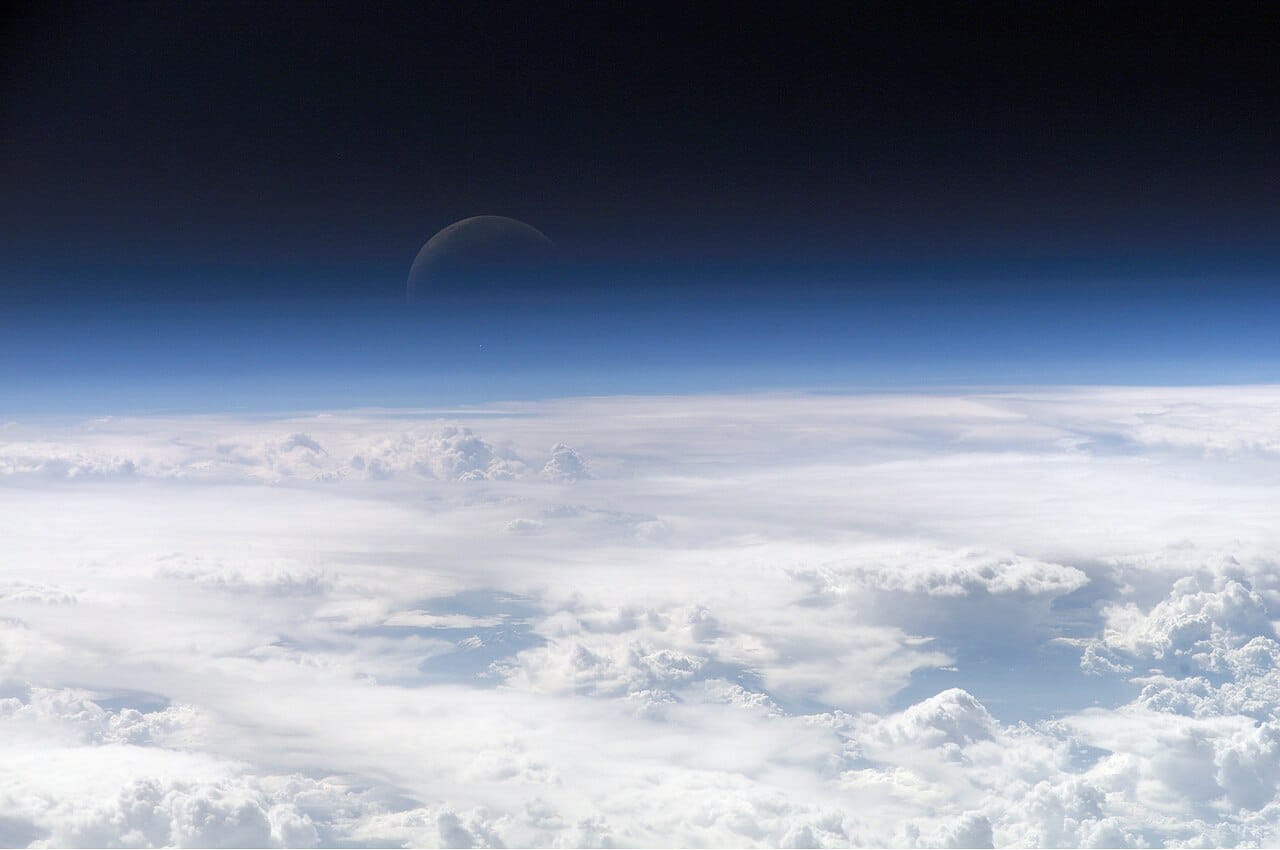
The atmosphere holds a tiny quantity at any moment, equivalent to a layer about two and a half centimetres deep if spread over the globe. That small reservoir turns over rapidly, with an average residence time of about nine days, which is why weather changes quickly.
Residence times elsewhere are far longer: centuries to millennia in deep groundwater and the deep ocean, and tens of thousands of years in ice sheets.
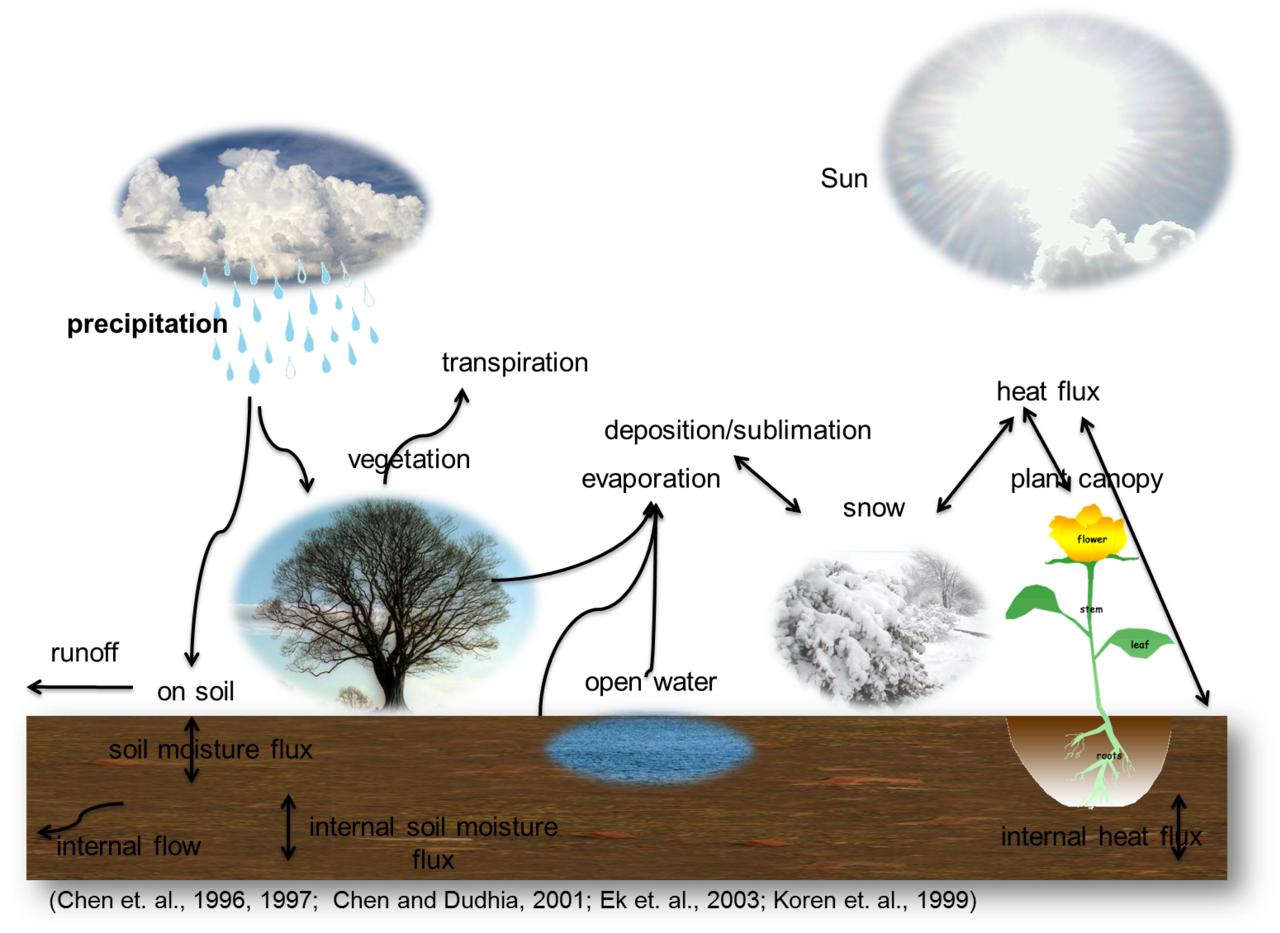
Solar energy supplies almost all of it. Evaporating water requires a large amount of energy, and a substantial share of the sunlight absorbed at the surface goes into it rather than into heating.
That energy is not lost. It is carried as latent heat in the vapour and released when the vapour condenses, which is why condensation warms the air aloft and why the cycle is a major mechanism for moving heat from the tropics toward the poles and from the surface upward.
Gravity supplies the return, pulling precipitation down and moving water downhill through rivers and through the ground.
Water vapour is the most abundant greenhouse gas, and its concentration is set by temperature rather than being independently controlled. Warmer air holds more vapour, which produces more warming, which is the water vapour feedback and roughly doubles the direct effect of carbon dioxide.
The relationship between temperature and moisture capacity is approximately seven per cent more vapour per degree of warming, and this is why a warming climate is expected to produce more intense precipitation events even in regions where total rainfall does not rise. The same relationship increases evaporative demand, which intensifies drought where rain does not fall.
Both effects follow from the same physics, which is why intensification of wet and dry extremes is expected together rather than being contradictory.
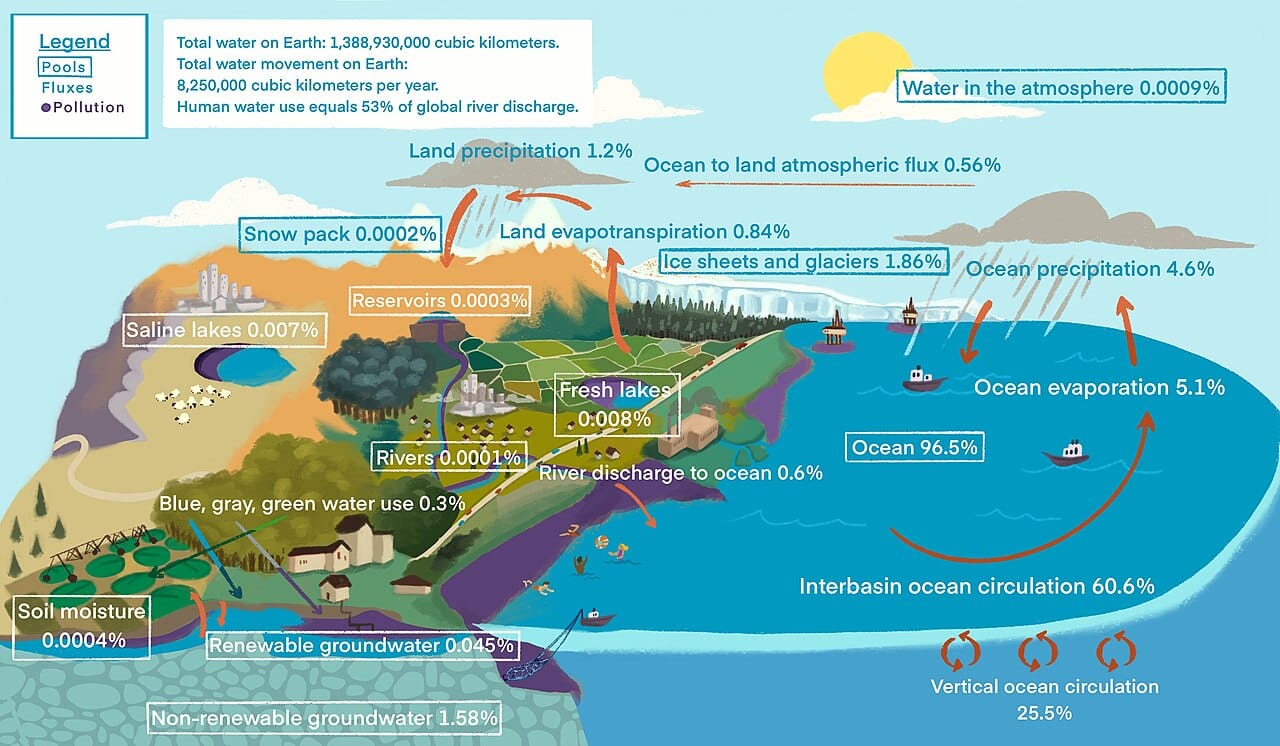
Humans withdraw a substantial fraction of accessible fresh water, mostly for agriculture, which accounts for around seventy per cent of withdrawals globally.
Groundwater is being depleted in several major agricultural regions faster than it recharges, and some aquifers contain water that entered thousands of years ago and is effectively not renewable on any useful timescale.
Dams and reservoirs alter the timing of river flow, land use changes affect infiltration and runoff, and urban surfaces prevent infiltration entirely, which increases flood peaks.
Deforestation reduces transpiration, and in large forested regions this affects rainfall downwind, since a substantial share of precipitation over continental interiors has been recycled through vegetation.
The water cycle determines where fresh water is available, which has shaped settlement and agriculture throughout human history and remains the constraint on both in much of the world.
It is also the mechanism through which climate change is experienced most directly. Temperature rise is the measurement; the consequences that reach people are floods, droughts, snowpack loss and shifts in where and when rain falls, all of which are changes in this cycle.